The Guardian of the Pristine Crimea
A great and inspiring history of the life of art photographer Vasyl Sokornov in Crimea.
Petro Volvach. "Krymska Svitlytsia" newspaper, 2017, issue No. 29
It often happens in life that people and figures who served the community or a cause the most sink into the sea of oblivion due to the indifference of the authorities and descendants. This trait was, above all, characteristic of the criminal communist system. It deliberately erased tens of thousands of outstanding personalities from human memory, which also significantly destroyed the genetic code of the nation.
If today one asks not only the average Crimean resident or illegal migrants from the now very common category of "newcomers" (ponayekhavshie), but even the loudmouthed, homegrown, professional shouting patriots what they know about the whole galaxy of outstanding figures of the past (even ethnic Russians), they will only be able to pull out from behind their poor intellectual and mental scenes the names of the profligate empress and a few bloody conquering field marshals. This is the entire baggage of historical knowledge of many Crimean ultra-patriots. So it is not surprising that with such an imperial education, thousands of bright personalities and prominent figures have been neglected by poorly educated descendants.
It is quite natural that in occupied Crimea, amidst the haze of imperial hysteria, the 150th anniversary of the prominent Crimean art photographer Vasyl Sokornov, an ethnic Russian, went unnoticed. I discovered this great art photographer back in my student years, when I became acquainted with the most outstanding scientific work on horticulture of the 20th century — the first volume of "Crimean Industrial Fruit Growing" by the horticultural genius of Ukraine, Levko Symyrenko.
Even in those distant years, I noticed the highly artistic illustrations of the famous Symyrenko work. They belonged to the completely forgotten art photographer Vasyl Sokornov. In the preface to the first volume, Levko Symyrenko expressed his sincere gratitude for the permission to use his picturesque photographs. Unfortunately, the horticulturist scholar, burdened by a huge volume of scientific material, says almost nothing in his work about the people whose research he references or to whom he expresses gratitude for their help. At that time, I realized well that the triumphant success of Symyrenko's work, not only in the Russian Empire of that time, was largely due to the use of solid illustrative material and, above all, the high-quality landscape photographs of Vasyl Sokornov.
The scholar had the opportunity to get acquainted with the works of the photo artist at exhibitions in Simferopol, St. Petersburg, and Paris. The life paths of these two outstanding personalities quite often crossed in Crimea as well. Unfortunately, information about the Crimean artist is absent in modern literature on art photography. And if it were not for the work of the Ukrainian horticulturist scholar, long-time researcher, and unsurpassed connoisseur of Crimean fruit growing, Levko Symyrenko, the name of the once famous and highly popular art photographer would have been lost. After all, the vast majority of his photographs were published on postcards, a significant portion of which was lost.
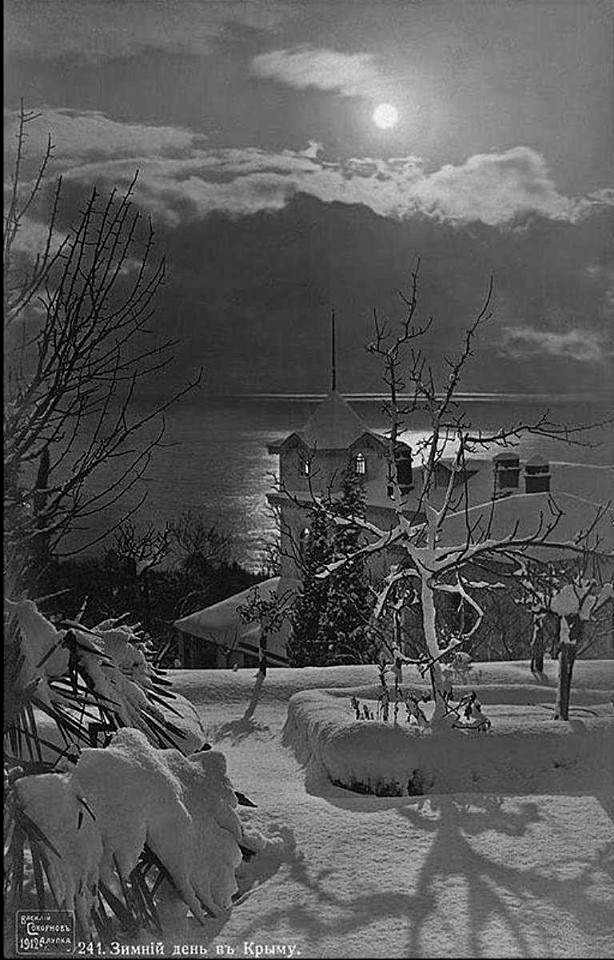
Winter day in Crimea, 1912
Almost no documents or publications about the life and work of the outstanding artist have survived. As a result of long searches even before the Russian occupation of Crimea, it was discovered that Vasyl Nykandrovych Sokornov was born on February 27, 1867, in the village of Vasylivske, Shubsky district, Vladimir Governorate. The future artist received his primary education at the Lushnykovsky School in Ostrogozhsky district, Voronezh Governorate. The boy was fond of painting and showed great artistic talent. He did not have the funds for full-time study at the St. Petersburg Academy of Arts, so after successfully passing the exams, he was accepted as an auditor in the painting department. The young man worked as a retoucher in the famous capital photo studio of Pazetti.
The owner of the studio, having appreciated the retoucher's talent and taking into account his financial difficulties, commissioned him to retouch and color a large photographic portrait of the daughter of a wealthy man. Pazetti sent this portrait to an international exhibition held in Paris, where it was highly praised and received a gold medal. The prestigious award inspired the young master, convincing him that he was already mature enough for independent work. However, the capital's climate, which was quite cold and damp, caused the young man to fall ill, likely with consumption. Doctors recommended that he go to Crimea for treatment. The Society for the Support of Young Artists allocated small funds for this purpose. Sokornov left the capital and traveled to Alushta.
Acquaintances recommended him lodging with full board at the home of a young widow, Stakovska. But the funds allocated by the Society soon ran out. To overcome his financial hardship and continue his treatment, the artist tried to paint sketches of the picturesque surroundings of the small settlement of Alushta. The surrounding mountain forests and the sea inspired his creativity. The artist tried to sell his works to vacationers through a local shop, but they barely sold. However, vacationers in Alushta and Yalta, which Sokornov frequently visited, willingly bought foreign postcards with landscape photographs of the South Coast.
The master recalled his former favorite work and concluded that photographic postcards could be made more professionally than foreigners did. He decided to return to his first profession. However, he had no money to equip a photo laboratory and purchase expensive reagents. The landlady of the lodging, sympathizing with Sokornov, decided to help. Having purchased everything necessary and set up a photo laboratory, the artist took up the work well-known to him since his youth.
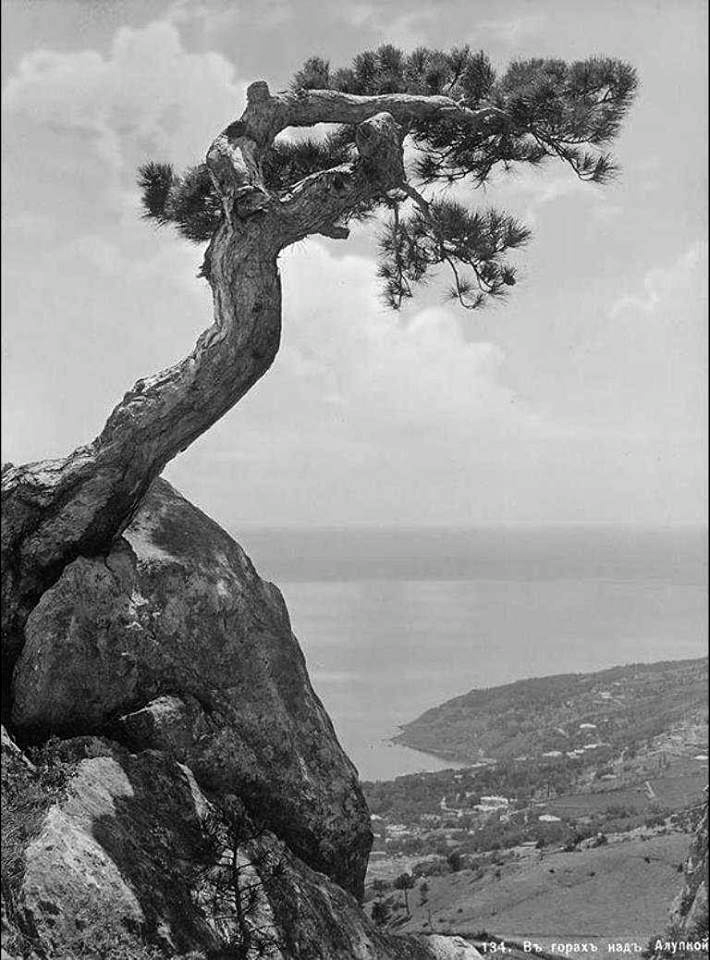
In the mountains above Alupka, 1905
Soon enough, the popular journals of the time, such as "Niva", "Solntse Rossii", and "Otkrytoe Pismo", became interested in Sokornov's work. Recognition and well-deserved fame came to the master. A tempting offer arrived from the journal "Solntse Rossii" to publish an album of photographs, and as early as 1902, the photo album "Views of Crimea" appeared in the retail network and reached European countries. It was these photographs that Levko Symyrenko, with the author's permission, used to illustrate his scientific work "Crimean Industrial Fruit Growing". The reprint edition of the first volume of "Crimean Industrial Fruit Growing," published by the "Tavria" publishing house in 2001, breathed new life into the photographs of the prominent master.
At various times of the year, traveling along the South Coast, the photo master, burdened with bulky photo equipment, made long, exhausting expeditions almost daily in search of unique photo subjects. Sokornov's photographs immortalized the master's routes: the environs of Yalta, Alushta, Simeiz, Bakhchisaray, and Sevastopol. The artist had a unique feeling for Crimean nature. He saw what was inaccessible to others. As a result of painstaking work and study, he chose such compositional angles of landscape objects that no other specialist could replicate. Today, even experienced masters wonder how such artistic masterpieces could have been created with the photo technology of that time. The photographs of Vasyl Sokornov preserved for future generations the pristine appearance of most South Coast resort towns and famous dachas.
During the years of Red and White terror in Crimea, the artist created almost nothing. Nor was he particularly active creatively under Soviet rule. Only in 1929, in Yalta, at 24 Masandrivska Street, Krymderzhvydav organized a photo workshop, where Vasyl Sokornov was invited. In 1931, the master handed over 1,300 negatives of Crimean landscapes to this bureaucratic and highly politicized organization. However, this unique artistic wealth did not interest state officials.
For them, it was more important to popularize working weekdays and praise the unheard-of successes of the Bolshevik government. This priceless collection disappeared in the publishing depths. Before the war, the artist, concerned about the fate of his creative heritage, selected 25 of the best landscape negatives to be sent to his alma mater, the Academy of Painting in Leningrad. But World War II, which began shortly thereafter, disrupted the artist's plans. Vasyl Sokornov died in his 80th year of life and was buried in the old Alushta cemetery.
Before the occupation of Crimea, specialists from the Yalta Museum of Local Lore had assembled a collection of photographs numbering over 70 items. After all, this is all that remained of the master's gift to the Alupka Museum in 1946. Thus, in the post-war years, almost 30 percent of the collection of photographs donated by the artist disappeared without a trace. Obviously, it was Sokornov's unique landscape photographs that vanished without a trace.