Ukraine Revitalizes Crimean Villages
The revitalization of Crimean villages on Ukrainian initiative in the post-war era.
Petro Volvach, Full Member of the Shevchenko Scientific Society (NTSh), Member of the National Writers' Union of Ukraine (NSPU), Honored Worker of Science and Technology of the AR of Crimea, Crimean resident with 60 years of experience. "Krymska Svitlytsia" newspaper, 2017, Issues No. 40 – 41
For nearly ten post-war years, the Russian authorities on the peninsula did not carry out any construction in rural areas. With state support during this time, only a few hundred houses for settlers were built, and not a single school, hospital, kindergarten, or community center. In line with the mentality of the typical Russian marauder, the bureaucratic ravens fully utilized the public premises and dwellings existing since the pre-war Crimean autonomy, and even the property and inventory of hundreds of thousands of deported Crimean Tatars, Greeks, Bulgarians, Armenians, Czechs, and Germans.
Into the depopulated villages, mainly in the South Coast and the Foothills, settlers from mainland Russia and the Krasnodar Krai were brought. The authorities provided the deported population's housing free of charge to a special and well-vetted contingent of Russian settlers. Local officials, acting on the instructions of Moscow leaders, successfully trafficked in the property and agricultural equipment of the exiles. Only at the end of 1953, when the free housing stock was exhausted, was individual housing construction allowed at the expense of subsidized loans and local financial resources.
In the very first year after the transfer of the Crimean Oblast, Ukraine faced the acute problem of accommodating the settlers. Indeed, it was from 1954 that the mass resettlement of the Ukrainian population into Crimean villages, mainly in the steppe regions, began.
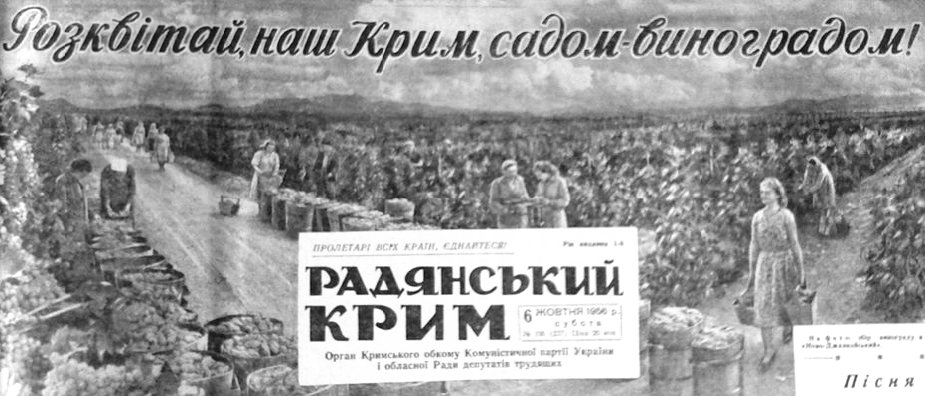
The pages of the Crimean press of the time are filled with such articles. From the archive of the "Radianskyi Krym" newspaper, March 27, 1956.
Studying the Crimean archives from the period of populating the peninsula with settlers from Ukraine, I came across a whole array of documentary materials describing the terrible living conditions of the first wave of Ukrainian settlers. Due to the lack of housing, families were accommodated in unsuitable premises where there was neither water nor heating. Most often, community centers, kindergartens, and often livestock farms were used for this purpose. The Crimean archives of the era of the great migration from Ukraine are full of complaints from settlers to various authorities. They tell of inhuman living conditions, indifference, and mistreatment by local officials. The archives contain many reports from various commissions confirming the numerous complaints of the settlers.
Kyiv officials were well aware of the entire burden that the "Kremlin sages" had placed on the shoulders of war-torn Ukraine, as well as their responsibility for implementing the state program to populate Crimea. Therefore, in the first months after the transfer of Crimea to Ukraine, in order to halt the flight of forced-voluntary settlers from the peninsula and prevent discontent and potential riots, the Kyiv authorities resorted to decisive changes in providing housing for the settlers.
On instructions from the Central Committee of the Communist Party of Ukraine (CPU) and the Council of Ministers of Ukraine, the relevant government department prepared a detailed report on the shortcomings in the resettlement of settlers in Crimea as of May 20, 1954. (Doc. No. 54. Collection of documents and materials "Crimea under conditions of socio-political transformations (1940-2015)", Kyiv, Clio Publishing LLC, 2016, pp. 231-245)
The report states that during 1951-1954, 9,970 families (almost 50,000 people) were resettled to Crimea. During the same period, due to unsatisfactory economic conditions, 1,005 families left on their own back to their previous places of residence. In Crimean collective farms (kolkhozes) alone, 925 families of settlers from 1952-1954 were not provided with housing, and 1,385 families did not have cows. Under the village conditions of that time, a cow was the main breadwinner of the family. The local authorities did not materialize the exchange of trade receipts promised to the settlers for 94 tons of potatoes and 45 heads of cattle.
The report also informed that the plans for building housing for settlers were failing year after year. Thus, out of the 2,700 houses planned for settlers in 1954, only 250 cottages were prepared by May of the current year, which is only 9.2% of the plan. Housing construction for settlers was particularly unsatisfactory in the Dzhankoi, Azov, Saki, Kirov, Nyzhniohirskyi, and Krasnohvardiiske districts. Not a single cottage for settlers was built in fish farms (rybkhozes) either, although according to the plan, 350 were to be built by May 1954.
In addition, it is emphasized that the houses built before 1954 by Russian shoddy builders had very serious defects. Their stoves turned out to be unsuitable for heating, the sheds were handed over without roofs, and there were no toilets in the yards. Thus, in the Malenkov collective farm in the Zuia district, 20 houses were in a state of emergency, as their foundations were laid with rubble stone on clay, and in some houses, window and door frames were installed without thermal insulation. Instead of the required two rooms and a kitchen, houses were handed over with only one room and a kitchen.
All these shortcomings and abuses by local "little princes" caused a mass flight of settlers from Crimea. For instance, in just one suburban farm, the "Simferopolskyi" state farm (sovkhoz) in the village of Trudove, located 6 km from the regional center, out of 86 families resettled in 1952, 10 left for their previous place of residence. To overcome all these shortcomings, the department for the economic resettlement of settlers under the Council of Ministers of the Ukrainian SSR ordered the heads of construction organizations to eliminate construction defects and instructed local authorities to discuss this issue at special meetings of the regional executive committee and the regional party committee.
With a long delay, on September 30, 1954, Dmytro Poliansky, the first secretary of the Crimean Regional Committee of the CPU, brought this painful problem of the unsatisfactory state of housing construction for settlers to the discussion of the regional committee's bureau. After the transfer of the Crimean Oblast to Ukraine, this meeting was the most representative, and the local authorities discussed the issue of resettling the immigrants probably for the first time.
The Crimean Regional Committee of the Party, led by Dmytro Poliansky, after thorough checks by republican authorities, was forced to admit "that the construction of housing for settlers is extremely unsatisfactory." And this was indeed the case. Out of an annual construction plan of 2,880 planned houses in Crimean villages, only 802 were put into operation by the end of September, and 1,166 houses were under construction. The construction of houses for settlers was particularly unsatisfactory in the farms of the Dzhankoi, Azov, Oktiabrske, Chornomorske, Kirov, Sovietskyi, and Lenine districts. In the eight months of the current year, construction of the planned 138, 101, and 94 houses in the Dzhankoi, Oktiabrske, and Sovietskyi districts, respectively, had not even begun.
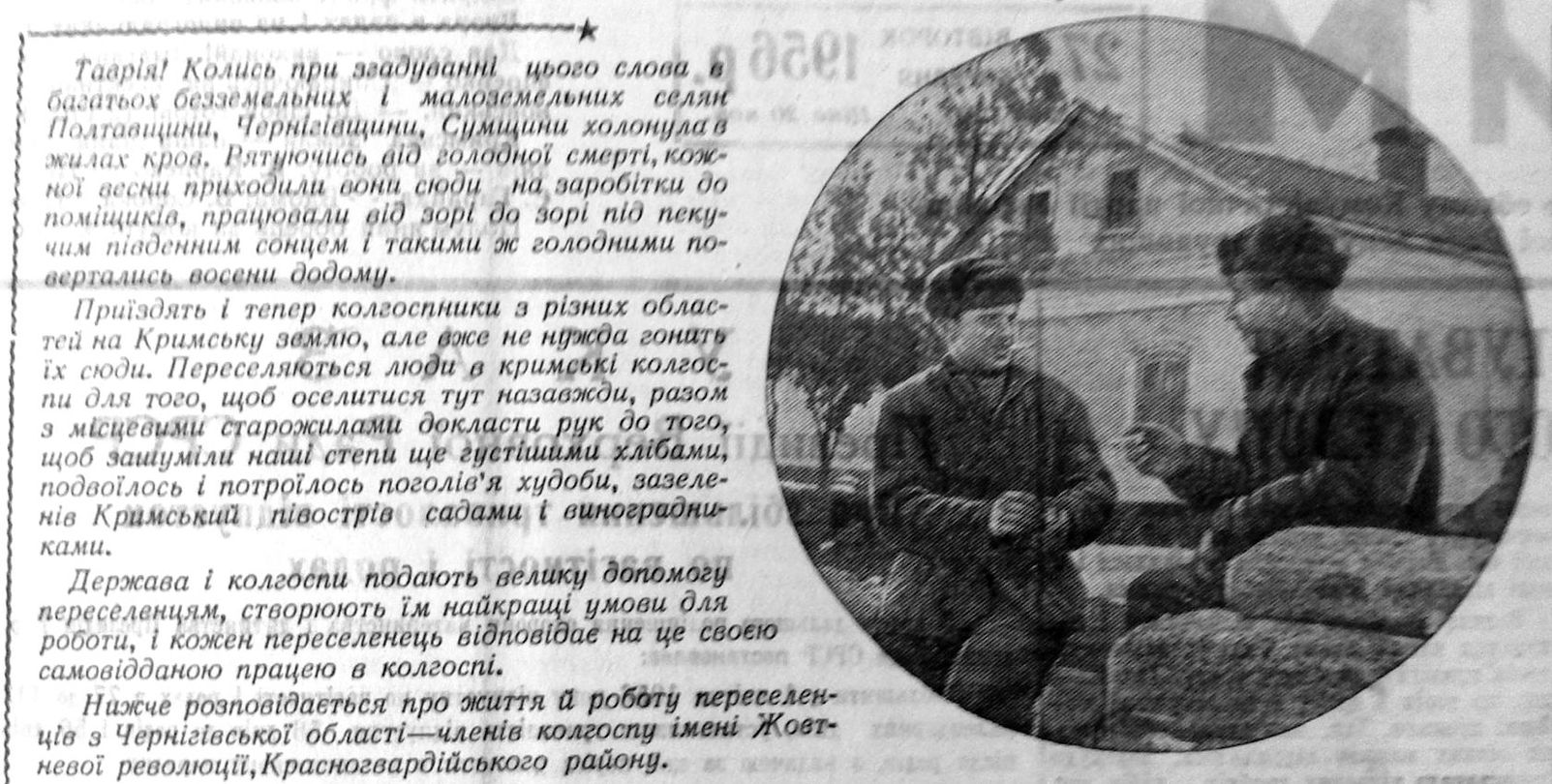
From the archive of the "Radianskyi Krym" newspaper, March 27, 1956.
Probably for the first time in the ten post-war years when Crimea was under the jurisdiction of the Russian Federation, Kyiv forced the rather sluggish Crimean Regional Committee of the Party and the Regional Executive Committee to recognize that the most important party and economic task for all local authorities was housing construction in the villages. "Without fulfilling this task," the resolution of the regional party committee's bureau emphasized, "further strengthening of Crimean collective farms is impossible."
Not without the insistence of Kyiv high-ranking officials, who actually ran the plenum of the regional party committee, it was decided to mobilize all the forces of collective farms and fishing organizations to eliminate the delay in housing construction. It was proposed to create construction brigades from the settlers in each farm, which would build housing more efficiently.
For the first time in the entire ten-year period of resettling people to Crimea from other regions of Ukraine, the Crimean authorities were also tasked with investigating the reasons for the outflow of settlers from Crimea. The personal responsibility of managers at all levels who neglect or fail to support the economic resettlement of settlers was introduced.
For unsatisfactory leadership in the construction of housing for settlers, the bureau of the regional party committee issued serious warnings to a whole range of responsible workers in the construction industry. The bureau of the regional party committee obliged the leadership of all Crimean district party committees and district executive committees to conduct discussions on the state of rural construction in each farm, and to develop concrete measures to improve the situation and ensure the fulfillment of planned targets for commissioning housing for settlers.
To fundamentally change the situation with housing construction for settlers and the development of Crimean villages, the clause of the resolution on the need to conduct a large-scale inspection of the resettlement of each settler family for the entire post-war period, from 1945 to 1954 inclusive, was of immense importance. The Main Directorate under the Ministry of Agriculture, together with the State Committee of the Ukrainian SSR for Labor and Social Affairs, did prepare such a report in 1954 (Doc. No. 88, ibid., p. 399). The report recorded a huge turnover of settlers during 1950-1953 due to extremely unsatisfactory living conditions and the failure of local authorities to provide appropriate benefits to the settlers.
True large-scale construction of houses for settlers began only after the transfer of the Crimean Oblast to Ukraine. The volume of housing construction even during the first decade of Crimea's incorporation into Ukraine was staggering. Every year, starting from 1954, about 5,000 families were resettled to Crimea. The Ukrainian government had to provide approximately the same number of families with housing annually. Even by very conservative estimates, Ukraine had to build and provide settlers, mainly in the foothills and the steppe zone, with 4,000 to 5,000 houses annually. But starting from 1956, the processes of populating Crimean villages became more intense. Synchronously, the volume of housing construction for settlers also increased sharply.
Thus, while the first wave of settlers from Russia until almost the end of 1953 received already prepared housing (mainly settling in the houses of the deportees), the families of settlers from Ukraine languished in buildings unsuitable for living and were forced to build houses for themselves. Therefore, the assertion that Ukrainians revived Crimean villages after 1954 is not an exaggeration.
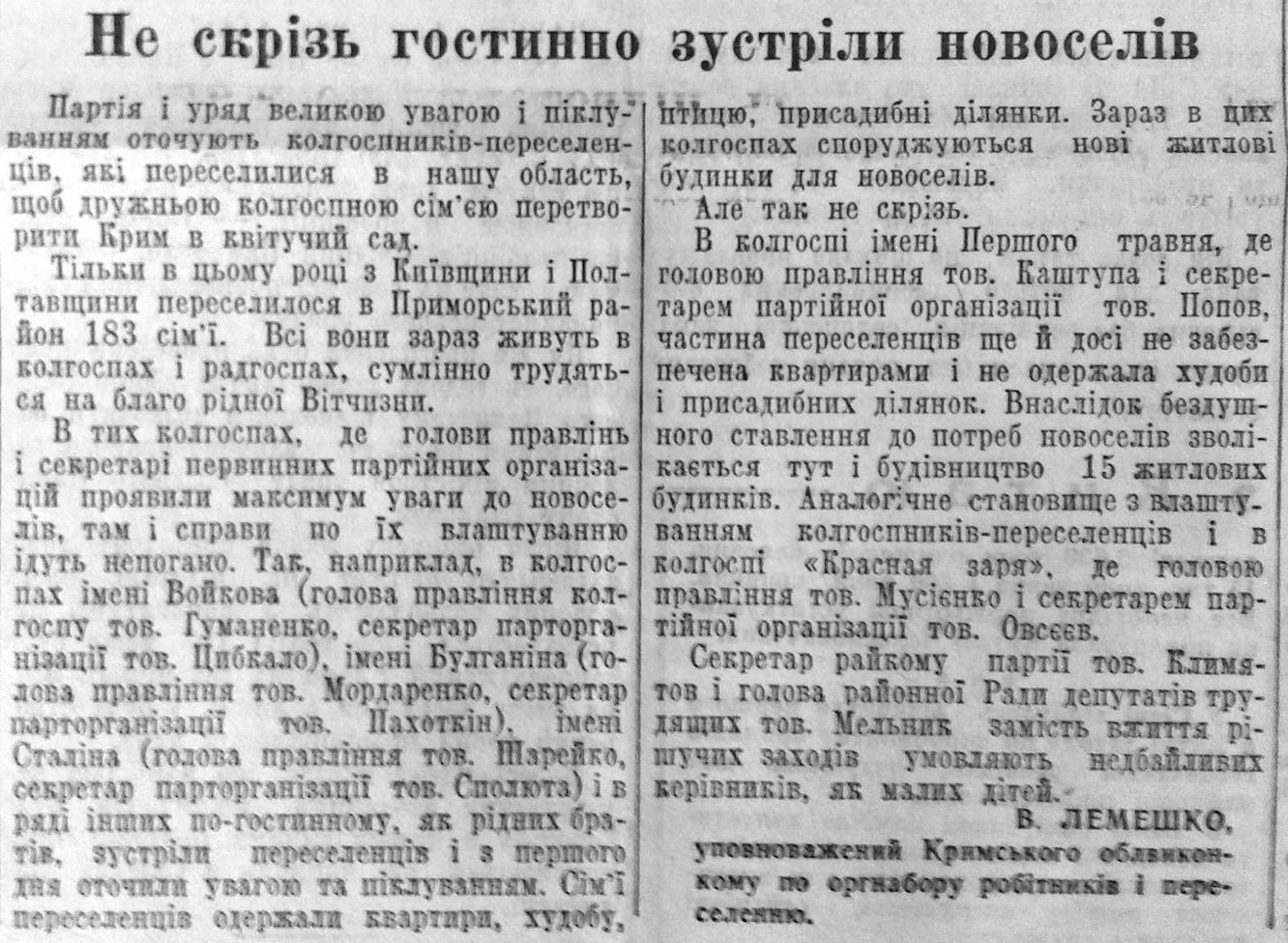
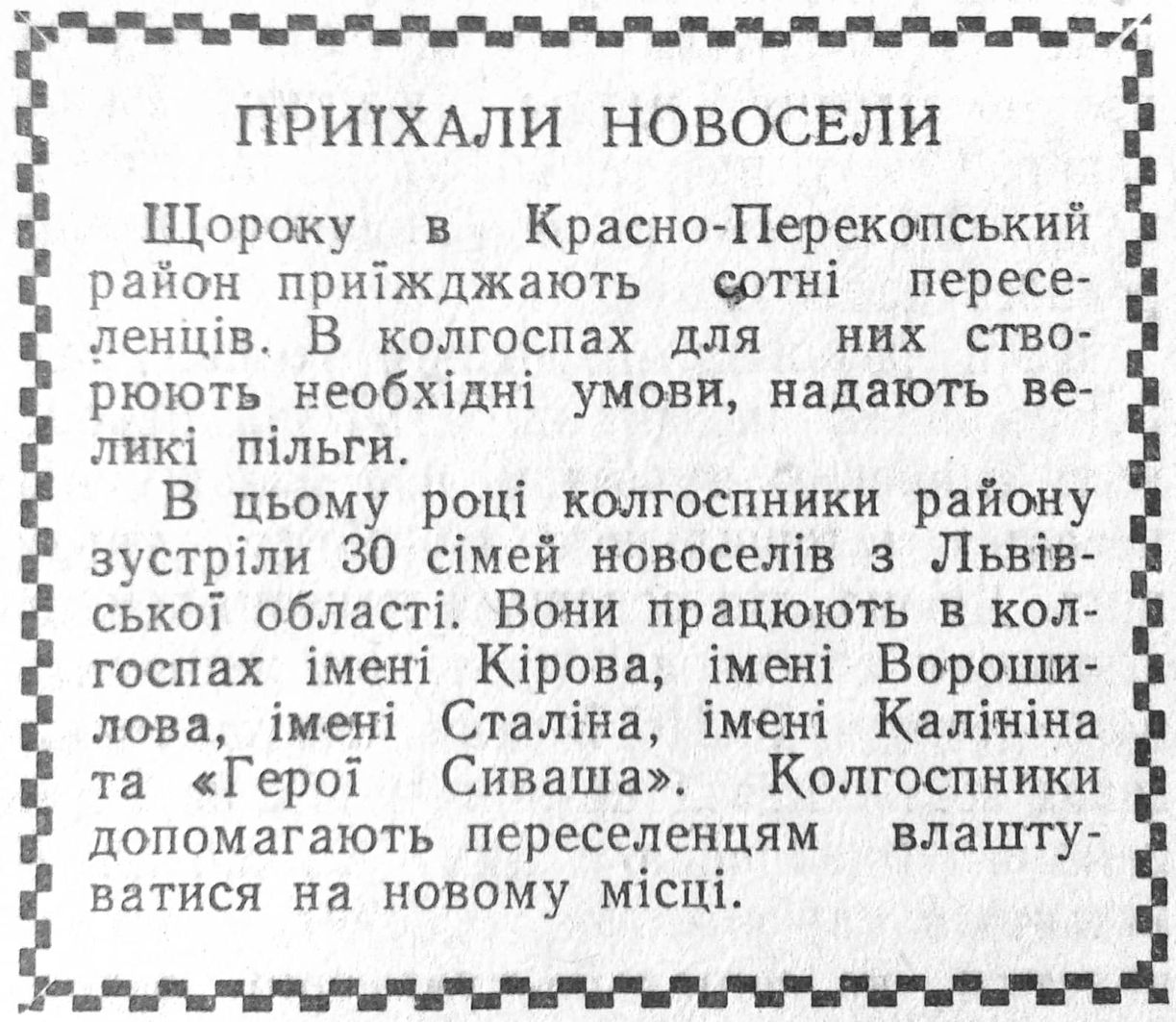
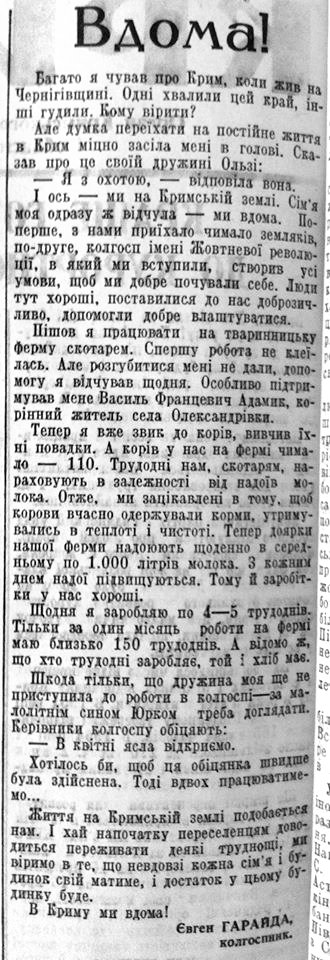
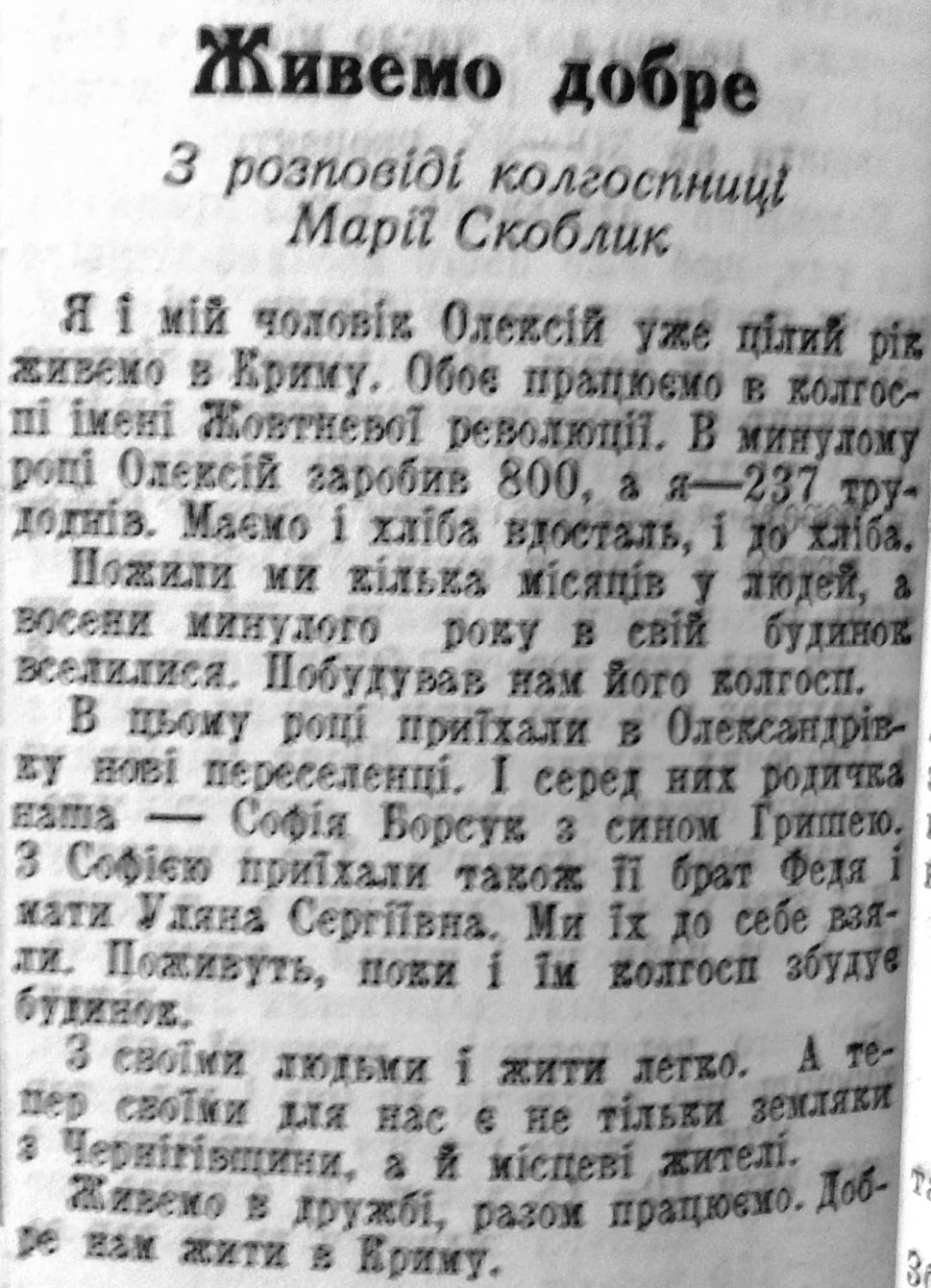
The newspaper pages testify to how settlers from other regions of Ukraine were received on Crimean soil. From the archive of the "Radianskyi Krym" newspaper for 1956-1957
Back in July 1954, the Council of Ministers of the Ukrainian SSR adopted Resolution No. 1508, which approved a rather ambitious plan to populate the Crimean Oblast. It envisaged the resettlement of 17,800 families (about 70,000 people) during 1954-1958. Therefore, during this period, it was necessary to build over 18,000 houses for the settlers.
A report by the Deputy Minister of Urban and Rural Construction to the Council of Ministers of the Ukrainian SSR dated March 15, 1957, certifies that since the end of 1955, housing construction for settlers in Crimean villages had become significantly more intensive. The state plan for 1956 in the Crimean Oblast envisaged the construction of 5,000 houses. (Doc. No. 131, ibid., pp. 536-538)
First of all, this was associated with radical personnel changes in the highest echelons of the Crimean government. For huge miscalculations in economic activity, serious shortcomings in the implementation of the government program to populate the peninsula, resistance or hidden simulation of the humanitarian policy proposed by Kyiv, at the end of 1955 the Kyiv leaders made a radical decision — to replace the leadership of the regional party committee and the regional executive committee. The replacement of the ambitious and almost unmanageable by Kyiv Dmytro Poliansky with the Ukraine-centric pragmatist and experienced economic manager Vasyl Komyakhov proved to be quite successful. The period of his leadership in 1955-1961 was one of the most successful and fruitful both in the development of the Crimean economy and in giving the region a Ukrainian face.
It was with the arrival of Vasyl Komyakhov to the leadership of the Crimean Regional Committee that a huge breakthrough occurred, not only in the revival of the traditionally leading sectors of the peninsula's economy — horticulture and viticulture, but also in rural construction. The peak of populating the peninsula with settlers from Ukraine also fell on this period. It is known that the regional administration for the organized recruitment of workers and resettlement to Crimea, established in the post-war years, expanded significantly after 1954. It existed until almost the 1980s. So, the scale of populating Crimea with Ukrainians is easy to calculate.
One can also determine the huge role of Ukraine not only in the post-war development of the Crimean village but also in the revival of the entire economy of the peninsula, and the Crimean villages in almost all districts were restored after 1954 by the Ukrainian people and the Ukrainian State. Providing Crimean villages with irrigation, initially with artesian and later with Dnipro water from the North Crimean Canal, contributed to the greening of the steppe villages and all the new settlements of the migrants. A few years later, the once waterless, gloomy, and vegetation-deprived steppe villages turned into green oases, adorned with lush gardens.