Black Sea Armenia
For almost a thousand years, a large Armenian community has lived on the Crimean Peninsula. The first connections between Armenians and Crimea are known from the times of the Armenian King Tigranes the Great and Mithridates of Pontus.
Yevheniia Borysenko. "Krymska Svitlytsia" newspaper, 2016, Issue No. 41
This is exactly how — Maritime or Black Sea Armenia — southeastern Crimea is called in Armenian chronicles of the Middle Ages. For almost a thousand years, a large Armenian community has lived on the Crimean Peninsula. The first connections between Armenians and Crimea are known from the times of the Armenian King Tigranes the Great and Mithridates of Pontus (2nd–1st centuries BC).
Armenian settlements in Crimea became particularly populous in the 13th–14th centuries, which was connected with the Mongol invasion of Armenia. From the beginning of the 14th century, Armenian settlers developed active operations in Crimea (constructing buildings, engaging in crafts and agriculture, participating in lively trade relations, opening schools, and founding scriptoriums).
Armenian merchants took an active part in Black Sea trade, as evidenced by Genoa's notarial acts. They played a significant role in the trade of the Italians themselves on the Crimean coast. It was the Crimean Armenians who distributed goods brought to the North and East. They played a major role in the development of craft production in Crimea, making up a significant percentage of the commercial and artisan population of Kaffa, Solkhat, Sudak, and Karasubazar.
A great ordeal in the life of the Armenian colony in Crimea was the capture of the peninsula at the end of the 15th century by combined Tatar-Turkish forces. The Genoese colony ceased to exist. Due to the bloodshed of 1475 and subsequent harsh persecution of Christians, the population of Armenian settlements in Crimea was greatly reduced. The situation changed only at the beginning of the 17th century. Conditions for a peaceful cultural life emerged. Craft production and trade revived, ancient manuscripts were restored, and educational institutions were opened, among which the theological school of the Surb Khach monastery was particularly famous, where prominent figures of the time taught.
In 1778, among other Christian peoples of Crimea, over 12,000 Armenians were deported. They were allocated barren lands near the banks of the Don. Only a few hundred Armenians remained in Crimea, who for one reason or another were permitted to stay. An important fact is that Crimean Armenians took with them many material assets they created in Crimea, including manuscripts. After the peninsula became part of the Russian Empire, some of the Armenians returned to their native places. Soon, their numbers in Crimea increased due to settlers from Eastern and Western Armenia. To revive the colony, the government created privileged conditions: temples, lands, and urban quarters were returned, and national self-governing city communities were established in Staryi Krym and Karasubazar.
Armenian settlements are recorded practically all over the peninsula: Feodosia, Staryi Krym, Sudak, Bilohirsk, Balaklava, Perekop, Yevpatoria, Yalta, and other cities. Ancient Armenian churches, other architectural structures, and everyday objects have survived to this day.
Armenia was the first country in the world to adopt Christianity as a state religion, and to the surprise of many ordinary Ukrainians who assume all Caucasians to be Muslims, Armenians are devoted followers of Christ.
The Armenian Church remains faithful to the dogma of the single divine nature of Christ adopted in 431 at the Third Ecumenical Council. The Armenian Church, whose primary see has since ancient times been in Echmiadzin, is dogmatically and liturgically close to Orthodoxy, but is a follower of Miaphysitism and recognizes as valid only the decisions of the first three Ecumenical Councils, preserving the traditions and ideology of early Christianity.
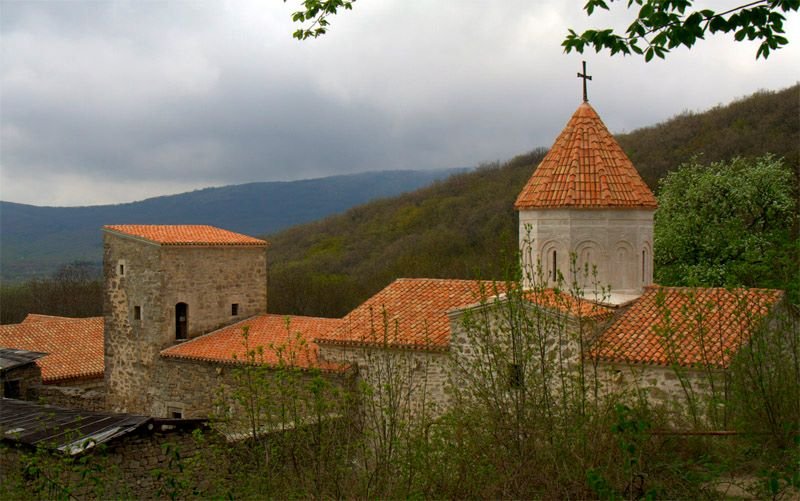
Of all the Armenian churches currently existing in Ukraine, three are in Crimea: the Feodosia Church of the Holy Archangels, the Yalta Church of Saint Hripsime, and the Yevpatoria Church of Saint Nikoghayos, as well as the restored Surb Khach monastery — a gem of Armenian medieval architecture in Crimea. The history of this masterpiece's creation is interesting: when in the 13th century many Armenians, fleeing the invasion of the Seljuk Turks, moved to Crimean lands, among them were monks looking for a place for a monastery. The monk Hovhannes Sebastatsi and his brethren had a vision in the shape of a cross. Thus, the Armenian temple Surb Nshan (Holy Sign) was established on this land.
It was erected in 1358 not only for Armenians but also for those seeking spiritual purification and peace. This date is recorded in a poetic inscription on the church's dome. Since then, a monastery began to form around the church. By the 17th century, the monastery became one of the main pilgrimage centers of the Armenian Church in Crimea and the Black Sea region. All researchers note the significance of the spiritual role of this monastery for Crimean Armenians. A theological seminary was located here, and a rich library existed. Novices not only wrote chronicles but also copied ancient books, decorating them with wonderful miniatures.
In general, Armenians left a large architectural heritage in Ukraine. This ancient cultural nation had significant urban communities in the polises of Galicia and Crimea. The main temple of Ukrainian Armenians was the Cathedral of the Assumption in Lviv, but the most beautiful Armenian temple in Ukraine is rightfully considered to be the church in Yalta.
The Church of Saint Hripsime was erected at the expense of a fabulously wealthy Baku oil industrialist, philanthropist, and Armenian by nationality, Poghos Ter-Ghukasyan (whom it was more convenient for Russians to call Pavel Osipovich Gukasov). Another famous Armenian who had worked for a long time in Baku, Gabriel Ter-Mikelian, was invited to design the church for the Armenian community of Yalta. He had carried out architectural commissions for Ter-Ghukasyan and other oil producers. As a basis for the Church of Saint Hripsime, the architect took the sketch of the legendary namesake temple in Echmiadzin and, of course, significantly redesigned it. The current church resembles the 7th-century Armenian shrine in its outlines and some details, but as a whole, this temple is unique and inimitable.
One cannot underestimate the significance of the contribution made over many centuries by the Armenian community to the development of trade, industry, agriculture, and culture of the Crimean Peninsula, for thereby it has organically integrated into the vibrant, colorful palette of peoples inhabiting this blessed land.