City of Russian Misfortune
Wars begin when thousands, hundreds of thousands, millions of people lose their faces, dressed in the same uniform, deprived of individuality, of their own 'I' — then soldiers are no longer people, but merely parts of a mechanism.
Valerii Verkhovskyi. "Krymska Svitlytsia" newspaper, 2016, Issue No. 48
Wars do not begin with the first shot, not with a mobilization order, not with diplomatic demarches. Not even with the fact that Tsar Nicholas II, greeting Emperor Napoleon III, offensively addressed him as 'dear friend' rather than 'dear brother'. And not from the fact that the Tsar wanted to celebrate the 400th anniversary of the fall of Byzantium in the Hagia Sophia, forgetting the four centuries of Ottoman rule of Constantinople like a bad dream.
Wars begin when thousands, hundreds of thousands, millions of people lose their faces, dressed in the same uniform, deprived of individuality, of their own 'I' — then soldiers are no longer people, but merely parts of a mechanism. In this way, states test whose 'mechanism' is stronger.
The 'Russian' army in Crimea and the Black Sea Fleet were 60% composed of ethnic Ukrainians. And this is worth remembering. But let's not forget that Ukrainians, besides the Little Russians loyal to the empire, also fought on the opposite side of the front. These were the Transdanubians led by Mehmet Sadik Pasha (Mykhailo Chaikovskyi). It was these 'Ottoman' Cossacks who entered Bucharest in February 1854, and Sadik Pasha briefly became the Sultan's governor in the Romanian lands.
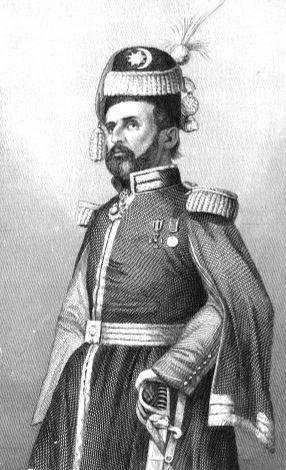
Portrait of Mykhailo Chaikovskyi (Mehmet Sadik Pasha)
Self-confidence cost Russia dearly. The Europeans, whom the Russian army eventually had to fight instead of the infidels, had the advantage: the French armed at least a third, and the British even more than half of their fighters with rifles, at a time when in Russia only 3-4% of the troops had rifled weapons. The Russian fleet was in decline, while Western nations were accelerating their technical modernization. One could be as proud as they liked that Russia constituted one-sixth of the landmass, but the official dispatch about the start of the Crimean War was delivered to Vladivostok only after the war had ended in total defeat.
While the Russian army sincerely hoped that the Anglo-French forces would strike just as ineptly as Russian generals were used to acting — head-on, sparing no soldiers of their own — the enemies calmly landed in Yevpatoria, where resistance to them was offered (according to local legend) only by the custom-house chief, who spoke neither English nor French. From there, the coalition forces went behind the Russian lines and blockaded Sevastopol. The city of glory of the Russian fleet — as it is commonly called, yet a look back at history casts doubt on this glory.
Initially, in September 1855, the Russian troops failed to stop the coalition forces on the Alma, and the latter succeeded in establishing the blockade of Sevastopol, the defense of which from the rear was simply not envisioned by any strategic plan.
Episodes of the Crimean War left a mark not only in Russian history and culture. Both the French and the British remember the Crimean War, although they do not realize that Russia 'also won' it. Near Balaklava in October 1854, General Raglan ordered the Light Cavalry Brigade of the Eastern Army, 'if possible,' to attack the positions previously captured by the Russian army under Menshikov and retrieve the guns taken by the Russians. Further events unfolded as follows (almost according to Murphy's law: if an order can be misinterpreted, it will be misinterpreted).
Captain Nolan, who delivered the written order to the brigade commander, apparently did not understand himself which guns were meant, as he pointed to the well-defended positions of a Russian artillery battery. Without thinking twice whether it was possible or not, six hundred riders of the brigade rushed to attack in the indicated direction. The advance was so decisive and rapid that the Cossacks of the Ural Regiment standing in their way simply fled, leaving the artillerymen undefended. Bursting into the battery positions, the cavalrymen carried out the order.
However, a Russian counterattack forced the British to retreat. Coming under fire during the retreat from another Russian battery (most likely the one General Raglan actually had in mind in his order), the Light Brigade lost over a hundred riders killed, and in total, counting the wounded and captured, three hundred and sixty-five out of six hundred men were missing. Of course, one cannot speak of the triumph of Anglo-Saxon military thought in this case, but... In the end, the coalition achieved its goal, and the Russian Empire in the Crimean War had to make concessions equivalent to defeat.
The incident with the charge of the Light Brigade led to hearings in the British parliament. Prime Prime Minister Aberdeen resigned. The bitter experience was learned by the British. In Russia, however, everything was different: that year the Tsar did not just resign, he died (there is a version of suicide), and there had never been a parliament here 'in all born days'.
This attack became an example of both unconditional bravery on the verge of madness and futile sacrifice. Alfred Tennyson wrote a poem about the feat of Her Majesty's cavalrymen, and Rudyard Kipling wrote about the fates of those who survived. And more than a hundred and twenty-five years later, the charge was sang by the rock band Iron Maiden — in the year of another victory of British arms, the victory over Argentina in the Falklands War.
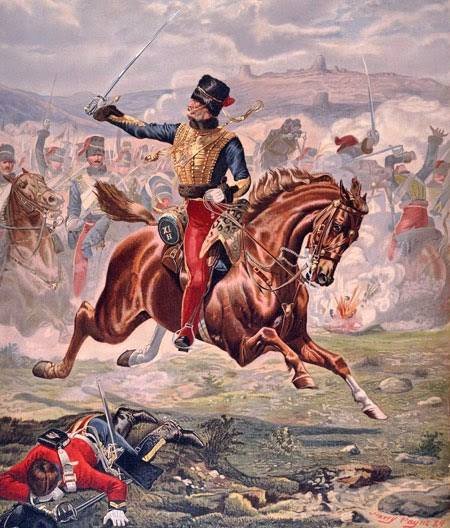
We have no way back, We go through the fire of Russian guns...
Steve Harris "The Trooper"
Perhaps Sevastopol should be considered a city of British glory. History is worth studying so as not to repeat the mistakes of the past. However, historical science is only capable of teaching those who seek to know the truth, rather than what is pleasing depending on the needs of the public or the bosses. Distorting history and glorifying defeats in the guise of victories can only lead to defeats pursuing descendants one after another like a curse. The defeat in the Crimean War did not serve as a lesson for Russia — yes, a revenge in 1878 was bought at the cost of great blood, but the First World War ended with the German occupation of Crimea and the scuttling of the fleet, the Second World War forced the naval crews of the Black Sea Fleet to fight as infantry, and not even naval infantry. Sevastopol became a city of shameful defeats, a city of Russian misfortune.