Water
Environmental issues regarding economic activity on the Crimean Peninsula.
Valerii Verkhovskyi. "Krymska Svitlytsia" newspaper, 2016, Issue No. 47
Any large-scale human economic activity is an interference in natural processes that disrupts their flow and balance in the environment. However, this activity can be carried out responsibly, keeping in mind that people must live on this land after us, or guided solely by motives of personal gain and current interest. How will the current leaders of Crimea go down in history?
Now "advanced Russian science" is energetically proving that the North Crimean Canal brought only harm to the ecology of Crimea. Waterlogging, flooding, seepage... Interestingly, research on the Crimean water issue is being written by scientists from Moscow, St. Petersburg, and Voronezh — undoubtedly, they have a better view from there.
Geologically, Crimea consists of three zones: Mountainous and Foothill Crimea, Eastern Crimea (the Kerch Peninsula), and Northern, flat Crimea. The last of these is located on limestone; it is a former seabed. Limestone is a valuable mineral resources, but not a sufficiently reliable or stable platform, and handling it requires vigilance and balance. If we add the seismic activity, which, though minor, makes itself felt from time to time, the exploitation of Crimea's subsoil creates a number of problems. Simply put, extracting oil, gas, or water in the northern part of the peninsula carries the risk of creating voids, faults, and landslides, amplified by the probability of an earthquake, the consequences of which are impossible to predict.
Therefore, despite all the ecological consequences of its operation, with its colossal water losses on the way to the consumer, and with the tribute that had to be paid to the Kherson region for flooding by the Kakhovka Reservoir, the Canal still looks like the lesser of two evils.
International standards for water resource availability are one thousand cubic meters per person — this is the critical minimum, below which civilized life is impossible. That is, Crimea, with its population of two and a half million people, needs two and a half billion cubic meters of water.
For example, in Israel (whose total area, including the Palestinian Authority, is approximately equal to that of Crimea), the water situation is no better, while the population of this country exceeds eight million. Its own water resources amount to 150 cubic meters per inhabitant, yet agriculture meets 95% of the country's needs. Of course, they do not grow rice in the desert there, but they cultivate cotton, plant orchards and vineyards — indeed, what an example for Crimea. In that country, hundreds of thousands of tons of seawater are desalinated — a resource still unheard of for Crimea.
But the limit of one thousand cubic meters per person is not a standard, but a minimum. In Crimea, this minimum was barely met thanks to the Canal, which provided three-quarters of the water. Another fifteen percent was provided by rivers, and the rest came from underground sources. It should be noted that the best drinking water in Crimea is precisely the underground water. Water from the lower Dnipro can only be used for irrigation and industrial needs. In total, only half a billion cubic meters of water can be extracted from the subsoil of the peninsula, which is three times less than what was supplied by the North Crimean Canal. And that half a billion is in theory. For it must be specified that the quality of water does not always match the quantity. This can be contaminated perched water (verkhovodka) or water saturated with hydrogen sulfide. It can be mineralized water, valuable in a medical or dietary sense, which is completely unsuitable for irrigation.
"Available data on the real volume of groundwater extraction in different years vary within the range from 161.4 to 319.3 million cubic meters per year" (E. Kayukova, T. Baroboshkina, I. Kosinova "Resource Potential of Fresh Waters of Crimea"). This refers to three thousand wells drilled back in Soviet times and mothballed for a rainy day, so to speak. With the annexation of Crimea by the Russian Federation, by all appearances, this "rainy day" has finally arrived.
But let's see what happens if the delusions about Crimea, forever cut off from Ukraine, as if it does not exist, did not exist, and cannot exist, come true.
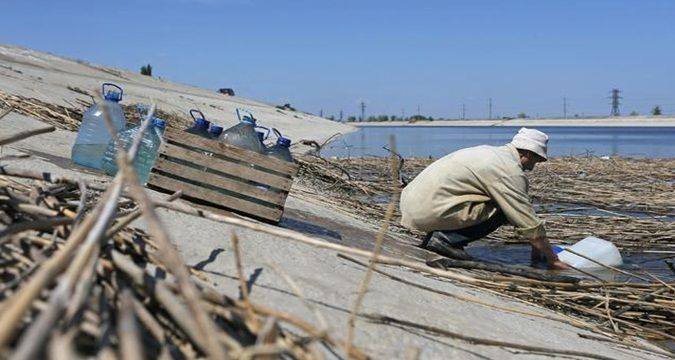
For the sake of reports on fulfillment for the Kremlin bosses, madness is committed: the bed of the Canal is filled with drinking water from underground sources, as a result of which the water is no longer drinkable, becomes contaminated, and mixes with river water. And since the repair and equipping of the Canal structures are never addressed, water losses remain as high as ever — from one-third to one-half of the total volume. Krymvodgosp (Crimean Water Management) has turned into an organization that ruins even the last water reserves of the peninsula.
Crimean rivers receive about a third of their water from underground sources. Extraction from wells will eventually exhaust the resources of river water as well. All water in nature is, as it were, in communicating vessels; shifting water from one place to another will rather decrease the quantity than increase it. Attempts to get by without mainland water supply sources will resemble the old Russian story of "Trishka's coat". Similarly, groundwaters in the coastal zone are connected to the sea and saline lakes (for example, the Syvash). Pumping fresh water from wells leads to the fact that saline water will gradually seep underground, and nothing living will grow on the salt flats (solonchaks).
Meetings at the Crimean State Committee for Water Management constantly note a catastrophic shortage of water. In the Nyzhniohirskyi district, the year 2016 was marked by the beginning of an ecological catastrophe. Salt flats began to appear in places, in patches. The efforts of the current Crimean authorities are directed at providing water to at least the resort zone of Crimea. Of course, one can give up rice, one can distribute water even in teaspoons, a little at a time to each village. Perhaps, over time, the experience of Israel or oil-dollar-rich Arab countries will be mastered in Russia, which is poor in oil-dollars.
But was it worth looking for happiness near foreign shores?