The River of Life. Part One: Origins from the Past
Resolving the age-old issue of water resources on the Crimean Peninsula.
Valerii Verkhovskyi. "Krymska Svitlytsia" newspaper, 2016, Issue No. 41
Crimea is Crimea. This statement becomes obvious as soon as one crosses Perekop. The steppe, it would seem, is just a steppe — whether north or south of that conventional line connecting the peninsula with Greater Ukraine — but you feel the differences immediately. A different landscape, different nature, climate... While drought is a misfortune for the steppe Ukraine, for the Crimean steppe it is a deadly catastrophe. Therefore, life in Northern Crimea existed for years and centuries from river to river, from a rainy year to a dry year.
Life cannot exist without water. And there seems to be enough water in Crimea — as many as two seas. But the water in them is salty. The peninsula's own water resources are unable to meet the needs of agriculture and industry. An explosion that echoed at Perekop on October 17, 1963, determined the fate of a vast territory and hundreds of thousands of people. Then the cofferdam was blown up, and water from the Dnipro arrived in Crimea, and from that time on, not only its southern half could be called a blessed place.
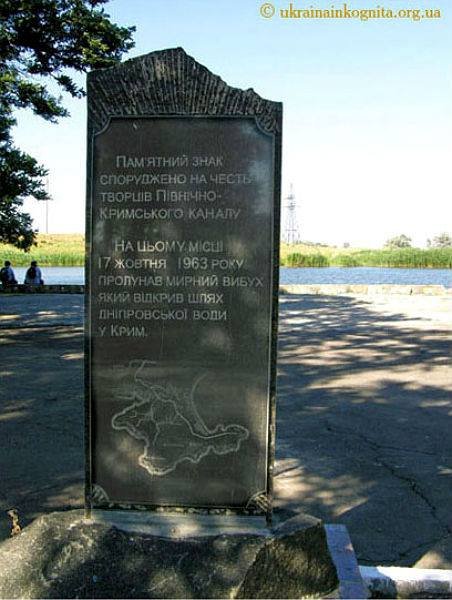
Memorial at Perekop, near Armyansk
The first to think about the water issue was Christian Steven, an outstanding Crimean scientist, founder, and first director of the Nikitsky Botanical Garden. A Swede by descent, born in Finland, he devoted almost his entire life to Crimea. It was people like him who created the Crimea we know. In 1846, while serving as the inspector of agriculture of Southern Russia, he proposed building a canal from the Dnipro to Northern Crimea to irrigate the arid steppes. The project required 40 million Russian rubles, which were never allocated by the government. For a time, Crimea came to be associated not with climatic and natural resources, but with the shameful defeat in the war of 1853-1855, with plans for revenge, and all resources were directed toward that end.
In 1916, another similar project appeared. The topic of irrigating Northern Crimea emerged from oblivion, but the First World War was underway, the empire was about to collapse, the February Revolution soon occurred, followed by the October Bolshevik coup. For a long time, the problems of the steppe part of Crimea concerned few people.
The communist empire did not spare funds. For some reason, building canals was a fixed idea for Stalin: White Sea-Baltic, Volga-Don... Perhaps Joseph Vissarionovich was impressed by the construction of the Panama Canal? The thesis of intervening in nature, of reshaping it, fit perfectly into the Bolshevik materialist doctrine. Man, they said, is the king of nature, and the Soviet man, 'equipped' with the only correct worldview, even more so, and the universe belongs to him. In this context, the opportunity to turn the arid steppe into a green field or a blooming garden coincided with plans to increase the volume of agricultural products for the anniversary of another plenum.
Therefore, the Soviet government, deprived of the 'chimera of conscience,' would always have enough money for a grandiose project, even if it had to be taken from a starving child. In the 1930s, plans for building a canal from the Dnipro to Crimea were discussed and everything was heading toward their implementation... But on June 22, 1941, the Second World War went slightly off the plan mapped out for it by the leader of nations. And the resolution of the issue was postponed again — for almost a decade.
Scientific research data show that in ancient times, when Crimea was not an island or especially a peninsula, it was part of the steppe, and the rivers we know flowed differently — the Molochna, the Kuban, the Don... Geological cataclysms changed the landscape of the territories which later, after historical cataclysms, formed the territory of our country. Crimea became almost an island, it is possible that for a certain period it was an island, and it is quite obvious that its outlines on the map were completely different. The river beds changed, water flows began to bypass Crimea, and its entire northern half turned into a dry steppe with patches of lifeless salt flats.
Almost fantastic projects were also considered. For example, there were plans to build a dam in the Kerch Strait that would replace the bridge built by the German occupiers, and at the same time serve as a regulator of water flows. Salty water from the Black Sea would not be able to flow into the Sea of Azov; over time, filled with water from the Don and the Kuban, the Azov Sea itself was to become fresh, and water could be taken from it to irrigate the steppes. I should note that previously the water in the Sea of Azov was much less salty, almost fresh, and older people in Crimea remember this, meaning that for all its fantastic nature, such a project had a real basis.
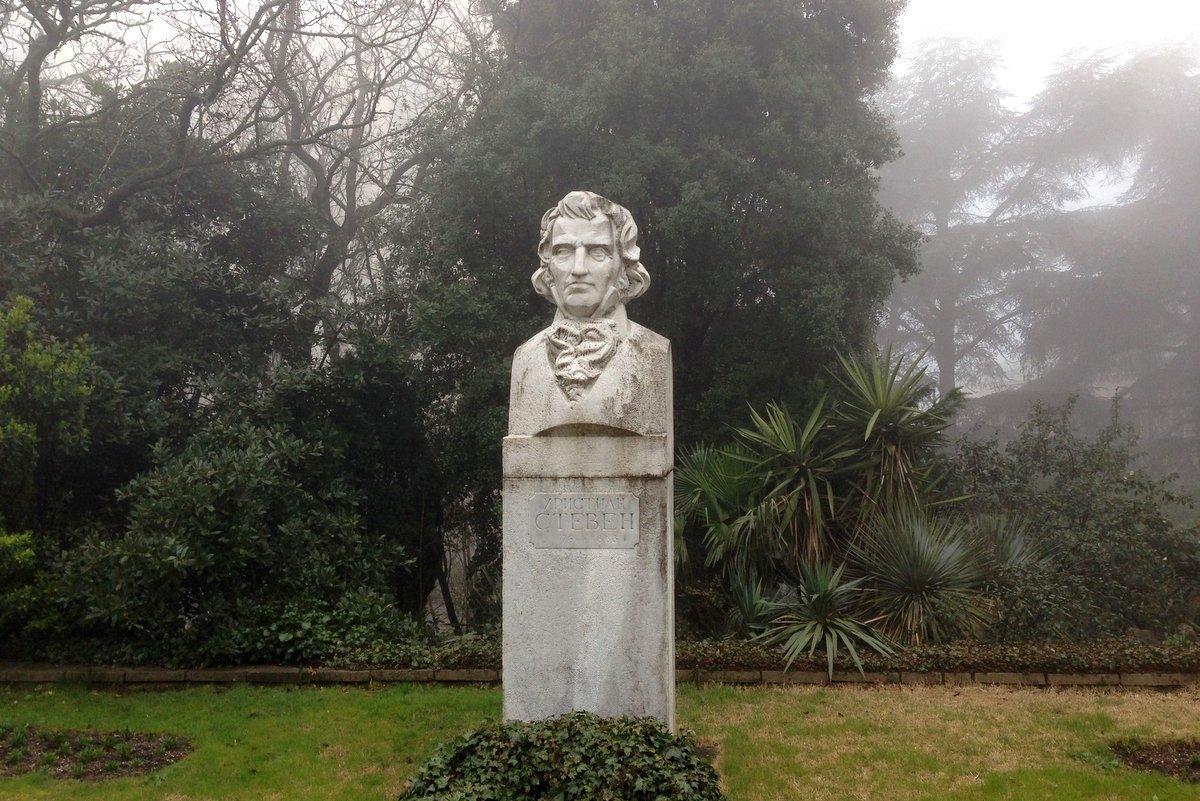
Monument to Christian Steven, founder of the Nikitsky Botanical Garden
Industrial Kerch in particular needed water, where at that time an increase in steel production and the development of shipbuilding were planned. Crimea's agriculture was to feed a huge mass of servicemen of the Black Sea Fleet, which was assigned a significant role in the grand plans for global communist expansion; the resort sector was to increase the number of vacationers multi-fold. In order to grow enough products, the Crimean village lacked one thing — water.
A variant of building a water pipeline from the Krasnodar coast to transfer part of the flow of the Kuban waters to the Kerch Peninsula was seriously considered. It is hard to imagine what such a structure would have cost.
But common sense prevailed then — on September 20, 1950, the government of the Land of Soviets officially decided to build the Kakhovka Hydroelectric Power Station with a reservoir of over two thousand square kilometers, and the South Ukrainian and North Crimean canals.
The history of the Canal had begun.