Ukrainian Reservoirs of Crimea
Crimean man-made reservoirs, the history of their creation.
Petro Volvach, Full Member of the Shevchenko Scientific Society (NTSh), Member of the National Writers' Union of Ukraine (NSPU), Honored Worker of Science and Technology of the AR of Crimea, Crimean resident with 60 years of experience. "Krymska Svitlytsia" newspaper, 2017, Issue No. 48
Regarding the North Crimean Canal as one of the most important life-giving water arteries of the peninsula, there is a huge array of archival research and information materials. However, on the peninsula, besides the canal, there are also true oases of life — man-made reservoirs. Most of them are located in the Foothills, and their existence is tightly linked to the only water sources — Crimean rivers and streams.
Remarkably, after the conquest of Crimea and the liquidation of the Crimean Khanate in 1788, the Russian Empire spent not a single kopeck of treasury funds on land reclamation, channel regulation, or river flow management for nearly a two-hundred-year period. During spring and summer floods, the calm and gentle rivers of the Crimean Foothills turned into unrestrained turbulent torrents. From their sources to the very sea, they destroyed entire villages, bridges, and roads on their deadly path, ruined orchards and vineyards, and devastated agricultural lands, causing immense damage to the peninsula's economy. In view of this, the idea of the need to regulate water flows in the Foothills and, as a consequence, to build reservoirs arose from time to time in Crimean society of that period.
The first large industrial reservoir — the Alminske reservoir — was built during 1929 (first stage) and 1934 (second stage). Its total capacity is 6.2 million cubic meters. In 1935, the Bakhchysaraiske reservoir was commissioned, which was fed by the Kacha River. The Ehyz-Oba ravine was chosen for its construction, and the reservoir's capacity is nearly 7 million cubic meters.
In 1938, on the outskirts of the town of Karasubazar, in one of the ravines on the Biyuk-Karasu River, the Taigan reservoir (with a volume of 13.8 million cubic meters), the largest on the peninsula at the time, was built. Its water was mainly used for irrigating orchards and vegetables. The achievements of the Soviet pre-war era also include the Aian reservoir, built in the Crimean Foothills. Its first stage was commissioned in 1933, and the second in 1936. The total volume of water in it is over 4 million cubic meters. The reservoir on the Aian River supplied water to the city of Simferopol.
The South Coast, with its resorts and sanatoriums, has always suffered from a lack of drinking water. In 1964, in the upper reaches of the Belbek River, on the northern slope of the Main Ridge, near the villages of Shchastlyve 1 and 2 and the village of Kliuchove, a reservoir with a capacity of 11.8 million cubic meters was built, and on the Kacha River, the Zahirske reservoir with a capacity of 27.85 million cubic meters was constructed. They were joined with the Shchastlyve-1 reservoir. Now, water from it flows through a specially constructed tunnel to Yalta. In the South Coast zone, Ukraine constructed several more reservoirs — the Izobilnenske on the Ulu-Uzen River, with a capacity of 13.25 million cubic meters, and the small Kutuzovske reservoir, constructed in 1986 on the Demerdzhi River, which supply their water to the surrounding villages and Alushta.
Thus, in the pre-war and post-war years, Russia constructed only 5 reservoirs to supply water to cities and surrounding villages — the Aian, Alminske, Taigan, Bakhchysaraiske, and Leninske (Yuzmakske) reservoirs, with a total capacity of nearly 40 million cubic meters. Now let's look at what water resources and extensive network of reservoirs, both of natural flow and filling type, the Russian aggressor seized Crimea with? As of January 2014, there were 23 reservoirs on the peninsula with a total water capacity of almost 400 million cubic meters. Consequently, Ukraine's contribution to the construction of Crimean reservoirs reaches 80%.
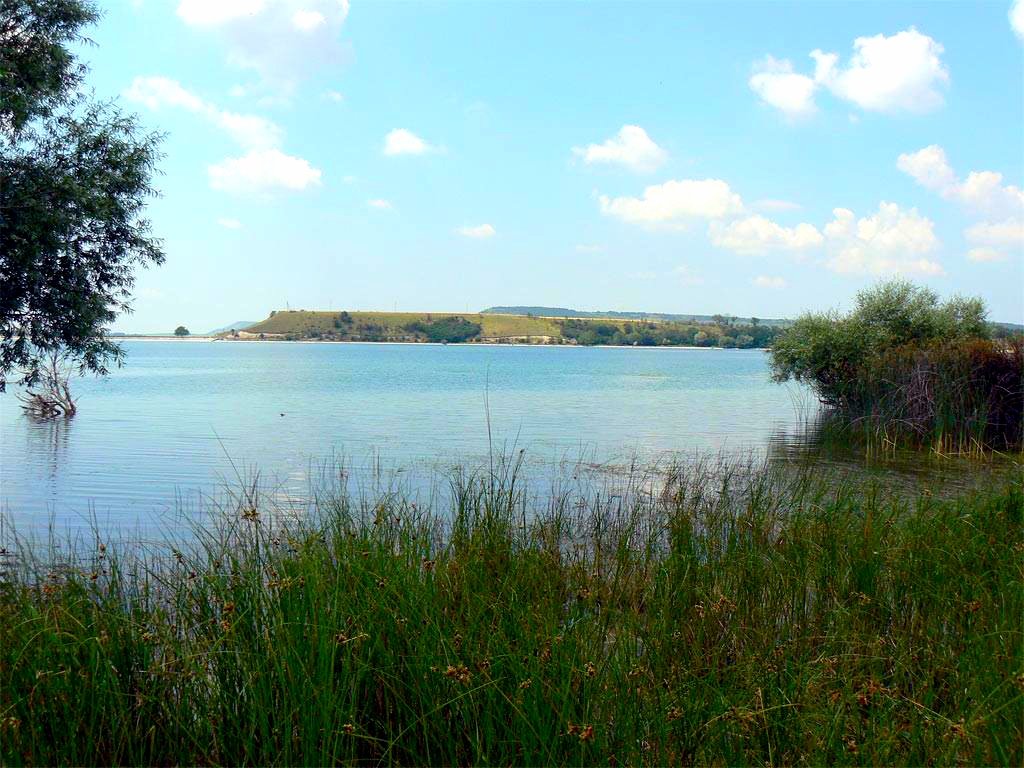
The oldest Crimean reservoir — Alminske
Before the commissioning of the North Crimean Canal, the construction of reservoirs and the establishment of irrigation networks took place only in mountainous and foothill Crimea. Just two years after the transfer of the Crimean Oblast to Ukraine, the largest man-made reservoirs on the peninsula were commissioned — the Chornorichenske near Sevastopol (with a capacity of 64.2 million cubic meters) and the Simferopolske (with a capacity of 36 million cubic meters). The first of these largely solved one of the most painful problems of Sevastopol and the Black Sea Fleet — the supply of drinking water.
The Simferopolske reservoir not only fully supplied the regional center with drinking water but also contributed to the establishment of the powerful Salhyr irrigation system. It provided irrigation for over 20,000 hectares of agricultural land in the Simferopol district. In addition, the Simferopolske reservoir (which Simferopol residents jokingly called their sea at the time) became a favorite spot for recreation and water sports.
Also of great importance for the development of horticulture, viticulture, and vegetable gardening is the Starokrymske reservoir, constructed in 1957 on the Churiuk-Su River (capacity of 3.2 million cubic meters). In 1964, the rather large Shchastlyvenske reservoir was built on the Biyuk-Uzenbash River. And in 1972, Ukraine initiated the construction of the huge Bilohirske reservoir on the Biyuk-Karasu River (capacity of 23.3 million cubic meters). It is located almost adjacent to the old Taigan reservoir. This complex solved the water supply problem for the entire Bilohirsk district and provided irrigation for agricultural lands, primarily orchards, vineyards, and vegetables.
In 1980, another large reservoir was built and commissioned on the Kacha River — the Zahirske reservoir, with a capacity of almost 28 million cubic meters. It allowed for the creation of a fairly powerful Kachynska irrigation system. It was the Kacha Valley, on par with the Salhyr and Alma valleys, that became an industrial producer of valuable Crimean fruits. The construction of the powerful Partyzanske reservoir on the Alma River in 1966 (with a capacity of 34.4 million cubic meters) is of great importance for providing good quality drinking water to the city of Sevastopol and the surrounding villages.
The commissioning of the North Crimean Canal made it possible to create a network of filling reservoirs in the once arid Crimean steppe. Experts call them reservoirs of the North Crimean Canal, including the Zelenoiarske, Mizhhirne, Samarlinske, Kerchenske (Stantsiine), Sokolske, Feodosiiske, Frontove, and Yuzmakske (Leninske) reservoirs, with a total capacity of 146.35 million cubic meters. Since the occupation of Crimea by Russia, all of them, deprived of Dnipro water, are either shallowing catastrophically, have dried up, or have turned into smelly swamps. In the same way, the unmaintained, waterless North Crimean Canal is gradually deteriorating and becoming overgrown with reeds.