Can Crimean Ukrainians Honor Wrangel?
Biography of Baron Pyotr Wrangel.
Serhii Konashevych. "Krymska Svitlytsia" newspaper, 2016, Issue No. 44
On September 18, 2016, a monument to Baron Pyotr Wrangel was erected in Kerch. He is known, in particular, in Russian history as the 'Ruler of the South of Russia' and the 'Commander-in-Chief of the Russian Army' — the one that fought against the numerically superior Bolshevik forces. The monument, funds for which were collected through private donations, was named in the Russian and Crimean media as 'the first in Russia'.
«Russian Tradition»
The monument was erected on the territory of the Church of the Apostle Andrew the First-Called with the blessing of Metropolitan Platon of Feodosia and Kerch. The opening ceremony of the monument was attended by the First Deputy Minister of Culture of the Russian Federation Vladimir Aristarkhov, who called the creation of the most valuable monuments and statues with public money a 'Russian tradition'.
Among the clergy who consecrated the monument was Archpriest Mykola Zinkov: it was he who on the night of February 27-28, 2014, sheltered citizens of Russia in the Andrew's Church, who arrived in Crimea under the guise of pilgrims to later participate in the seizure of the peninsula. Recently, with the support of the 'head of Crimea' Sergei Aksyonov, he proposed to the Deputy Governor of the Krasnodar Krai Mykola Doluda, who is also the 'ataman of the Kuban Cossack Host,' to assist in building a chapel in honor of the Kuban 'Cossacks' who in the spring of 2014 'protected Crimea from Ukrainian nationalists'.
The local union of monarchists put forward a proposal to erect a monument to Wrangel in Kerch back in the spring of 2015; then the city 'authorities' agreed to it. In particular, the 'heads' of the city 'council' and 'administration' made a joint decision to erect the monument in the square near the Marine Station.
This event provoked a mixed reaction in the Russian media and scientific environment. Thus, for example, the Russian publication 'Nakanune' notes: '"White Guard" and "monarchist" sentiments are broadcast not so much by the people of Crimea as by the authorities: the wife of the governor of Sevastopol petitioned for the erection of a monument to [Empress] Catherine [the Great], while the famous prosecutor Poklonskaya came out with an icon of Nicholas II during the Immortal Regiment march alongside people carrying portraits of their grandfathers who fought in the Great Patriotic War'.
A representative of the ideology that Pyotr Wrangel actually fought against did not stand aside either — communist Stepan Kiskin, who is currently a 'deputy' of the Simferopol 'city council'. 'I believe that Wrangel played a negative role for Crimea by staging the "White Terror". A monument to him is useless. Monarchist ideas are as "popular" in Crimean society as Bandera and his ideas,' the Simferopol 'deputy' noted.
Let us return to the speech of the Deputy Russian Minister of Culture Vladimir Aristarkhov at the opening of the monument to Wrangel. According to the official, one of the leaders of the 'White movement' was not only 'one of the best commanders in the Russian army', but also a 'great organizer of civil affairs': supposedly, thanks to him, an example was shown in Crimea of how 'Russia can be Russian, national, state-run, and properly organized, from which it is not a sin to learn even today, remembering much of what was done then'.
Indeed, today's Crimea has something to learn from Wrangel, where everything Ukrainian is being weeded out and burned away, where the last school classes for Ukrainian-speaking children are being destroyed through administrative pressure, where the temples of Ukrainian churches are being forcibly seized and closed, and where you cannot find a Ukrainian printed word even with a candle in broad daylight. Let's talk about this in more detail below.
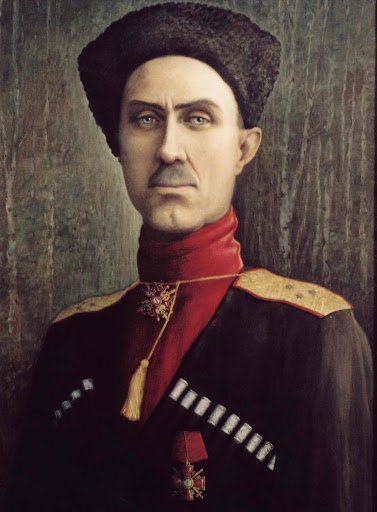
Relations of the "Government of the South of Russia" with Ukraine
It is known from history that in the spring of 1920, the main tactical task of the 'Black Baron's' army was to exit Crimea and break through to Northern Tavria, where it was planned to replenish food supplies and join forces with parts of the troops of Symon Petliura, the head of the UNR Directory, with whom Wrangel was negotiating. In the autumn of the same year, by his decree, he equalized the Ukrainian language with Russian in rights on the territories under his control, ordering 'all educational institutions, both governmental and private, in which instruction is conducted in the Ukrainian language, to be granted all rights established by current laws'. At the same time, the national-cultural societies 'Krymska Osvita' (Crimean Education) and 'Ukrainska Khata' (Ukrainian House) were created in Crimea. On the eve, Wrangel banned the propaganda of national enmity by order.
The attitude towards Ukrainian pro-independence advocates, compared with the times of Denikin's management of the 'White movement', changed significantly: the 'traitors' came to be called 'brothers'. After the legal ban on the use of the word 'Ukraine', in 1920 topographical discrimination at the official level ceased. An Ukrainian Committee was established in Crimea under the leadership of General Vasyl Kyrii, a descendant of Chernihiv Cossack officers, who established diplomatic relations with Ukraine at Wrangel's headquarters.
Information can be found that for Wrangel, during his administration in Crimea, the question of relations with Ukraine was of considerable importance. The closest relations at that time were established with the Ukrainian National Committee, which was created in November 1919 in Paris and had its representations in many countries. In Crimea in May 1920, Wrangel received a military diplomatic delegation from the UNR Army led by General Mykhailo Omelianovych-Pavlenko, which came 'for information and clarification of the conditions of a possible agreement'. They agreed to 'beat the common enemy' (meaning the Bolsheviks) and to seek that 'public moderate circles and individuals would curb the chauvinists on both sides'.
At the same time, Lieutenant General Kyrii outlined the relations between the 'Government of the South of Russia' and Ukraine. 'Interestingly, the military representatives of the UNR held a clandestine meeting in Sevastopol with almost 300 naval officers, who welcomed the guests by singing Shevchenko's "Zapovit" (Testament), and sent them off to the sounds of the anthem "Shche ne vmerla Ukraina" (Ukraine Has Not Yet Perished),' Ivan Tsapko noted in his memoirs. On the same day, Colonel Omelianovych-Pavlenko, in his speech, focused on the reasons for the loss of the Black Sea Fleet: 'Two years ago, the raising of Ukrainian flags gave hope for the creation of the Ukrainian Navy, but isolation from Ukraine, the struggle of the Crimean Tatar people for an independent Crimea, the "one and indivisible" views of the Russian government, and the active armed offensive of the Bolsheviks made it impossible for the sailors of Sevastopol to wear the insignia of the Ukrainian Fleet'.
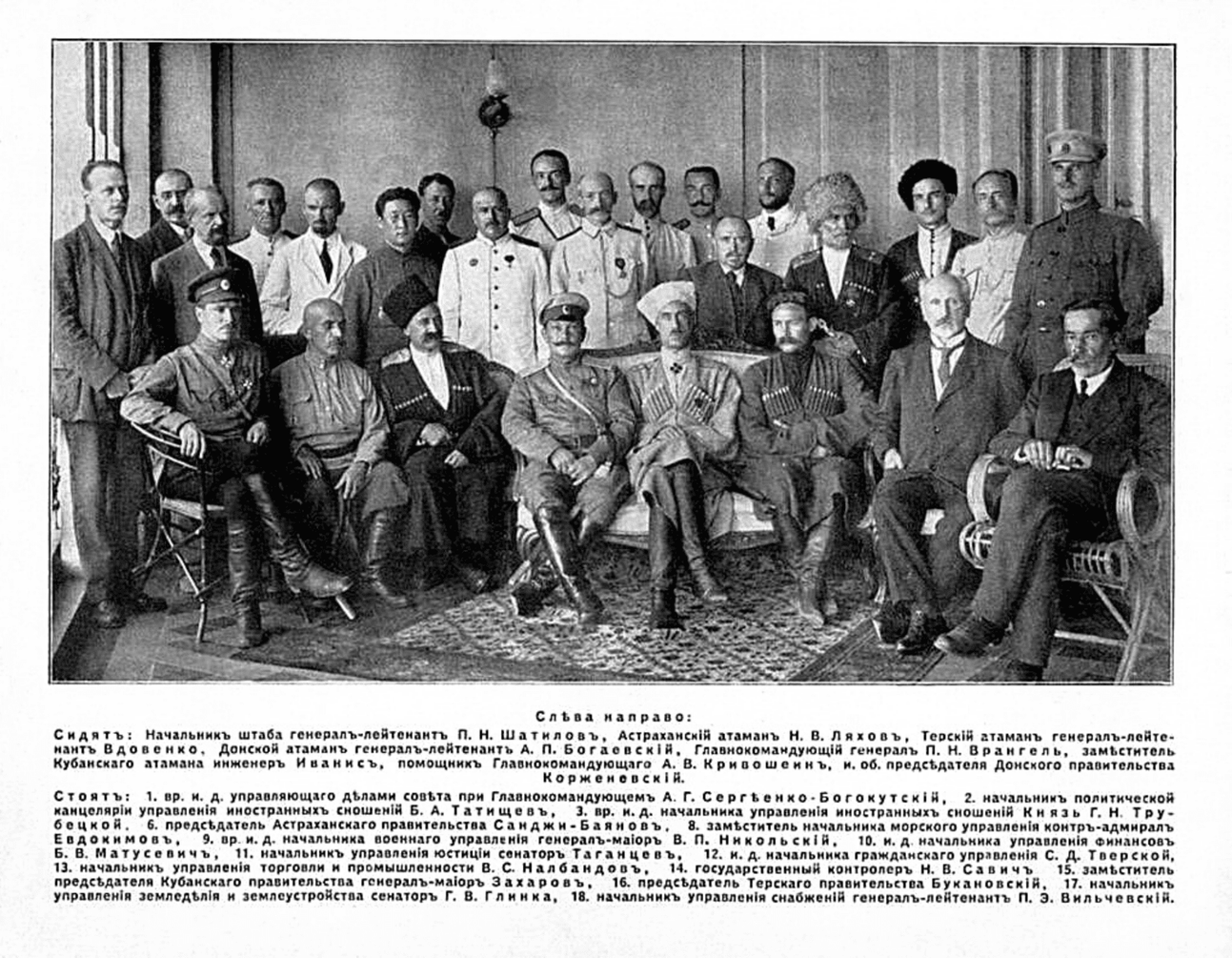
General Wrangel, members of the governments of the "South of Russia", Astrakhan, Kuban, and Don state formations. Sevastopol, July 22, 1920. Next to Wrangel — Vasyl Ivanys
Yellow-and-Blue Colors in Sevastopol Strange as it may sound today, Sevastopol under Wrangel's rule became in fact the center of Ukrainian political life in Crimea:
In particular, in his memoirs, one of the prominent political figures of the Kuban of that time, Vasyl Ivanys, recalled how in Sevastopol he met 'a man in an unusual uniform with yellow-and-blue colors': he introduced himself as a Ukrainian colonel and noted that 'with a group of Ukrainians, he wants to agree on joint actions with Wrangel'. Having met with this group, Ivanys 'received a vague answer' to the question of whether they were Crimean Ukrainians or from the mainland.
They wanted to see General Kyrii, who was absent from the city at the time. 'I realized that they were acting on their own, having no powers or connection with the Ukrainian authorities,' Ivanys noted then. Another time, he met a young man in a European uniform with yellow-and-blue patches, who told him in broken Russian-Ukrainian dialect that he was from Galicia. Ivanys heard about the Galician army for the first time then. 'The young man began to boast that the Galician army was not as demoralized as the Dnieper one. This boastfulness was so unpleasant that I hastened to end the conversation,' recalled Vasyl Ivanys, testifying that in Sevastopol at that time one could indeed often meet representatives of various Ukrainian military formations and political associations.
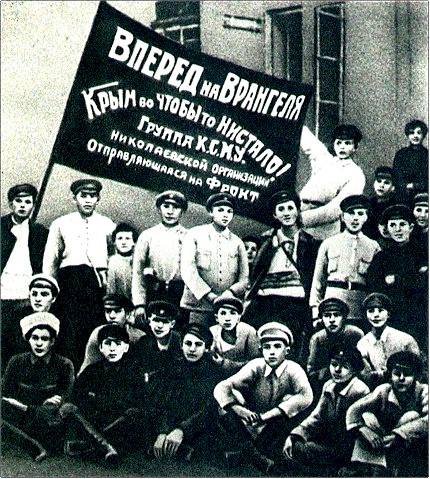
Mykolaiv Komsomol members: "Forward against Wrangel! Crimea at any cost!"
Outlaws (Wait, no, "Кубанські козаки у Криму" -> "Kuban Cossacks in Crimea")
(Wait, let's fix it, my draft translation had ## Kuban Cossacks in Crimea which is correct, and I will write that)
Kuban Cossacks in Crimea
On August 4, 1920, in Sevastopol, the 'Agreement between the ruler and commander-in-chief of the armed forces of the South of Russia and the atamans and governments of the Don, Kuban, Terek, and Astrakhan' was signed. It proclaimed the absolute independence of the indicated state formations, however, the commander-in-chief was recognized with full operational and organizational authority over the armed forces, the right to relations with foreign states, as well as to establish a unified monetary and customs system and conduct foreign trade. The Cossack troops were to occupy the entire North Caucasus and Transcaucasia, separating them from Soviet Russia.
The agreement was valid 'until the complete end of the civil war,' without providing a mechanism for its amendment or denunciation. Vasyl Ivanys, the acting Kuban military ataman at the time, signed this agreement on behalf of the Kuban People's Republic. At that time, there was a division of Kuban Cossacks (4.5–5 thousand) in Crimea, who had no relations with Ukraine, although they had sent a delegation to the mainland to establish contacts.
Ivanys in his memoirs admitted that the agreement was only a paper unconstitutional act, and recalled the distrust between himself and Wrangel. In October, he obtained permission for his like-minded associates from the Kuban Rada to come to Crimea from Georgia, but they decided not to come after a warning from Wrangel about the impermissibility of their pro-Ukrainian activities on the peninsula. The Kuban Cossacks in Crimea, according to Ivanys, fared 'like a son-in-law in a bad father-in-law's house,' but there was nowhere to relocate them.
However, Wrangel, criticizing the policy of his predecessor Anton Denikin, noted: 'Instead of uniting all the forces that set themselves the goal of fighting the Bolsheviks and the commune, they fought the Bolsheviks, the Ukrainians, Georgia, Azerbaijan, and only a little was missing to start fighting the Kuban Cossacks'.
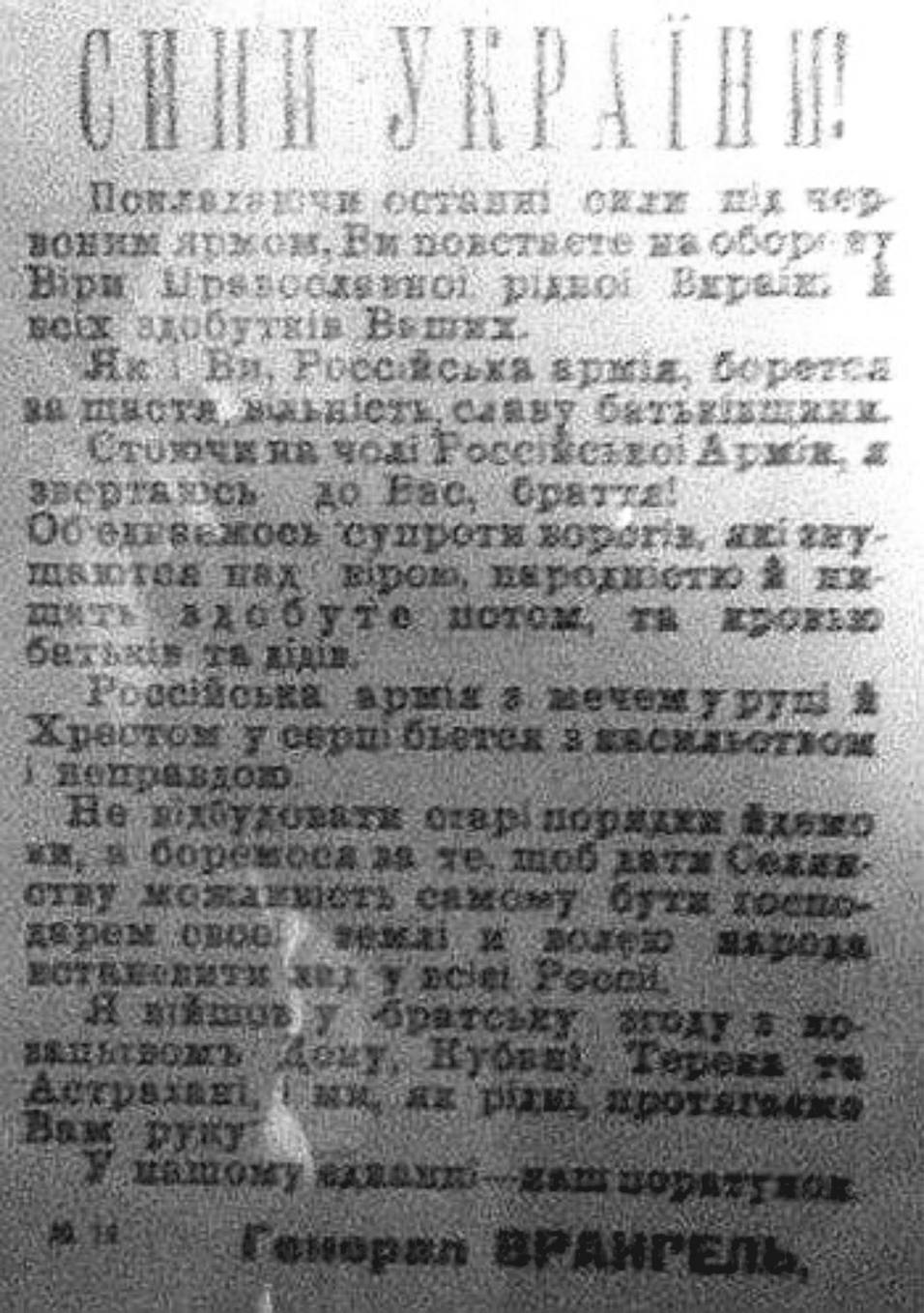
Wrangel's appeal to Ukrainians
The Ukrainian Element in Wrangel's Army
Crimean historian Andrii Ivanets points out that, perhaps, it was in vain that the pro-Ukrainian organizations of the peninsula ignored the date of its departure by representatives of the 'White movement'. The researcher supports this idea with a fact unknown even to all professional historians: the activities of the Ukrainian underground in Wrangel's army, whose ideological basis was the Ukrainian statehood idea combined with anti-Bolshevism while orienting towards UNR circles. According to the data cited by the historian, in the late summer and early autumn of 1920, there was '70-80% of the Ukrainian element' in Wrangel's army. A large percentage of Wrangel's army officers had previously served in the troops of the UNR or the Ukrainian State; among them were true Ukrainian patriots who had reasons to distrust Wrangel's regime.
Among the Ukrainian organizations in Crimea, the UNR platform was popular, which allowed for a compromise with Wrangel on an anti-Bolshevik basis under the conditions of recognizing Ukraine's sovereignty.
After the Red Army broke through the Syvash positions and Perekop fortifications, one of the largest naval evacuations in history took place from the ports of Crimea in November 1920: 126 ships carrying 150,000 people left the piers of Yevpatoria, Sevastopol, Yalta, Feodosia, and Kerch. Vasyl Ivanys in his memoirs notes that 15,000 Kuban Cossacks were among those evacuated from the peninsula. 'Interestingly, in emigration, a part of the baron's army soldiers turned to the UNR authorities with a request to help them reach Petliura's Army or obtain a UNR passport.
Therefore, a wreath with a blue-and-yellow ribbon on the waves of the Black Sea near the shores of Sevastopol will not be superfluous during the days of honoring the exit of anti-Bolshevik units from Crimea,' Andrii Ivanets notes. How appropriate wreaths with ribbons in the colors of Ukrainian symbols would look under the monument of Pyotr Wrangel — it is not easy to answer yet.
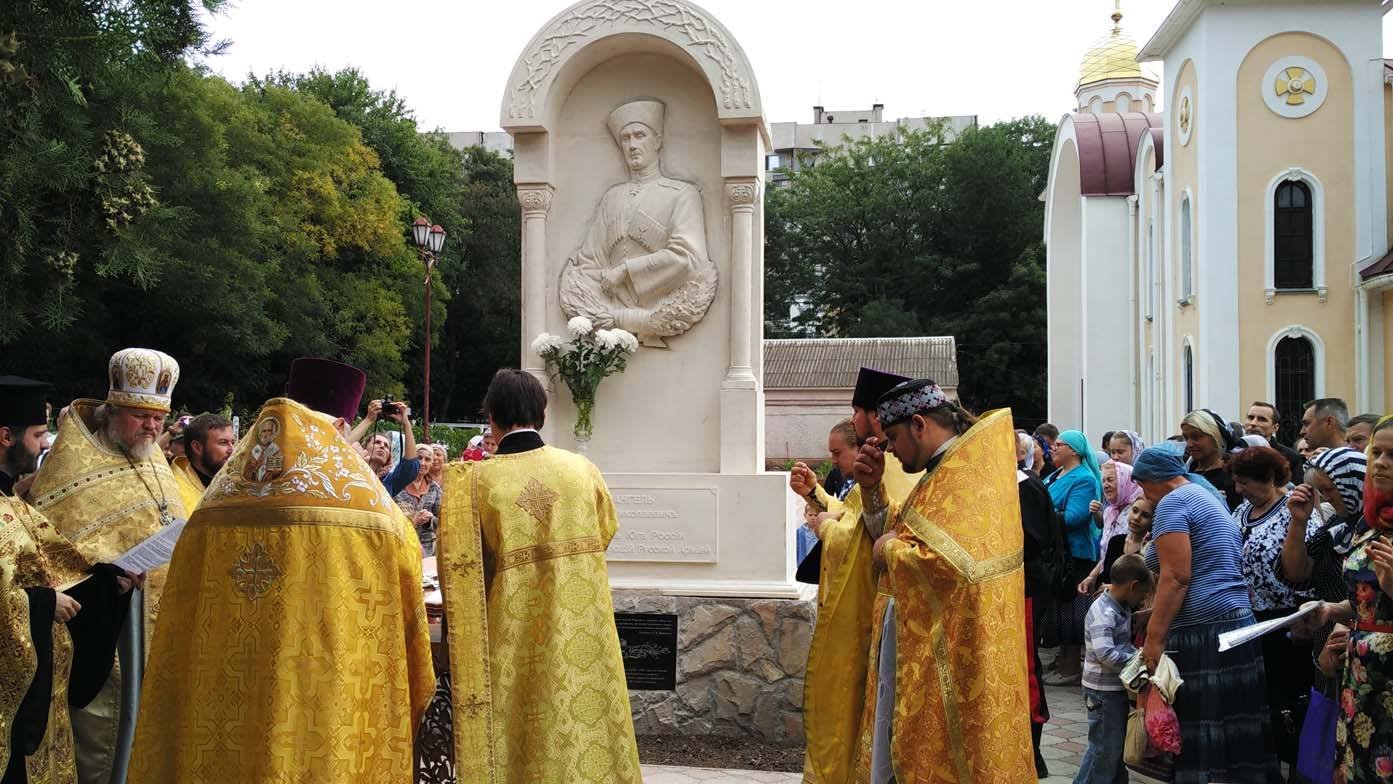
Opening and consecration of the monument to Wrangel in Kerch, September 2016