Volcanoes of Crimea
The generous Crimean nature continues to surprise us — Crimea is not Kamchatka or Iceland, but there are also volcanoes on our peninsula.
Valerii Verkhovskyi. "Krymska Svitlytsia" newspaper, 2017, Issue No. 51
The generous Crimean nature continues to surprise us — Crimea is not Kamchatka or Iceland, but there are also volcanoes on our peninsula. Although they spew not fire and magma but only liquid clay, and are small compared to real volcanoes, 400 years ago one of them caused real disaster with its eruption.
Salsa — Not Only a Dance
Salsa is not only a hot sauce or a spirited Latin American dance. Salsa is also a 'salsa', meaning a mud volcano that is a depression in the ground. Cone-shaped mud volcanoes are called macaluba. But in Crimea, there is another unofficial name common to both types — 'bliuvaky'. They erupt from underground not only a mixture of clay and water, but also hydrogen sulfide and natural gas — therefore sometimes their particularly powerful eruptions are accompanied by flames and thunder, and ejections of rock fragments, resembling a real eruption. For the most part, unlike real magma, mud 'magma' has time to cool before it reaches the surface. Due to the high saturation of the liquid clay thrown to the surface with hydrogen sulfide, iodine, and bromine, this mud is considered healing.
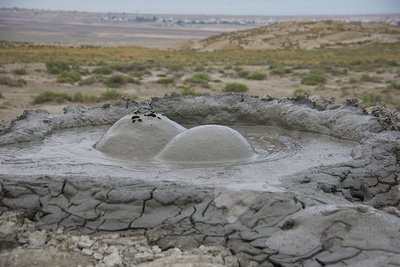
Bulganak mud hill
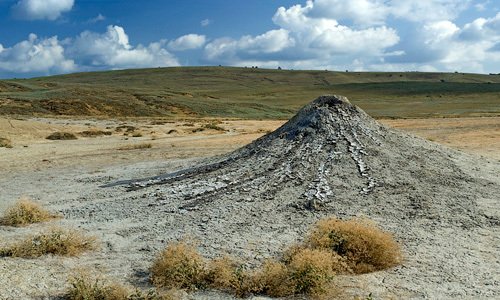
Bulganak mud volcanoes
Ak-Monai Strait and the Kerch Isthmus
It is no coincidence that volcanoes are located only in Eastern Crimea: from a geological point of view, the Kerch Peninsula is not part of Crimea. Millions of years ago, as scientists prove, the strait between the Sea of Azov and the Black Sea already existed, but much further west, at the site of the current Ak-Monai Isthmus, and the Kerch and Taman peninsulas were one. On Taman, mud volcanoes are just as common.
Not far from Kerch, there is the Bulganak group of mud volcanoes: the Obruchev, Vernadsky, Abich, Pavlov, Tyshchenko, and Andrusov mud hills, as well as a typical salsa, the largest in diameter (25 meters) among Crimean mud volcanoes — Central Lake. The highest of them — the Obruchev mud hill — has a height of 74 meters above sea level. However, there is an even higher volcano in Crimea.
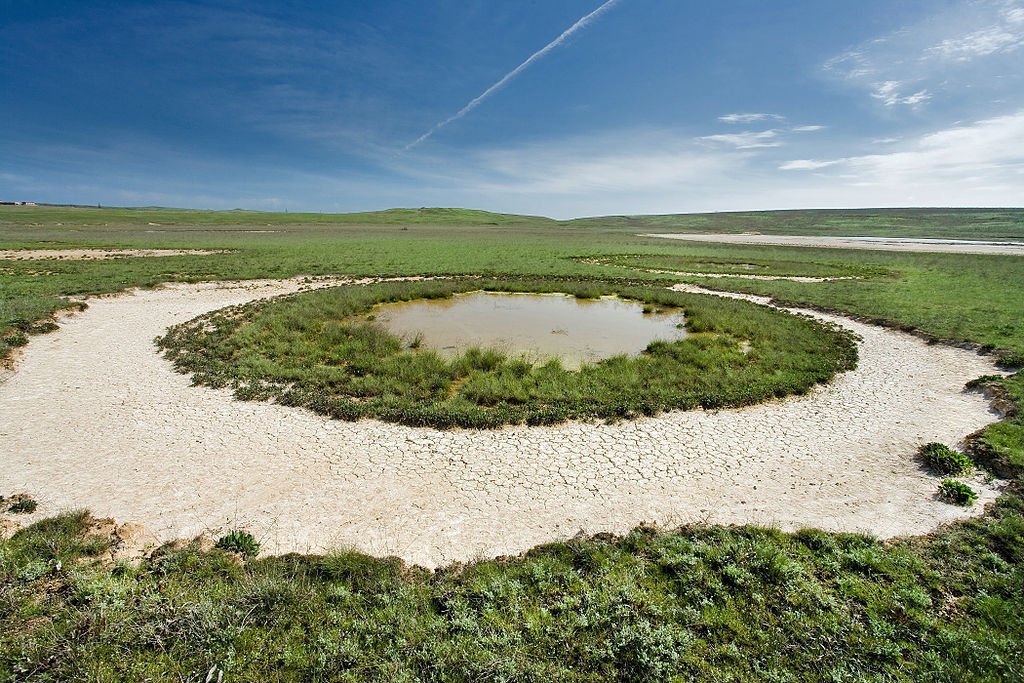
Obruchev mud hill
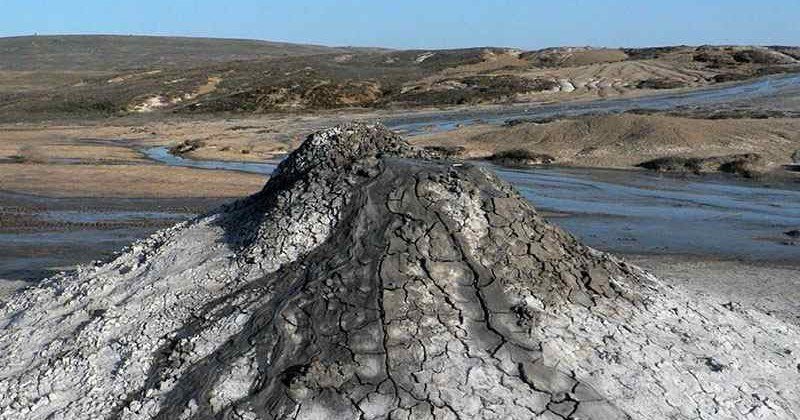
Jau-Tepe mud volcano
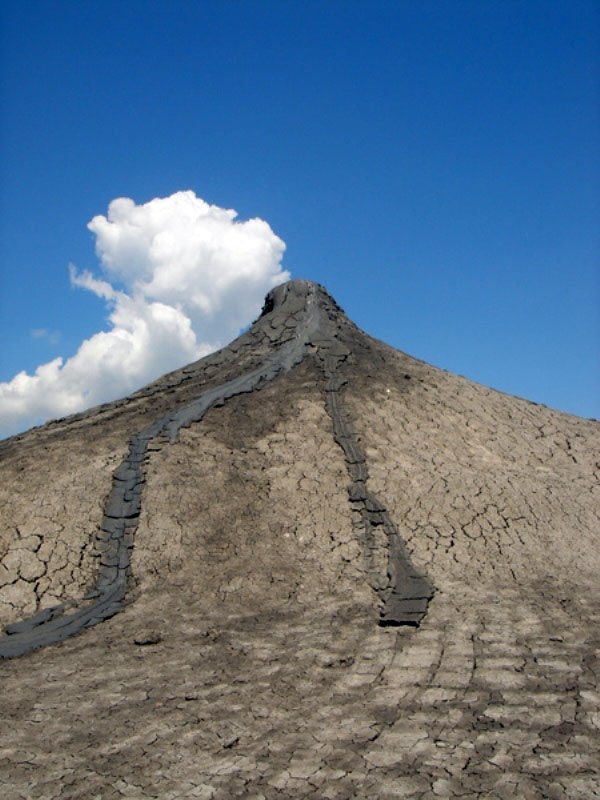
Mud volcano
Crimean Mini-Etna
This is Jau-Tepe, which reaches a height of 120 meters above sea level. 'Mountain-enemy' — this is how its name is translated from the Crimean Tatar language. And it had reasons to be called so — in the 17th century, its eruption destroyed a nearby village. In 1964, this natural object was declared a natural monument of local significance, and since 1975 it has become a landscape natural monument of national significance.
The most powerful in terms of the volume of ejected mud, one might say exceptional, was the eruption of 1909, when the mud flow reached 330 meters in length and 20-30 meters in width. A total of 128,000 tons of volcanic mud was ejected from the vent.
The volcano also came alive on March 14, 1914. Flashes of flame erupted from the vent and a huge column of black smoke rose. Its roar could be heard dozens of kilometers away. A huge flow of volcanic mud began to move toward the village, causing panic among the local residents. But it was all over in half an hour.
Jau-Tepe woke up again in 1925 and 1927, though not as powerfully. One of the largest eruptions was recorded in 1937, when a tongue of mud extended for 130 meters. The last notable eruption occurred in 1982.