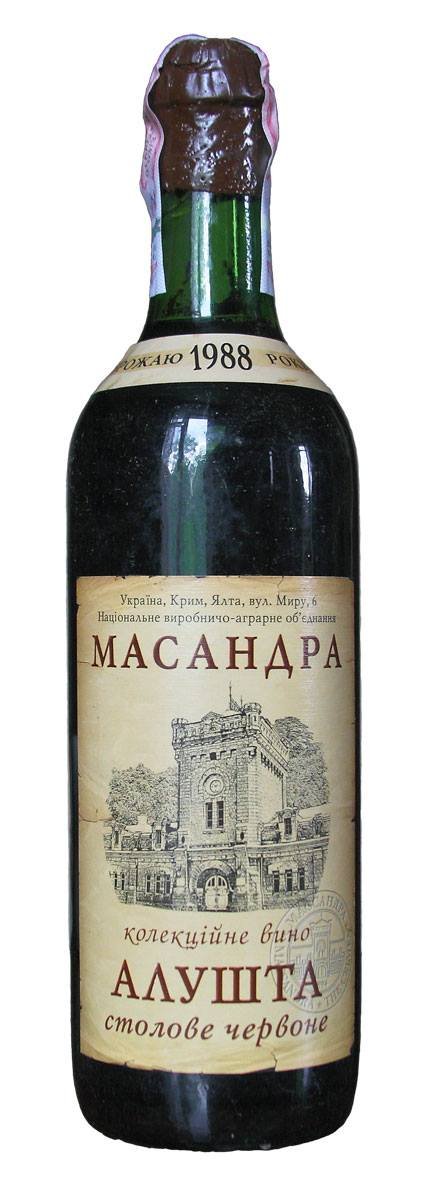
Legends of Wines: Red Table Wine \"Alushta\"
Crimean wines are legendary, enveloped in a cloud of true and imposed epithets and stories; they are unique drinks that are already becoming a legend in the full sense of the word.
Maksym Duboviaz. "Krymska Svitlytsia" newspaper, 2018, Issue No. 38
Crimean wines are legendary, enveloped in a cloud of true and imposed epithets and stories; they are unique drinks that are already becoming a legend in the full sense of the word.
To start with, the classical ancient Greeks (Hellenes) drank... barley beer. Archaeological research points to this. They drank beer until a cultural hero, who was later added to the pantheon of Hellenic gods and is now known by the name Dionysus, set off from Achaea on long travels and returned home with a wonder-vine. In our case, this legend is interesting precisely due to its 'geographical' component.
The travels of that god were a 'round-the-world trip' along the shores of Pontus, that is, the future Black Sea. The young god acquired that wonderful vine soon enough, and then nurtured it, placing it sequentially in the skulls of a nightingale, a monkey, a lion, and a donkey along the further course of the route. Botany has its own Schliemanns, and it was natural scientists who, not without surprise, discovered — less than a hundred years ago — that nowhere in the Old World, but only in one place, does the wild grapevine live in nature. And this place is not Hellas, nor Colchis, nor Libya, but only the mountain forests of Taurus, that is, Crimea.
It is precisely in Crimea that it grows, one of more than three hundred brothers in the grape family, the common ancestor of all modern grape varieties (white and black, table and 'technical', as those varieties are called in agriculture) from which wine is made. In nature, it is a vine with sparse clusters of small, round berries that are neither white nor black, but red. Subsequently, human attention and careful cultivation produced the entire variety of modern sorts from that primary ancestor.
As is most often the case in science, this is a hypothesis, a version that exists until it is proven or disproved. For completeness, it is worth noting that there is also Isabella — the American 'cousin' of our Old World grape, which at one time directly entered European winemaking, but is still not a classic grape in the full sense of the term. It has its own consumer niche, its admirers and fans, but it has never competed for leadership at the highest level with the achievements of its Old World 'cousin'.
Therefore, the development of Crimean winemaking in the 19th century was as promising as it was natural. True, we do not know how well the wines of the Hellenic and Italian colonies of the sunny peninsula were known in the Oecumene of that time. At least, the ancient poets, glorifying various types of ancient wines unknown to us now in their poems, in no way mention that at least one of those poetic drinks had a Taurian origin.
New, as is well known, is often well-forgotten old. And the newer colonists of Crimea 200 years ago did not pay attention to the fact that the peninsula had its own achievements in growing cultivated grapes. A certain exception, perhaps, is the famous Crimean universal variety Kokur, but more about it and its less famous relatives later. Thus, the new landowner-winemakers imported en masse the vines of famous European brands, in modern terminology. They sincerely hoped to obtain from the Crimean fields equivalents of the Rhine wines famous in Europe... But it turned out that Crimea has its own character.
The same vines that yielded exquisite, light table wines — fashionable in those days — from the native fields of Europe, 'balked' in Crimea. Winemakers know that the master is not the one who makes a barrel of strong wine, but the one who nurtures a bucket of dry wine. So they nurtured it. There were successes recorded in the reports of researchers and travelers, and there were failures. Until the future father of domestic winemaking — Prince Lev Golitsyn — arrived in Crimea and put the business on a broad research and production foundation.
It was Golitsyn who proved that due to the peculiarities of the soils of the Crimean mountains and foothills, Rhine and most other European vines were unable to easily yield Rhine-type wines, but instead, they produced wines of that category popular among the less demanding public, which was then called 'lafite'. It was the lafite-profile wines that later made the fame of typical Crimean winemaking, and one can talk about this for a long time and interestingly, and it is worth it.
But masters are masters everywhere: in conditions unfavorable for this, Crimean winemakers nevertheless produced a masterpiece — a truly exquisite, light, luxurious red table wine.
Legend connects its origin with the name of Golitsyn and his students. Supposedly as a masterpiece, that is, a student's work to obtain the rank of master, the Alushta winemakers presented to the old maestro a red table wine that even perfect connoisseurs could not distinguish from the best authentic Bordeaux. They say that the eccentric prince used this opportunity again to proclaim the main formula of his life's path: 'Grapes and wine are the product of variety and locality!'.
And he allegedly said to the masters something to the effect that they should not name it after the variety — South Coast Bordeaux, or Crimean, or some other 'Bordeaux' — but honestly name it just like the first creators did. Bordeaux is in France; in Crimea, it is Alushta. Thus, supposedly, appeared that seemingly simple name 'Alushta', which tells nothing to the average consumer, but for the connoisseur, it is a vintage red table wine.
This is a legend. In fact, the standard for this rare, exquisite wine was created much later, about three-quarters of a century ago. It was almost impossible to find on the shelves of wine shops even in Crimea; it was distributed, apparently right from the winery, to elite wine cellars and outstanding wineries. There is a legend, which is also still waiting for its Schliemann, that it was this wine that was involved in the incident, well-known in the corridors of the Soviet youth beau monde, with French pioneers in 'Artek' who demanded... wine for lunch — and it was indeed provided to them, and this wine was precisely 'Alushta'.
But that is another story — just one of many in which memories of Crimean wines are so rich...