The Loss of the Flagship
The tragedy of the Black Sea Fleet — the loss of the battleship and the revenge of the "Black Prince" Valerio Borghese.
Valerii Verkhovskyi. "Krymska Svitlytsia" newspaper, 2018, Issue No. 5
For those who believed that the Second World War ended in 1945, the night of October 29, 1955, did not portend any trouble. But instead of celebrations on the occasion of the centenary of the city's defense (during the Crimean War), a tragedy occurred in Sevastopol — the best Soviet warship sank from an explosion. 829 people died in the disaster. Admiral Kuznetsov lost his post, and his fleet development program, which envisaged replenishing the fleet with aircraft carriers, came to naught.
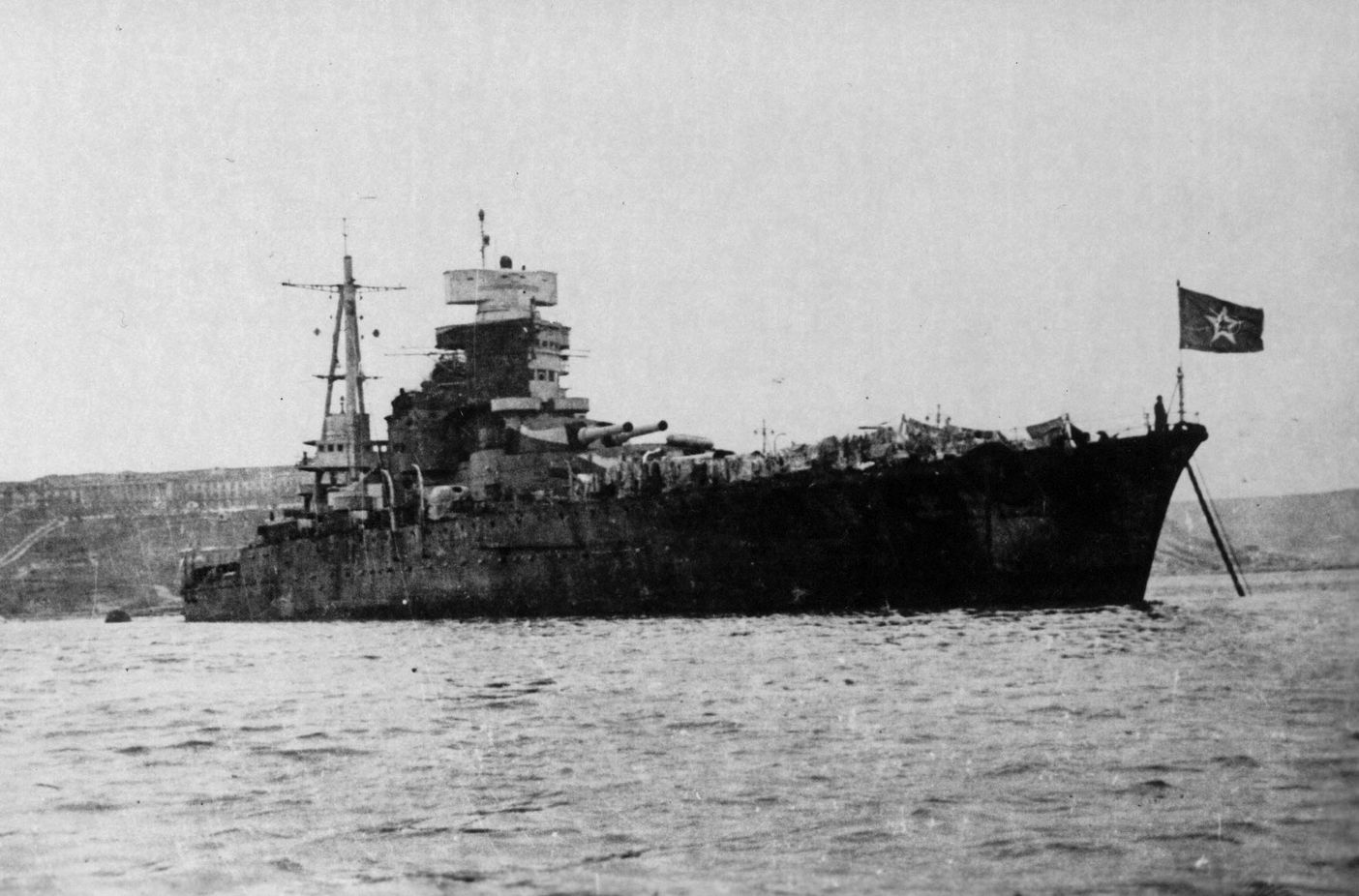
Battleship "Novorossiysk" in Sevastopol, 1949
A strange coincidence: in 1915, practically in the same place, the flagship of the Russian Empire's Black Sea Fleet, 'Imperatritsa Mariya' (Empress Maria), sank. Forty years later, another flagship sank — a battleship, a warship that went through two world wars, serving its native country in them under the name 'Giulio Cesare' (meaning Julius Caesar), and was later named 'Novorossiysk' in the Red Fleet.
On December 9, 1948, the battleship 'Giulio Cesare' set off for Russian captivity... Commander Valerio Borghese (known as the 'Black Prince') vowed to avenge this disgrace. On February 3, 1949, the ship in the Albanian port of Vlorë was handed over to representatives of the Soviet Navy. On February 26, the ship arrived in Sevastopol, and on March 5, it was named 'Novorossiysk'. Launched in 1911 in Genoa, the battleship — not only against the background of our Black Sea Fleet, twice named after the destruction of the squadron, but also as part of the entire Soviet military fleet — 'Giulio Cesare' turned out to be the most powerful warship.
An eloquent fact: ammunition for its main battery guns did not exist in the USSR at all, and their production was established for the sake of this single battleship. There were even plans to shoot nuclear shells from its 320-mm guns.
Well, it was said of the Italians that they knew how to build ships better than to fight on them. Their land army in the Second World War fought so reluctantly and ineptly that their German allies joked that German tanks had three forward gears and one reverse gear, while Italian tanks were the opposite. The Italians set almost all aviation records in the interwar period, but Italian aces achieved no significant success in winning air superiority. The Italian navy looked magnificent, yet only one unit of the entire fascist military won recognition from both enemies and allies — the underwater saboteurs of Valerio Borghese's unit.
In favor of the version about a sabotage action testified not only that the 'Black Prince' had a habit of keeping his promises. The Italians had already sunk Soviet ships and submarines in 1942 in besieged Sevastopol. Borghese recalled: 'The Italian Navy, meeting the wishes of the allies, sent a flotilla of MAS torpedo boats under the command of Captain 1st Rank Mimbelli and several "pocket" submarines of the CB type to the Black Sea. These ships performed their tasks with honor (one boat sank a Russian cruiser, and the tiny CBs sank two Russian submarines)'.
Having successful experience in sabotage work of combat divers in the First World War, in the Second World War Italy relied on naval saboteurs — daredevils who could sink enemy ships directly in their home ports, secretly swimming underwater and planting mines under the very bottom of the ship.
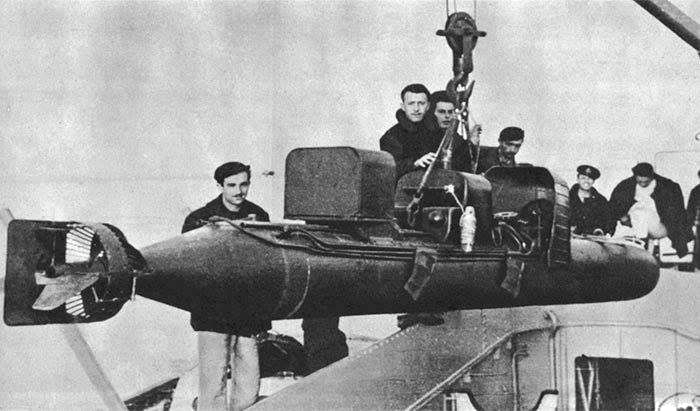
SLC, or "maiale", was a midget submarine designed to deliver two operators and a warhead to an enemy ship
In the photo is a device resembling a manned torpedo. This similarity is misleading, which is why Italian combat swimmers were called human torpedoes and considered suicide squads, but unlike the Japanese 'teishintai' (naval kamikaze), they were suicide squads no more than saboteurs of any country in any war. This is the SLC, or unofficially 'maiale' (Italian for 'pig') — a midget submarine, so to speak, an underwater motorcycle designed to deliver two operators and a warhead to an enemy ship.
The Italians managed to conduct several successful 'naval operations,' in particular at British naval bases in the Mediterranean: Alexandria, Valletta (on Malta), and Gibraltar. The list of victims of these sabotages is dominated by tankers and small ships — the cruiser 'York' and the aircraft carrier 'Ark Royal,' while the battleships 'Queen Elizabeth' and 'Valiant' suffered significant damage and were put out of action for some time, which delayed the collapse of fascist Italy, but after repair, the British ships returned to the Mediterranean...
In 1943, Borghese planned a sabotage operation even in the port of New York, but the rapid advance of Anglo-American troops and the unreadiness of the Italians to continue the war led to a change in the political situation; in the end, the southern part of the country found itself under the occupation of Americans and British, and the northern part under the control of Hitler. It is indicative that after Italy's official exit from the war in 1943, Italian naval saboteurs ended up on different sides, as the Americans offered them — yesterday's enemies — to serve in their ranks, while the other part of the unit and the 'Black Prince' himself, who remained north of the front line, continued to fight on the side of the Nazis. In 1945, Borghese was convicted for this and spent four years behind bars.
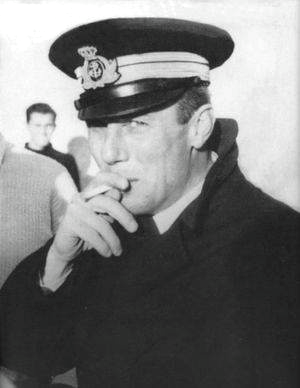
Valerio Borghese
In July 2013, the secret became public — Ugo D'Esposito, a former officer of the Decima Flottiglia, declared that the combat swimmers of this unit had indeed blown up the former 'Giulio Cesare'.
In October 1955, an Italian cargo ship set off for Ukraine for grain. Passing Cape Khersones, a group of saboteurs set off on a sortie on a midget submarine and planted mines under the battleship's keel. According to another version, the main explosive charge was planted back in Italy during preparations to hand the ship over to the USSR, and the saboteurs only had to install a small detonating charge. One way or another, on October 28, the 'Novorossiysk' moored in the area of the Hospital Wall, and at night, at 1:31 AM, an explosion rang out.
Exactly thirty seconds later, a second explosion occurred (such 'punctuality' indicates a targeted sabotage). The ship remained afloat for another three hours, so if the command had set the goal of saving human lives, the casualties would have been much fewer, but in the Soviet tradition they saved the material assets, i.e., the ship, which subsequently went to scrap anyway.