The Curtailment of the Short-Lived Ukrainization of Crimea
How Ukrainian settlers identified themselves on Crimean soil and how Ukrainian culture developed on the peninsula.
Petro Volvach, Full Member of the Shevchenko Scientific Society (NTSh), Member of the National Writers' Union of Ukraine (NSPU), Honored Worker of Science and Technology of the AR of Crimea, Crimean resident with 60 years of experience. "Krymska Svitlytsia" newspaper, 2018, Issues No. 47 – 48
Studying the huge array of documentary materials on the post-war resettlement of the Ukrainian population to Crimea, both before and after its transfer to Ukraine, we conclude that the Kremlin criminals did not care about the fate of the settlers from Ukraine. The settlers were viewed by the Communist Party authorities merely as a submissive workforce needed only to revive Crimea, which had been neglected by the government and Russians.
In all these annual and government resolutions, starting from 1944 and ending in the 1980s, Ukrainian settlers were not identified as a national community having even curtailed rights to satisfy their national, educational, cultural, and spiritual needs.
The hundreds of thousands of settlers from Ukraine were viewed by the Kremlin as a substrate for creating a single, naturally Russian-speaking 'Soviet people'. None of these documents mention the need to provide the children of the settlers with kindergartens, primary, and secondary educational institutions with instruction in their native language. Nothing was said about preserving the national identity and native culture of the people forcibly relocated from their homeland.
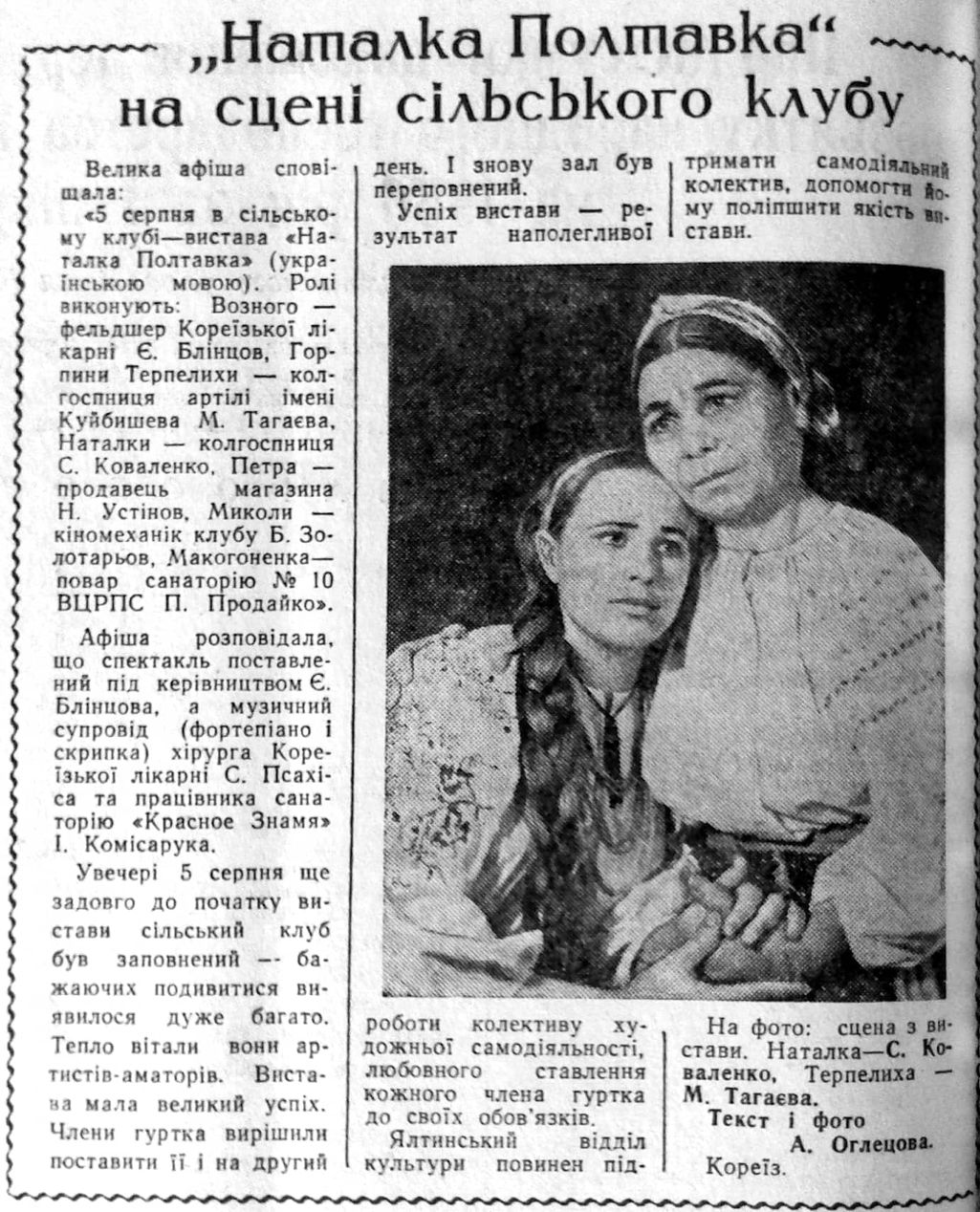
Publication in the newspaper "Radianskyi Krym", 1956
The Moscow leadership quite consciously, in the very first years after the deportation of the Crimean Tatars, set a course for the Russification of Ukrainian settlers. After all, people were resettled as entire villages, with heads of village councils, collective farms, with agronomists and teachers. And no one from the Moscow, Kyiv, or Crimean leadership raised the issue of creating Ukrainian-language schools and Ukrainian classes for the children of settlers from Ukraine in the areas of their compact settlement. The people themselves, who had survived the Stalinist Holodomor of 1932-1933, repressions during collectivization, and discrimination for being under occupation, could not, or rather were afraid to, put forward any demands to the authorities.
The settlers understood well that any resistance to the authorities, any fair demands to them, or even the display of any dissatisfaction would inevitably bring punishment, deprive them of proper assistance and benefits, and cause arrest and exile to Siberia. Therefore, during all the post-war years, not a single public dissatisfaction or disobedience of the settlers was recorded in Crimea or on mainland Ukraine. The Kremlin and Kyiv officials were well aware that they could do whatever they wanted with an ox-like patient, submissive, and silent people.
Therefore, in the post-war years, to the Crimean Oblast, subordinated to the RSFSR, tens of thousands of Ukrainian families were illegally resettled from Ukraine in a directive manner. For the preservation of their national identity, the chauvinistic Moscow and Crimean officials did not take a single step. It was this conscious indifference that would lay the foundations for future Crimean Communist-imperial separatism and the annexation of the peninsula by the Russian Federation after 60 years of its radical revival by Ukraine.
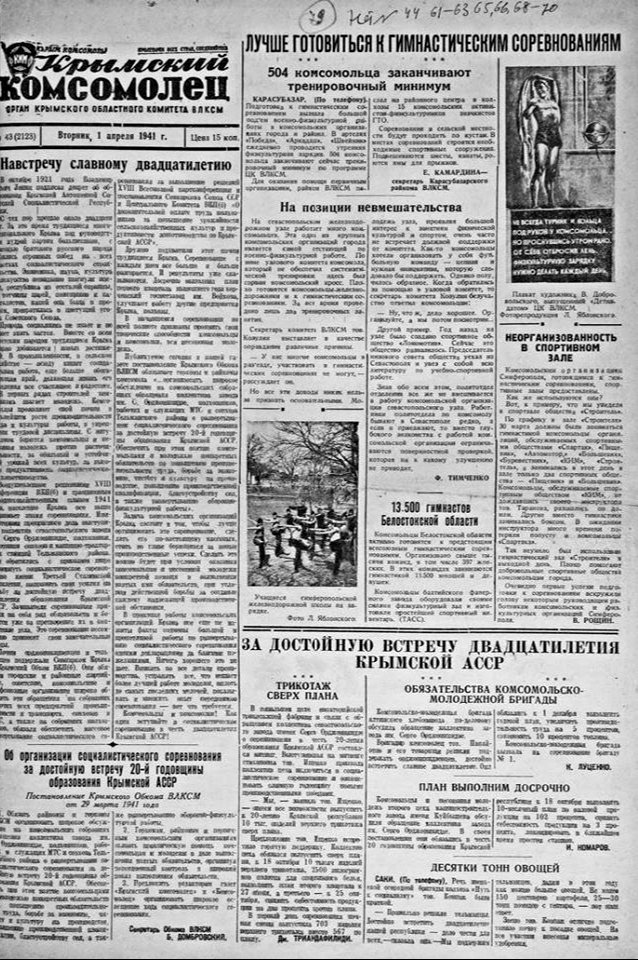
The newspaper "Krymsky Komsomolets", April 1, 1941
Shortly after the official entry of the Crimean Oblast into the Ukrainian SSR (but even before the decision of the Supreme Soviet of the USSR), in March 1954 in Simferopol, Mykola Pidhornyi, the second secretary of the Central Committee of the CPU, who spoke at the XXV Party Conference, had to answer questions primarily prepared by covert opponents of the transfer of Crimea to Ukraine. Experienced provocateurs from among the NKVD members expressed concerns about the likely Ukrainization of Crimea. Moreover, these provocateurs were deliberately selected with Ukrainian surnames. One of them, with the surname Sushchenko, expressed concern that Ukraine would introduce office work in the Ukrainian language in Crimea. There is no doubt that this question was an outright provocation.
After all, the vast majority of Crimeans were concerned about the terrible state of the Crimean economy, the completely ruined agriculture, the acute shortage of electricity, neglected roads, lack of water, and the absence of sewage systems in cities and Crimean resorts. But these problems did not interest the prepared provocateurs. For them, it was more important to sow distrust of the Crimean population towards the official Ukrainian authorities. What could a Moscow-trained, Poltava-born figure who was dependent in his decisions — Mykola Pidhornyi — answer?
He assured the delegates of the party conference that education and office work in Crimea were and would remain Russian-language. And, as an example to follow, the Russified party official himself cited the Stalino (now Donetsk) and Voroshilovgrad (now Luhansk) regions. It was at that time, according to Kremlin directives, that the Ukrainian population of the east and south began to be intensively Russified, primarily through education and the mass media.
Little Russian party officials prepared the same scenario for Crimea and Ukrainian settlers. So the foundations for the humanitarian loss of the peninsula, which caused the Russian occupation in 2014, were laid back in 1954. It was a rather successful imperial-NKVD-KGB project: to revive the neglected Crimea through the efforts of the Ukrainian people and, at the right moment, to forcibly strap it back to the imperial uniform.
However, the resettlement of a large number of Ukrainian people to Crimea in the post-war years and the harsh criticism of the national policy implemented by Kyiv officials by the foreign diaspora forced the authorities to simulate at least some activity in the national sphere. Therefore, such party documents appeared as the Decision of the Presidium of the Central Committee of the CPU No. 49 'On Providing Assistance to Party, Soviet and Economic Organizations of the Crimean Oblast' of July 6, 1954.
This order provided for an increase in the second half of the year in the supply of Ukrainian publications to Crimea, and the establishment of regular tours of Ukrainian choral and theater groups in Crimea. Ukrainian creative unions were obliged by this order to strengthen information and propaganda activities in the region. The first exception in the complete indifference of the Crimean party bureaucracy to Ukrainian issues was the resolution of the bureau of the Crimean Regional Committee of the CPU on duplicating the newspaper 'Krymsky Komsomolets' in the Ukrainian language ("Crimea under conditions of socio-political transformations (1940–2015). Collection of documents and materials." - K., Clio Publishing LLC, 2016, doc. 75, pp. 364-365).
Apparently, it was adopted under pressure or on the advice of the Kyiv leadership. As if waking up from a lethargic sleep, the Crimean authorities remembered that in the region, besides Russians, several hundred thousand resettled Ukrainian people were also concerned with the problem of rebuilding the peninsula. The vast majority of Ukrainians were not yet Russified. For more effective propaganda work, also not without the advice of Kyiv party officials, the Crimean Regional Committee requested to increase the circulation of the newspaper 'Krymsky Komsomolets' to 20,000 copies, 5,000 of which were to be published in the Ukrainian language.
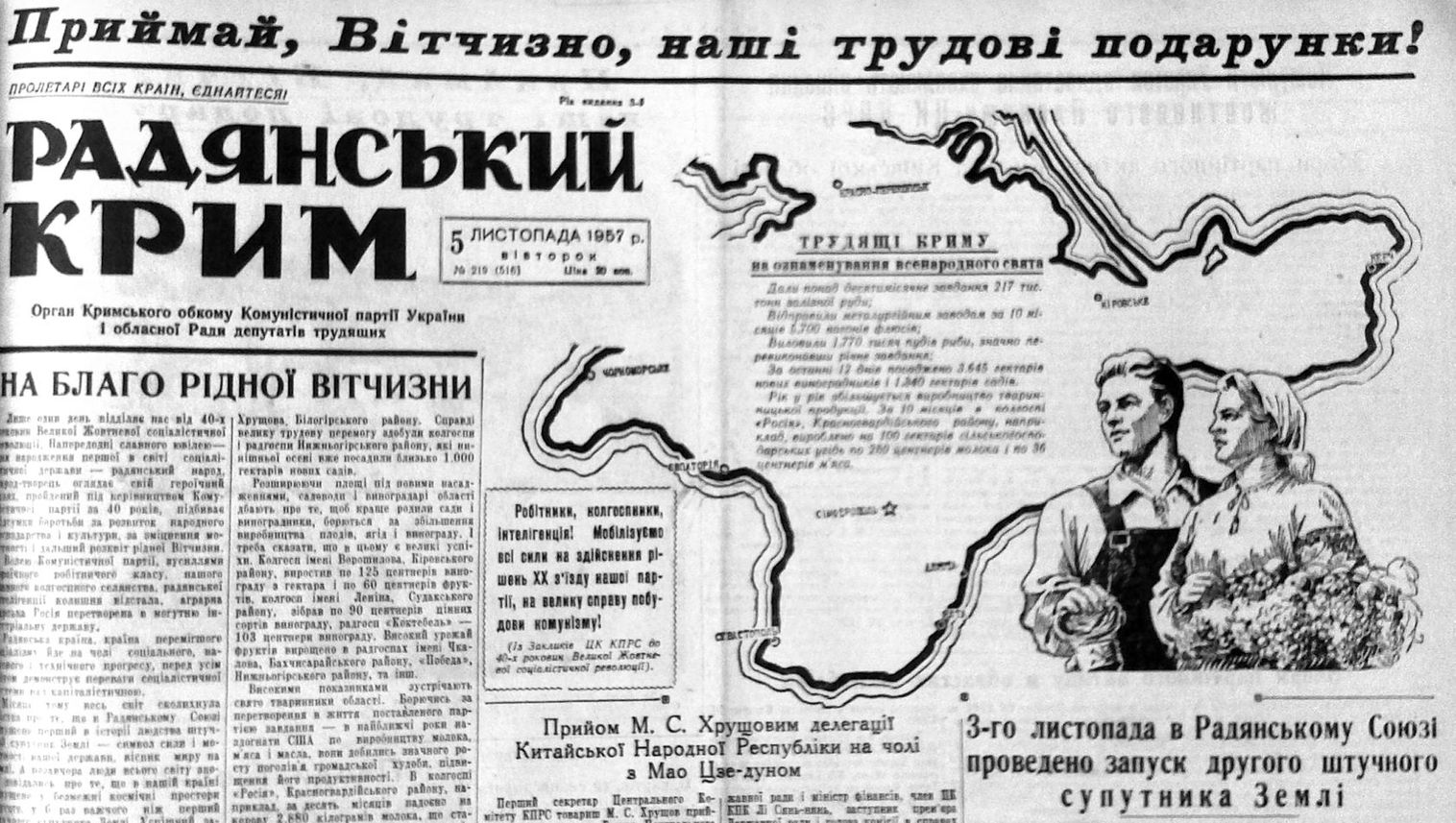
Publication in the newspaper "Radianskyi Krym", 1957
Among the huge array of party and government documents that the then leaders of the Ukrainian SSR, who were actually Kremlin vassals, adopted in the first years of the Crimean Oblast's incorporation into Ukraine, only two related to language and national policy. Almost a year and a half later (August 2, 1955) after the transfer of the Crimean Oblast to Ukraine, a meeting was held at the office of the First Deputy Chairman of the Council of Ministers, Mykhailo Hrechukha, on the study of the Ukrainian language in schools of the Crimean Oblast ("Crimea under conditions of socio-political transformations (1940–2015). Collection of documents and materials." - K., Clio Publishing LLC, 2016, doc. No. 107, pp. 482-484). It was attended by educational and government officials responsible for education.
The transcript of this meeting shows how hesitantly and timidly the officials considered the crucial national issue — the constitutional guarantee of the rights of Ukrainian citizens resettled to Crimea from mainland Ukraine to educate their children in their native language. But the very discussion of this problem shows that even at that time, in government and party circles of the republic, albeit a subject one, there were people and certain forces that tried to do at least something for the national preservation of the large mass of settlers from Ukraine. And it was the introduction of the study of the Ukrainian language and literature into the school educational program in the completely Russified Crimea that ensured, though not in full, the preservation of the national identity of the children of Ukrainian settlers.
The uncertainty of Kyiv officials regarding educational and language policy in Crimea allowed them to avoid responsibility for the decisions made and legalized the naive and outspoken supporters of the region's Ukrainization. Vasyl Komyakhov, who was transferred from the Sumy region and elected first secretary of the Crimean Regional Committee of the CPU in 1955, sincerely believed in the Ukrainization of Crimea. He replaced the chauvinistic party careerist Dmytro Poliansky in this position.
Not only the revival of the once leading sectors of the Crimean economy neglected by the Russians — horticulture, viticulture, vegetable growing, and industrial crops — is associated with the name of the new party leader, but also an attempt to give Crimea a Ukrainian face. Vasyl Komyakhov renewed the leadership in party and Soviet bodies, called on leaders to communicate with the rural population in their native Ukrainian language, cared for the development of Ukrainian-language school education and Ukrainian-language book publishing, and contributed to increasing the circulation and authority of the newly created Ukrainian-language party newspaper 'Radianskyi Krym'.
However, attention to the problems of studying Russian and Ukrainian languages in Crimean schools, which for some reason was so hypertrophied after the October bureau of the Crimean Regional Committee — which resulted from petitions and complaints of a small group of parents initiated by the Russian special services (KGB agents) — showed that the era of Ukrainization in Crimea supported by Vasyl Komyakhov had come to an end, and the situation in the humanitarian and educational sphere in the region began to gradually return to the previous post-war state.
After that, the first secretary of the regional committee, Vasyl Komyakhov, with whom serious educational work was probably carried out not only in Kyiv, but also in Moscow, no longer held plenums in the Ukrainian language and did not call on party apparatus workers to use it in party work, and no longer advised regional committee secretaries — ethnic Ukrainians — to communicate with peasants in their native language.
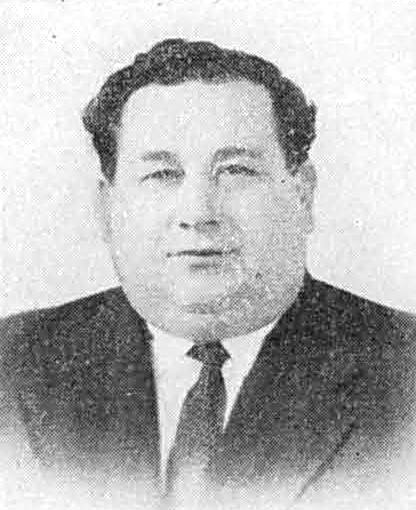
Vasyl Komyakhov
The 1959 All-Union Census in Crimea was conducted so skillfully that even in most steppe rural districts, the dominant national group turned out to be Russians. This is eloquently evidenced by the information on the national composition of rural settlements of the Crimean Oblast based on the 1959 All-Union Census (ibid., doc. No. 148). The census data made any steps by Kyiv officials and Ukrainian patriots in the local government to Ukrainize the Crimean Peninsula impossible.
Before the hundreds of thousands of Ukrainians resettled to Crimea, the Kremlin ideologists set a single and main task — to revive the economy of the peninsula and save Crimea from decline and destruction. Preserving the national identity of hundreds of thousands of settlers from Ukraine, and developing the Ukrainian language and culture was not part of these far-reaching plans of the Kremlin leaders and their Kyiv henchmen. According to their plans, Crimea was to become a testing ground for the creation of a new historical community — the 'Russian-speaking Soviet people'. And, as subsequent events showed, the Kremlin ideologists largely succeeded in implementing this task.
Vasyl Komyakhov, the father and generator of the revival of Crimean horticulture, viticulture, and winemaking, one of the organizers of the construction of the North Crimean Canal, and an active champion of irrigated agriculture on the peninsula who also cared about the development of Ukrainian education and culture, was actually squeezed out of Crimea. In 1961, he was sent to raise the Poltava region, and in June 1966, he was elected secretary of the Central Committee of the CPU. He was in charge of agriculture. In October 1966, at the age of 55, he died.
After the removal of Vasyl Komyakhov, a frantic offensive began to curtail all of his Ukraine-centric projects and initiatives. Ukrainian schools were no longer opened, Ukrainian classes were not created, Ukrainian-language publications were liquidated, the repertoire of the Ukrainian theater in Simferopol changed radically, and the rhetoric of party propagandists and teachers of Marxist-Leninist disciplines in Crimean higher education institutions also underwent changes. All socio-political life in Crimea was moving towards complete Russification.
That is why Crimea met the collapse of the totalitarian Soviet system and the proclamation of Ukraine's independence in 1991 without a single Ukrainian-language school, without Ukrainian media, with a one-hundred-percent Russian-language television and radio broadcasting, a degraded and Russified already non-Ukrainian theater, without the presence of public organizations, and most importantly — with the same Communist-chauvinistic elite. The bitter experience of many years of unsuccessful state building, both in Soviet times and in the era of Ukraine's independence, convincingly proves that a Ukrainian Crimea can only be built by Ukrainian patriotic authorities — both local and national. Therefore, after the liberation of Crimea from the Russian occupiers, the primary task of our state must be the formation of precisely such authorities on the peninsula and a fundamental change in the strategy of national and cultural policy.