Dehydrated Crimean Decade
The problem of acute water shortage in the Crimean Peninsula.
Petro Volvach, Full Member of the Shevchenko Scientific Society (NTSh), member of the National Writers' Union of Ukraine (NSPU), Honored Scientist and Engineer of the Autonomous Republic of Crimea, a Crimean resident of 60 years. "Krymska Svitlytsia" newspaper, 2017, issues No. 18 – 20
In highly arid Crimea, all ethnic groups that have inhabited the peninsula for millennia have always valued water. After all, it was the main prerequisite for life and successful economic activity of hundreds of generations of diverse Crimean people — from Cimmerians, Tauri, Scythians, Greeks, Romans, Goths, Rusychs (proto-Ukrainians), Karaimes, Krymchaks, to Crimean Tatars and Turks.
In a region where in most natural and climatic zones the annual precipitation does not exceed 300–400 mm, people have long learned to frugally use God's greatest gift — water — and to treat it with care. Therefore, not only rivers and small streams, but even tiny springs and source-heads were considered sacred and were always carefully tended and protected.
The engineering and hydro-reclamation art of water supply created by our predecessors for the peninsula's city-states, cave towns, and hand-built fortresses remains insufficiently studied and fully comprehended by contemporaries.
Also noteworthy is the undeniable fact that, despite the fairly high population density of the region, over millennia no global humanitarian catastrophe related to drought and lack of water for economic activity has been recorded on the peninsula.
In the last few centuries, the most devastating events were the annexation of Crimea by the Russian Empire in 1783, the Crimean War of 1853–1856, the Bolshevik and White Guard terror of 1917–1921, and the Second World War of 1941–1945. For Crimea, it began in 1941 and ended at the end of 1943.
Despite the fact that the population in post-war Crimea was halved as a result of the war and deportations, people and farms suffered from an acute shortage of water. In cities and most regional centers, the water supply network was destroyed, damaged, and required repair or replacement. Most of the rural population used water from hand-dug wells. The quality of water accumulated in them from shallow aquifers was low. Furthermore, during dry seasons, surface waters always disappeared.
For irrigation, river water or water accumulated in small ponds was used. Only in some Crimean cities were wells preserved and operating. However, they were unable to satisfy the water needs of both the population and the recovering industrial enterprises and construction organizations. So it is not surprising that the problem of water supply proved to be one of the most acute in post-war Crimea.
Back in 1949, the Soviet Government and the Central Committee of the party adopted a resolution "On solving the water supply problem in Crimea." It envisaged the creation of a whole series of reservoirs on all Crimean rivers and the drilling of several thousand deep wells. However, the construction volumes determined by the resolution were not met year after year.
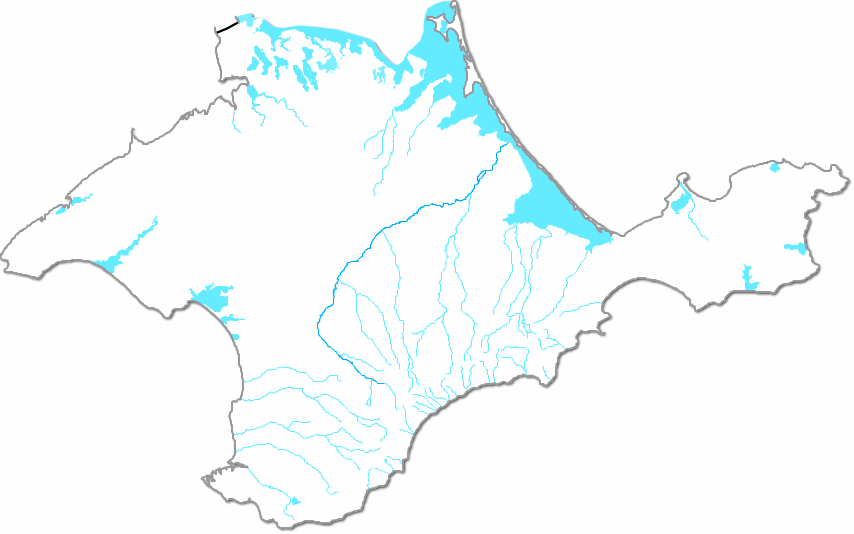
Map of water resources of Crimea
A rather bleak picture of the region's water supply and the state of the water sector emerges from the transcript of a meeting chaired by P. Neporozhnyi, Deputy Chairman of the Council of Ministers of the Ukrainian SSR, on April 23, 1955, which reviewed the master plan of Simferopol (TsDAVO of Ukraine. – F. – 4906. – Op. – 1. – Spr. 250. – Ark. 119-121).
The participants of the meeting closely linked the prospects of the city's development as a regional center (at that time, the city had about 140,000 residents) to the problem of its water supply. The daily water requirement of a city with this population was 42,000 m³ per day. Meanwhile, the city reservoir — the only water source for the city — was only capable of providing 26,000 m³, thus covering only 50–60% of its daily need. The city had water reserves for only 14 days.
The transcript of the meeting recorded the terrible water supply heritage of the regional center, which Ukraine inherited from the previous Russian government: "The Chervona Hirka area with its large population is not supplied with water. The residents use water from shaft wells. The water in them is almost unfit for drinking. In summer, the wells dry up. There is also no water in the Sergiivka area. The Ukrainka area is also waterless."
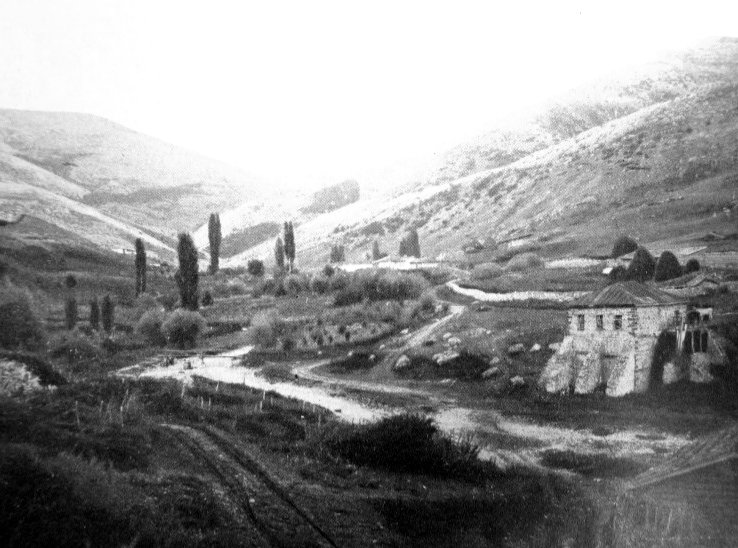
Ayan Spring
Due to the unsatisfactory water supply of the regional center and the almost non-existent sewage system in the city, Ukrainian urban planning experts proposed to limit its further population growth, capping its population at 150,000–170,000. However, this faced opposition from Communist Party officials who intended to Russify it by providing housing to retired military personnel from across the Soviet Union.
The task was set to raise the dam at the Ayan Reservoir. This would significantly increase its water capacity. Great hopes for improving Simferopol's water supply were pinned on the Simferopol Reservoir, the construction of which Ukraine significantly accelerated after Crimea was subordinated to the republic. The Deputy Chairman of the republican government himself proposed to make the Simferopol Reservoir fully regulated and spoke in favor of introducing a specific water allowance per person. Looking forward, the experienced administrator also suggested using Dnieper water from the North Crimean Canal for the city's water supply, construction of which had not yet begun in Crimea.
The experienced specialist advised regional and city leaders to focus on developing municipal infrastructure, primarily greening, urban improvement, and building a high-quality sewage system. As an experienced urban planner, he noted that most cities always become cleaner after spring downpours. Simferopol, however, is constantly flooded even after minor rains; in some years, more than 700 houses were flooded. Since the city is situated in a depression, all the water from the surrounding areas drains into its center. The city becomes covered with a layer of silt up to 35 cm thick. Russian historians and local researchers prefer not to mention this nearly two-hundred-year-old disgrace, and degraded Russian jingoists remain bashfully silent.
The situation with fecal sewage was even more dreadful. Lest I be accused of a biased assessment, let us refer to the official document, the transcript of the aforementioned government meeting: "As for fecal sewage, only 5% of households in the city have it. The biological treatment station is able to receive and dispose of only 25% of wastewater, while 75% — 9,000 m³ of feces — is dumped into the Salhyr River. In summer, the river dries up and turns into a stinking cesspool." Already in the first year of Crimea's transfer to Ukraine, a relief sewer was built in the regional center. It helped prevent flooding in the central part of the city.
The transcript further notes that: "The city roads are in an extremely neglected state, with only 16% of them paved. All the rest are, in fact, worse than dirt tracks. It is urgent to pave at least the main thoroughfares so that children can at least walk to school and adults can get to work."
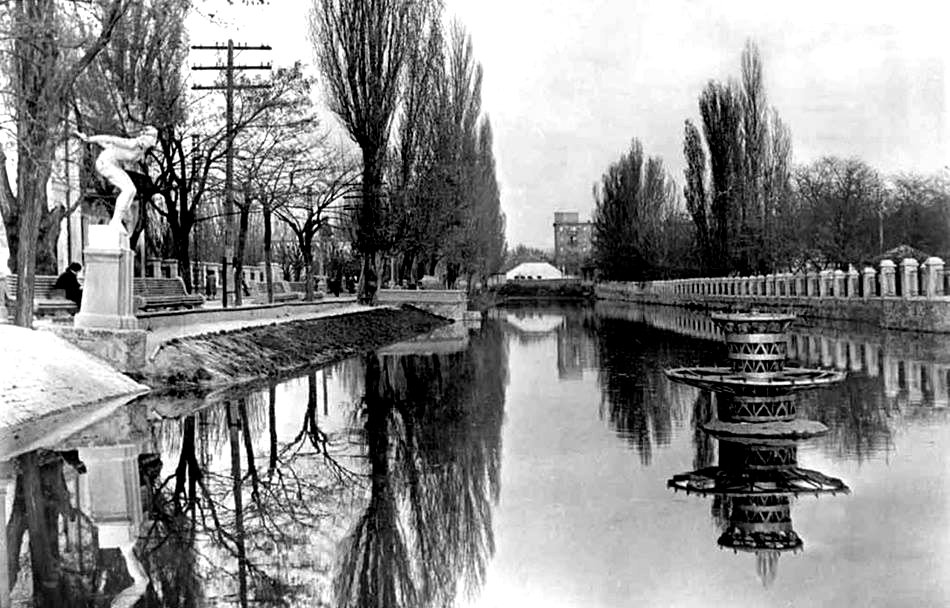
The Salhyr River in Simferopol
The situation with electric street lighting was no better. As of the beginning of 1953, 42 streets in Simferopol had no lighting. A highly authoritative commission, chaired by Neporozhnyi, Deputy Chairman of the Council of Ministers of the Ukrainian SSR, discussed regional planning projects for the Southern Coast of Crimea on April 20, 1953. The project's economist, H. Kaplin, noted that the health resort complex located on the Southern Coast, which comprised 111 institutions and had a capacity of nearly 16,500 beds, suffered annually from a major water shortage, particularly in the summer. A large number of relatively small sewage systems present in this region discharged their waste directly into the sea and polluted the beaches.
The water supply from the drinking water network amounted to 37,500 m³ per day. Irrigation consumed 7,500 m³. Water consumption for drinking and household needs was projected to increase to 29 million m³, and for irrigation to 18 million m³. Even taking local sources into account, there would still be a deficit of 12 million m³ for the water supply of the existing health resort facilities on the Southern Coast and land irrigation. These were planned to be sourced from the reservoirs: Chornorichensky — 4.6 million m³ and Alminsky — 7.3 million m³. However, construction of the first stage on the Chorna River
was not yet completed at that time. The Alminsky Reservoir was scheduled for construction only several years later. The issue of power supply for the Southern Coast was also unresolved. For this, "Krymenergo" was to build two substations with a voltage of 111 kW in Yalta and Alupka, and two substations with a voltage of 35 kW in Gurzuf and Alushta. The meeting also raised the issue of constructing a sewage system on the Southern Coast. The authorities had failed to solve it either in the pre-war period or during the first post-war decade. This problem was shifted to Ukraine's shoulders.
One of the co-authors of the Southern Coast water supply project, S. Hrybov, emphasized that water supply to this region was quite problematic and complex. Local water supply systems consisted of facilities that were mostly of natural origin. Municipal water pipelines existed only in the cities of Yalta, Alushta, and Alupka. All the rest were local, departmental ones. To supply already existing facilities, all functioning sources were used. However, not all of them were in satisfactory condition, and they required thorough reconstruction.
Furthermore, local water sources were distributed unevenly along the Southern Coast. Most of them were in the Alushta district (33% of all existing sources). The Yalta district accounted for only 14% of all water resources. All other districts were so poor in natural water sources that they periodically suffered from shortages.
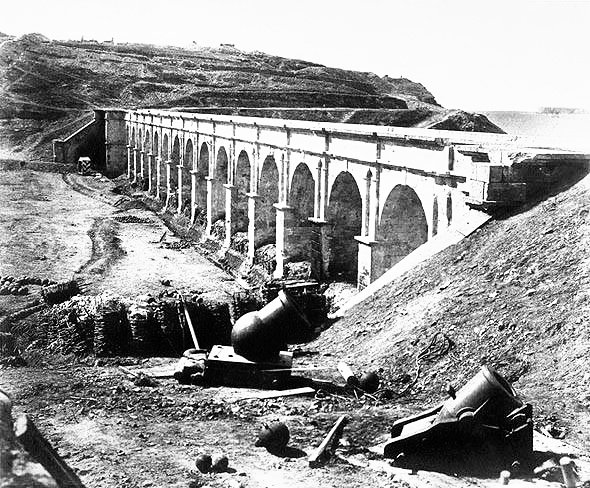
Aqueduct in Apollonova Gully
No less acute was the water supply problem in the historically waterless steppe and eastern Crimea. The entire Kerch Peninsula, especially the city of Kerch and adjacent Feodosia, suffered from frequent deficits of not only drinking but also industrial water. A rather strange and, as it seems now, extremely belated resolution of the Council of Ministers of the USSR No. 140 of January 26, 1954, "On the development of agriculture in the Crimean region and the supply of water to the cities of Kerch and Feodosia, as well as the industrial enterprises of these cities" was adopted (literally just a few weeks before the transfer of the Crimean region to Ukraine).
What the Russian Federation failed to accomplish in ten post-war years, Moscow, with the dexterity of a card shark, shifted onto Ukraine's shoulders. In response to this insidious Moscow decree, on March 15, 1954, the Ukrainian government issued a lightning-fast resolution No. 38 "On the Construction of the North Crimean Canal."
It was precisely because of this that at the meeting convened later on the water supply of the Southern Coast, the steppe and eastern Crimea were not discussed. It should be noted that in southern Ukraine and in the Zaporizhzhia and Kherson regions, work on the construction of the North Crimean Canal had already begun in the early 1950s.
The participants of the meeting also highlighted several other acute problems, not only on the Southern Coast but throughout Crimea — the lack of treatment and biological disposal of solid sewage components and the disorder of landfills. The meeting also emphasized that even where a system of discharging sewage into seawater existed, it was not pre-cleared of solid residues and was not disinfected. No deep-water sewage outfalls located far from the shore existed on the Southern Coast at all.
The sanitary and epidemiological service constantly reported unacceptable pollution of seawater not only in the waters of the Yalta seaport, but along the entire coast. All participants of this important and representative meeting, perhaps the first in the entire post-war period, were unanimous in their assessment of the critical situation with the water supply and the neglect of the water sector along the entire Southern Coast of Crimea. Therefore, the implementation of the task set by the Central Committee of the Communist Party of Ukraine and personally by the First Secretary of the Central Committee of the CPSU, Nikita Khrushchev, to transform this region into an all-Union health resort and sanitary-resort zone was directly linked to the water supply of the Southern Coast.
Undoubtedly, this issue could not be resolved solely by using local water resources, or even by involving the already existing first stage of the Chornorichensky Reservoir near Sevastopol. Indeed, at that time, it did not fully meet the water needs of even the not-yet-rebuilt Sevastopol. Meanwhile, the militarized city was developing rapidly.
The glaringly hopeless, catastrophic state of the city's entire utility service and its sanitary-epidemiological neglect attract attention. The chairman of the city executive committee reported to the Ukrainian government that, in implementation of a special government decree, during April–June 1955, they finally began to put the city in sanitary order. How poorly managed must the "city of Russian glory" have been, that it took instructions from the "Kyiv uncle" (a favorite term of Crimean separatists) to start cleaning up their own home.
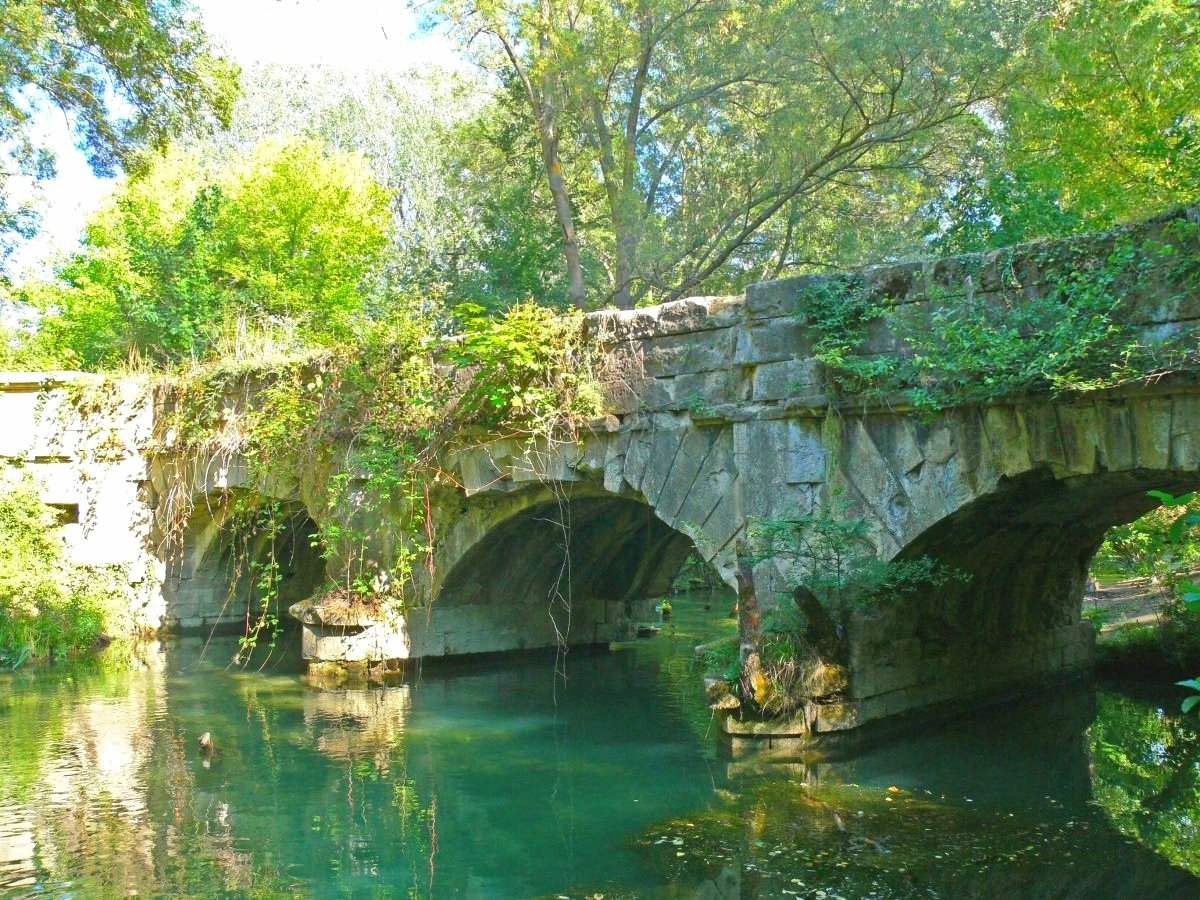
Chorgun Aqueduct
The scale of Sevastopol's littering over the ten post-war years is eloquently demonstrated by the volume of garbage and sewage removed from the city in three months of 1955, which amounted to 32,600 m³. Ukraine provided the city with several garbage trucks, and large enterprises and construction organizations were tasked with garbage removal: the Ordzhonikidze Plant, Trusts No. 38 and "Sevastopolmiskbud," and the KEO (Communal Operations Department) of the Black Sea Fleet.
From the report of the chairman of the city executive committee, it becomes clear that in Sevastopol, during the 10 post-war years, a city sewage station had still not been built. The head of the city's executive authority proudly reported to the Ukrainian government that by mid-summer 1955, the city was finally cleared of the garbage and sewage accumulated over the winter, and unauthorized landfills had been liquidated. As it turns out, in the song-praised "city of Russian glory" and "legendary Sevastopol," before Crimea joined Ukraine, there was a shortage of replaceable trash bins.
Thus, after the intervention of the "Kyiv uncles" in May 1955, 286 replaceable waste bins were installed during the summer. By the end of the year, the city authorities promised to manufacture another 500 such works of "architecture." Following the government decree, 480 garbage boxes were built and repaired. They also promised to open 75 public toilets. It turns out that for all ten post-war years, the heroic Sevastopol residents had gotten by without them.
It turns out that sewage infrastructure in the city was practically non-existent. From the report of the mayor, Mr. Sosnytskyi, it becomes clear that a residential area of the city with a population of 15,000 was still not provided with sewage services ten years after the war. Only in May 1955 was a 7 km sewer network commissioned from the pumping station located at Korabelna Bay. By August of the same year, the second stage of the sewer system was planned to be commissioned there. The sewage system in Inkerman was also put into operation shortly after Crimea was subordinated to Ukraine. Meanwhile, the so-called "Northern Side" (Severnaya Storona) had no sewage network at all. The previous administration planned to complete the technical documentation for it only in 1958.
Consequently, in Sevastopol, with its nearly 150,000-strong population, industrial facilities, and powerful Black Sea Fleet, the problem of restoring and disposing of sewage had to be solved by Ukraine in the first years after the Crimean region was subordinated to our republic.
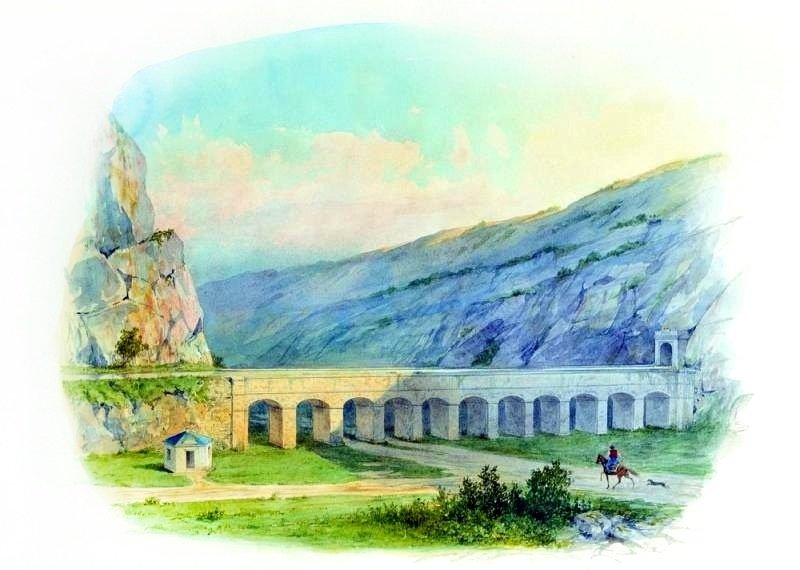
Aqueduct in Inkerman. Lev Lagorio, 1850, watercolor