Crimea as a Part of the Ukrainian State. Year 1918
During 1917–1921, Crimea found itself at the epicenter of revolutionary battles and interventions. The newly created Ukrainian government cautiously and gradually built ambitious plans to unite the Crimean Peninsula with Ukraine.
During 1917–1921, Crimea found itself at the epicenter of revolutionary battles and interventions. The newly created Ukrainian government cautiously and gradually built ambitious plans to unite the Crimean Peninsula with Ukraine.
Despite the fact that according to the Third Universal of the Central Rada, Crimea did not belong to the Ukrainian People's Republic, and contrary to rather unfavorable military and political circumstances, established contacts with representatives of the Crimean Tatar national movement still gave the UPR leadership reason to count on the peninsula joining the Ukrainian state.
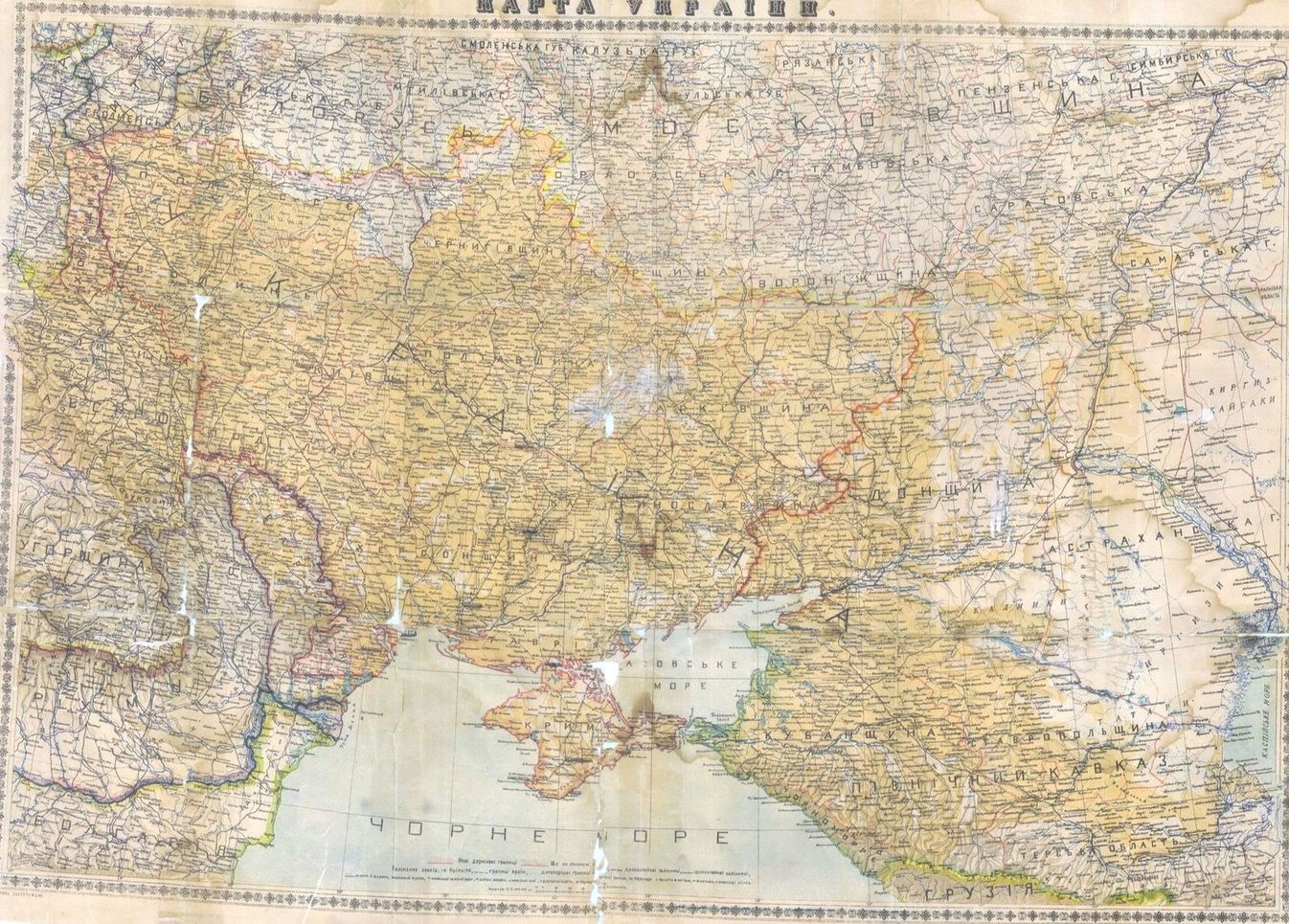
State Archives of Lviv Oblast, Map of Ukraine, published in Vienna in 1918.
For a long time, documents from the period of the Ukrainian Revolution (1917–1921) were classified. The access restriction was lifted in the 1990s after the declaration of Ukraine's Independence. The Central State Archives of Supreme Authorities and Administration of Ukraine have preserved the administrative documents from the early 20th century. This includes recorded decisions regarding the jurisdiction of the Crimean Peninsula. According to the meeting log of the Council of People's Ministers of the UPR (dated February 14th, 1918), it was determined that "Crimea remains under the influence of Ukraine," and "the entire fleet (including the merchant fleet) in the Black Sea belongs only to Ukraine."
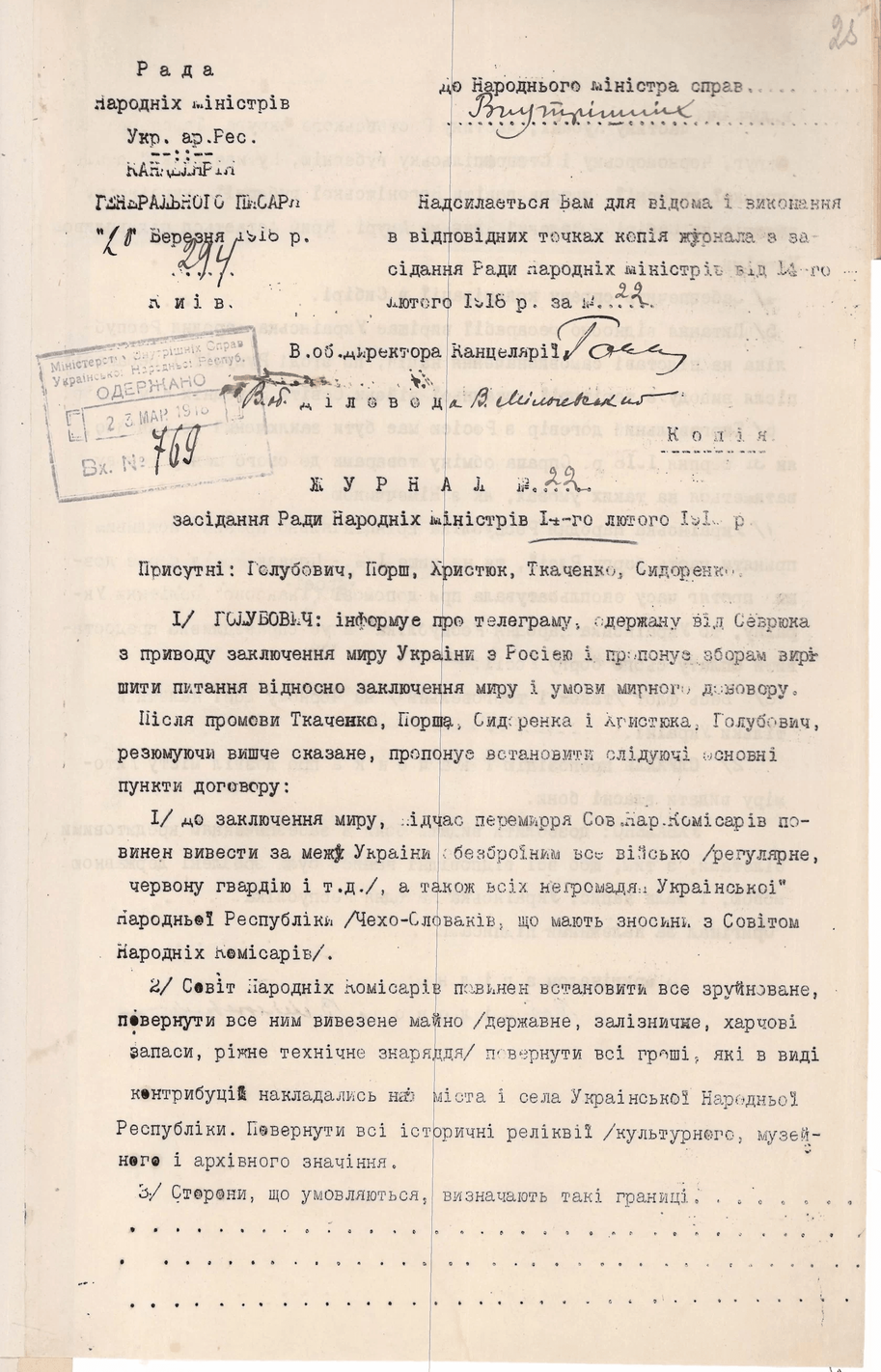
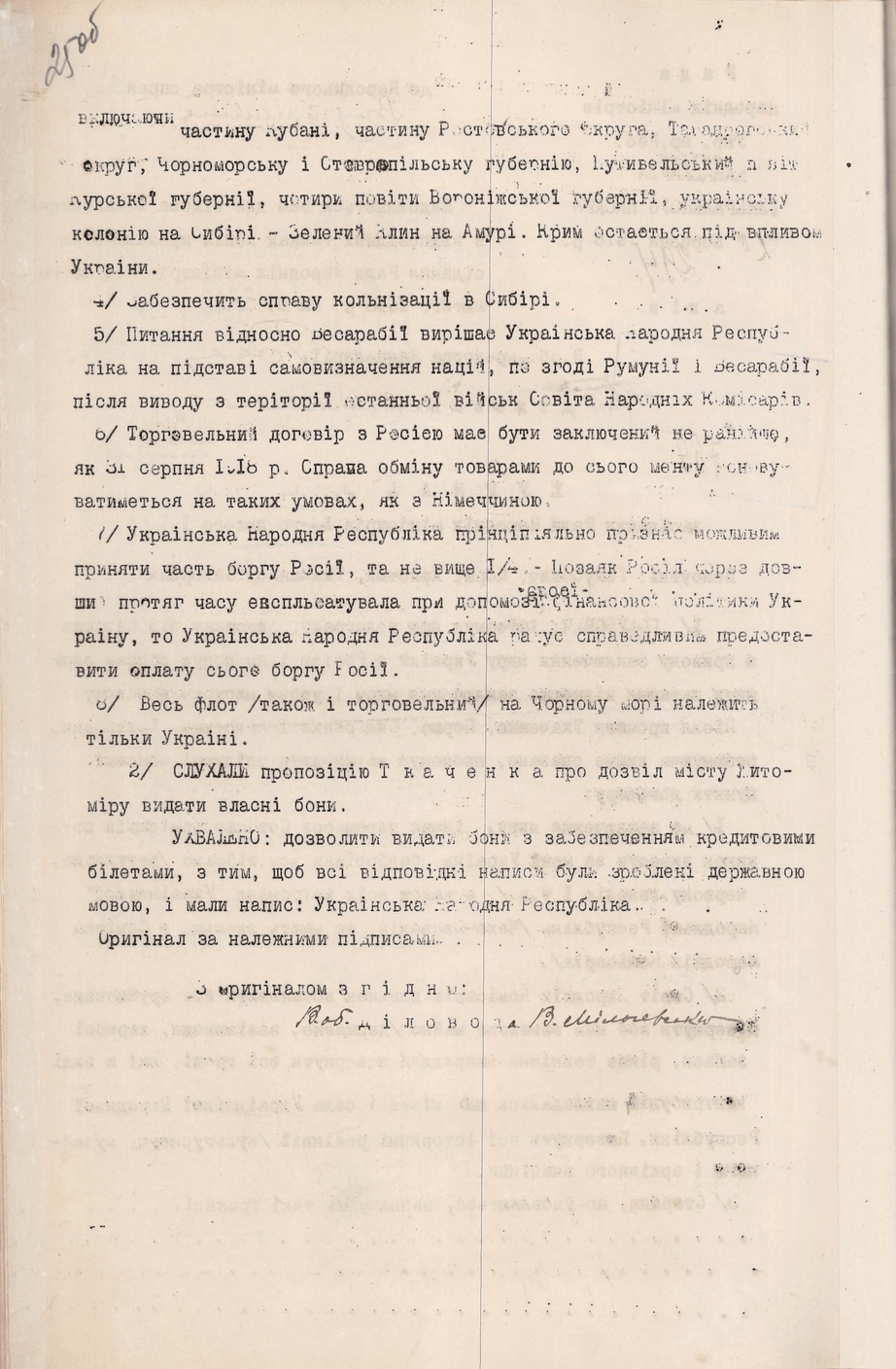
From the meeting log of the Council of People's Ministers of the Ukrainian People's Republic on the ownership of the entire fleet in the Black Sea by Ukraine. February 14th, 1918. Certified copy. TsDAVO of Ukraine. F. 1064. Op. 1. File 5. Sheets 25, 25obv.
The Crimean Peninsula has always been a strategically advantageous foothold. In the early 20th century, the Black Sea Fleet held about 400 warships, as well as auxiliary vessels. The Bolsheviks and other representatives of opposing forces constantly sought to strengthen their positions on the peninsula. In April 1918, the hold on Crimea slipped from the hands of the Bolsheviks. The Zaporizhian Corps of the UPR Army, under the command of Colonel Petro Bolbochan, forced them to retreat from the peninsula. The set goal of establishing Ukrainian authority on its territory and control over the Black Sea Fleet was achieved.
April 22nd, 1918, was forever engraved in the annals of Ukrainian history. And in 2018, Ukraine celebrated 100 years since the liberation of Crimea from the Bolsheviks.
At the time of liberation, Ukrainian troops were greeted enthusiastically by Crimean Tatar cavalry detachments. Since the struggle for Crimea in the spring of 1918 took place under a simultaneous offensive by German and Ukrainian troops against the Bolsheviks, the Germans obviously saw Ukrainians as a serious competitor.
With the actively forming volunteer detachments that sympathized with the Ukrainian military, Colonel Petro Bolbochan planned to organise them into a regular unit. However, the Chairman of the Central Rada Mykhailo Hrushevsky, and Prime Minister of the UPR government Vsevolod Holubovych, did not risk open confrontation with Germany, and agreed to order the Ukrainian army to leave Crimea.
During Petro Bolbochan's detachment retreat from the peninsula, a coup d'état occurred in Kyiv, and Hetman Pavlo Skoropadsky came to power with German support. The first real attempt to legally secure Crimea for Ukraine was done under this Hetmanate. According to Pavlo Skoropadsky, "a part of the population of Crimea sincerely expressed a desire for the closest connection with Ukraine, believing that any other option would be ruinous for both Crimea and us."
In the meeting log of the Council of Ministers of the Ukrainian State dated May 7th, 1918, the question of the necessity of annexing Crimea is raised: "To recognize the initial border outlined on the map presented by the Minister of War, corresponding with the ethnographic conditions, while paying special attention to the necessity of annexing Crimea to Ukraine. Having heard the statements of the Lord Hetman about his negotiations with the German Ambassador and his intention to send the German Ambassador a letter in his own name confirming the necessity of annexing Crimea to Ukraine – to approve the sending of such a letter so that additional data on this subject, upon approval by the Council of Ministers, be communicated by the Minister of Foreign Affairs to the German Government."
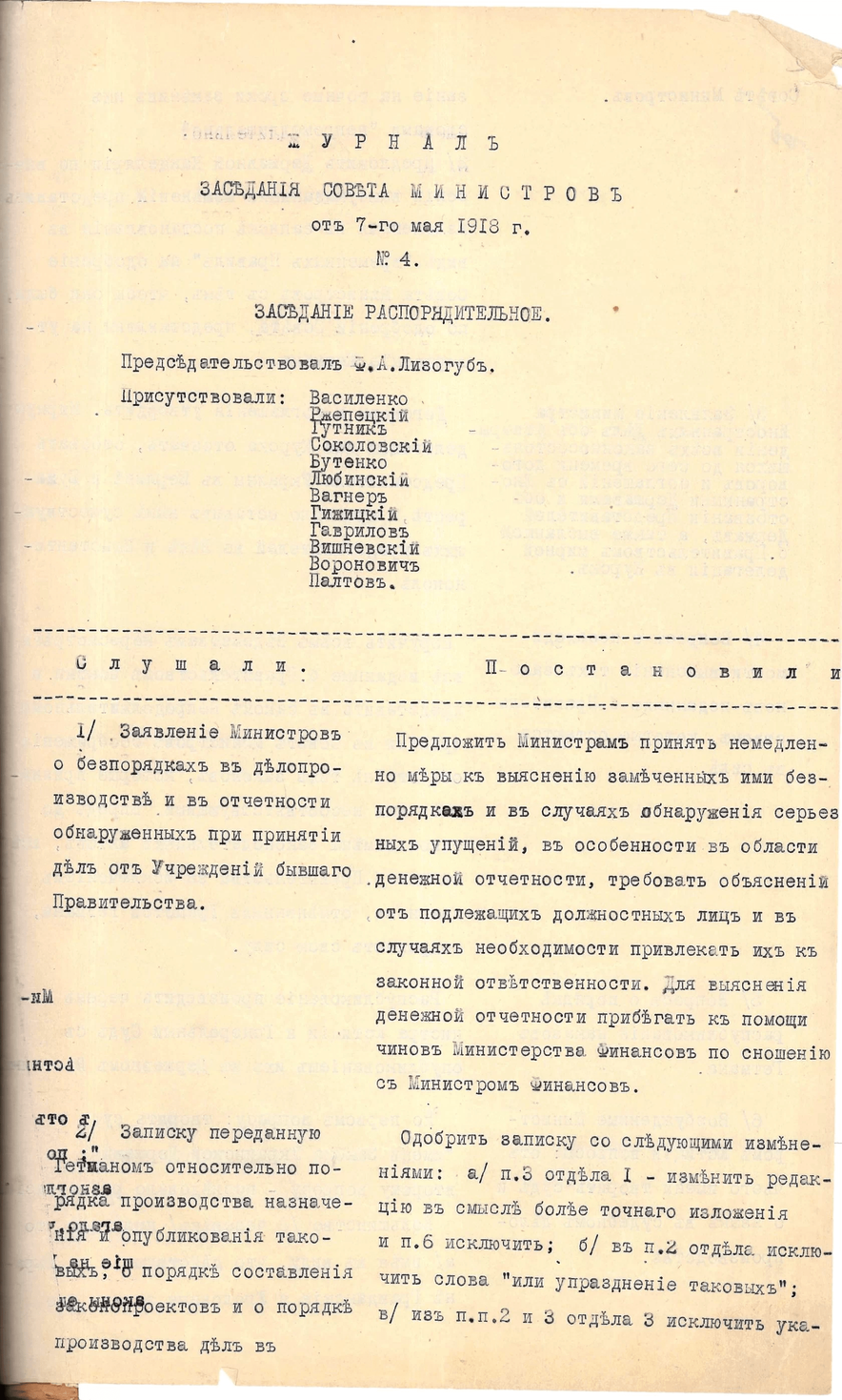
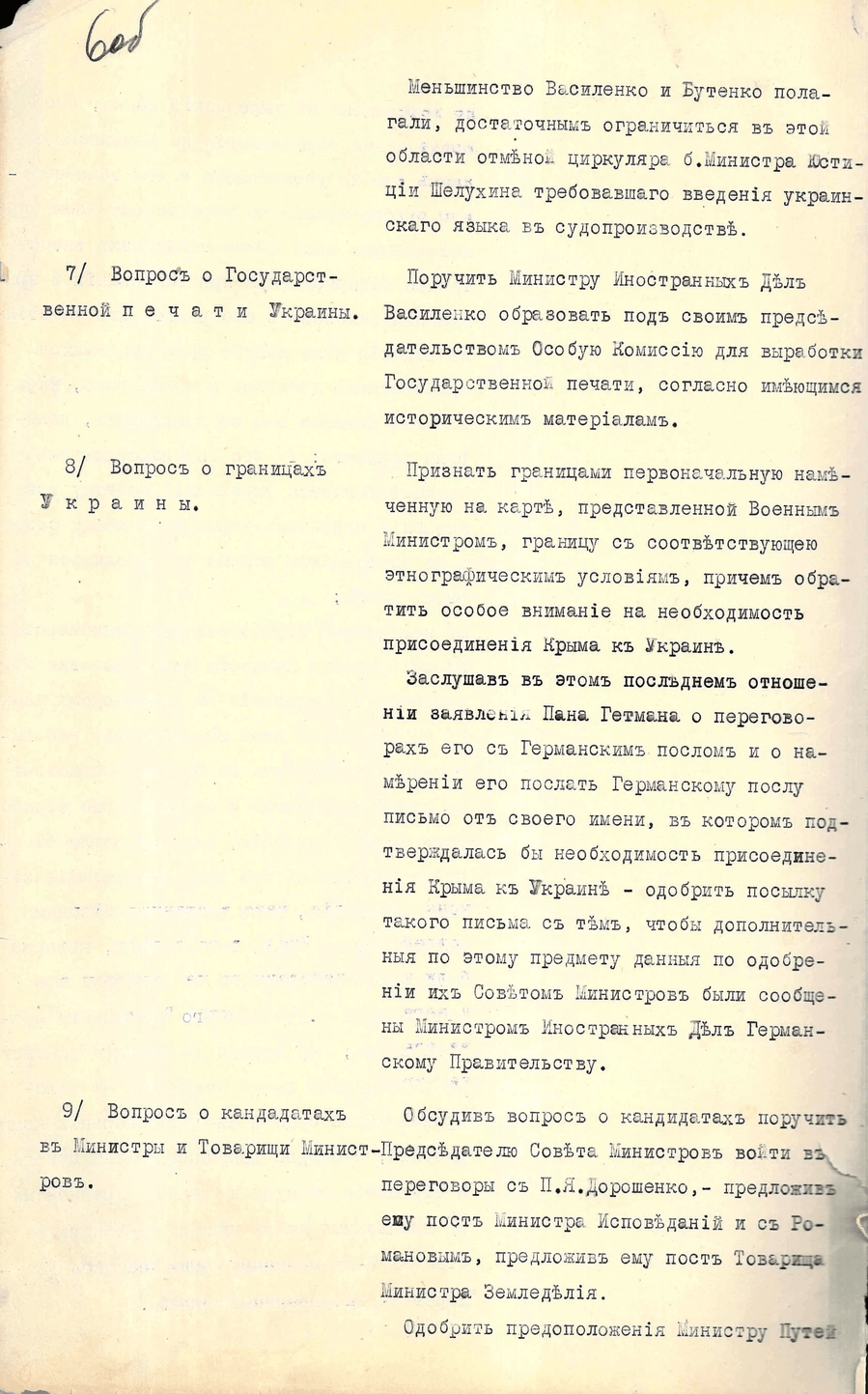
From the log of the meeting of the Council of Ministers of the Ukrainian State on the necessity of annexing Crimea to Ukraine (item 8). May 7, 1918. Copy. TsDAVO of Ukraine. F. 1064. Op. 1. File 6. Sheets 5, 6obv.
On June 5th, 1918, the German occupation command delegated governing authority on the Crimean Peninsula to Suleyman Sulkevych. Sulkevych's government began negotiations with Kyiv in September 1918, and as early as October, a preliminary agreement was reached. This agreement allowed for Crimea's accession to the Ukrainian State as an autonomy with its own parliament, government, and armed formations. A permanent state secretary from Crimea was to become a member of the Ukrainian government. From the meeting log of the Council of Ministers of the Ukrainian State on ending the customs war with Crimea to conduct negotiations on Crimea's accession to Ukraine (item 7).
September 18th, 1918: "Having learned of the decision of the representatives of Crimea to enter into negotiations with the Ukrainian Government regarding the conditions of merging Crimea with Ukraine, and in view of the difficult situation of the population of Crimea, who are unable to sell their harvest of fruit and grapes under a customs war, with the permission of the LORD HETMAN, resolved: 1. To temporarily suspend the customs war on condition of the immediate dispatch of authorized individuals to Kyiv to open the aforementioned negotiations by the representatives of Crimea"; 2. To request the Minister of Finance to lift the customs inspection of goods heading to Crimea from Kyiv; 3. Negotiations with the representatives of Crimea upon their arrival in Kyiv regarding the conditions of merging Crimea with Ukraine are to be conducted directly by the ministers of the interested departments, without delegating their powers to other persons."
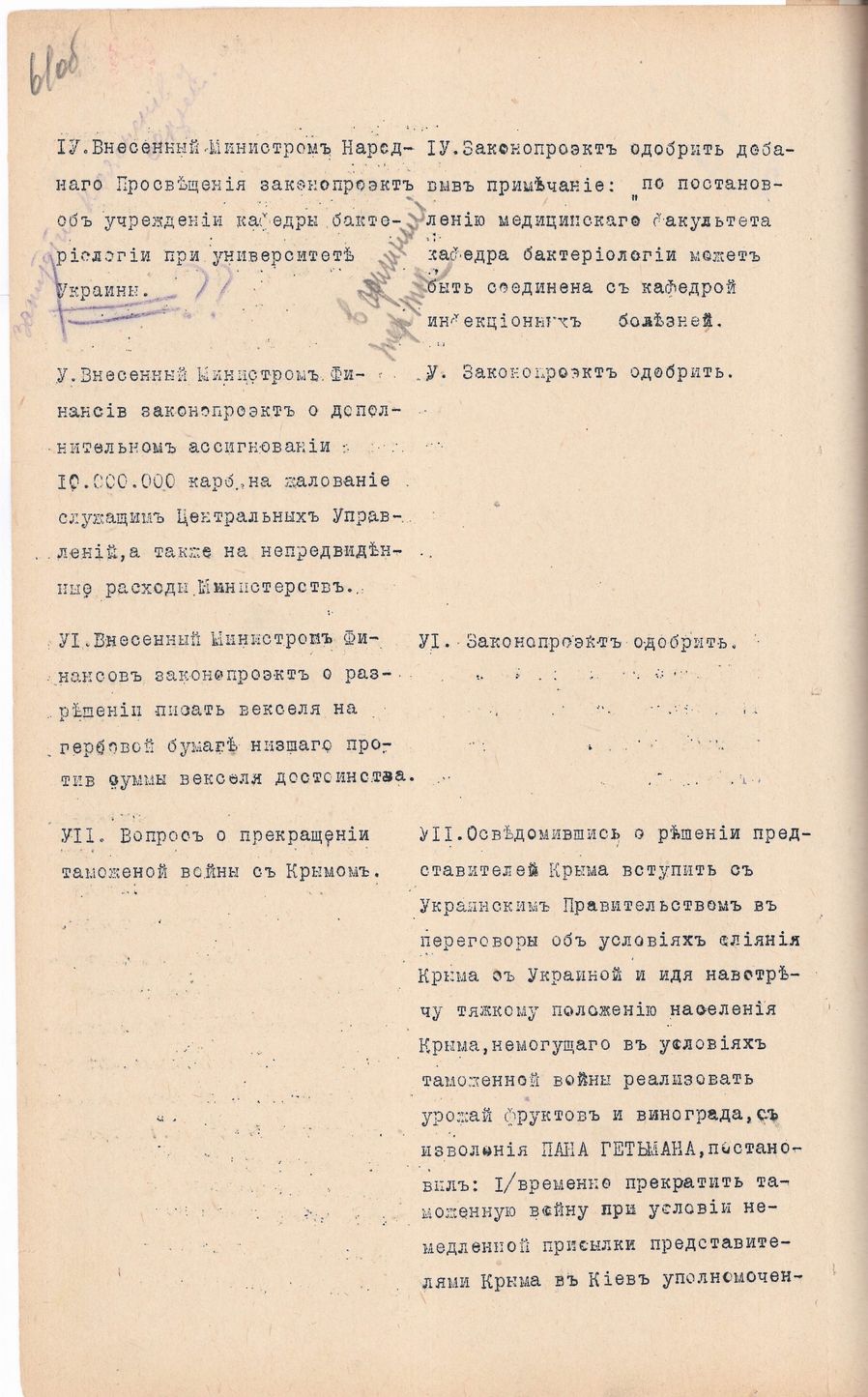
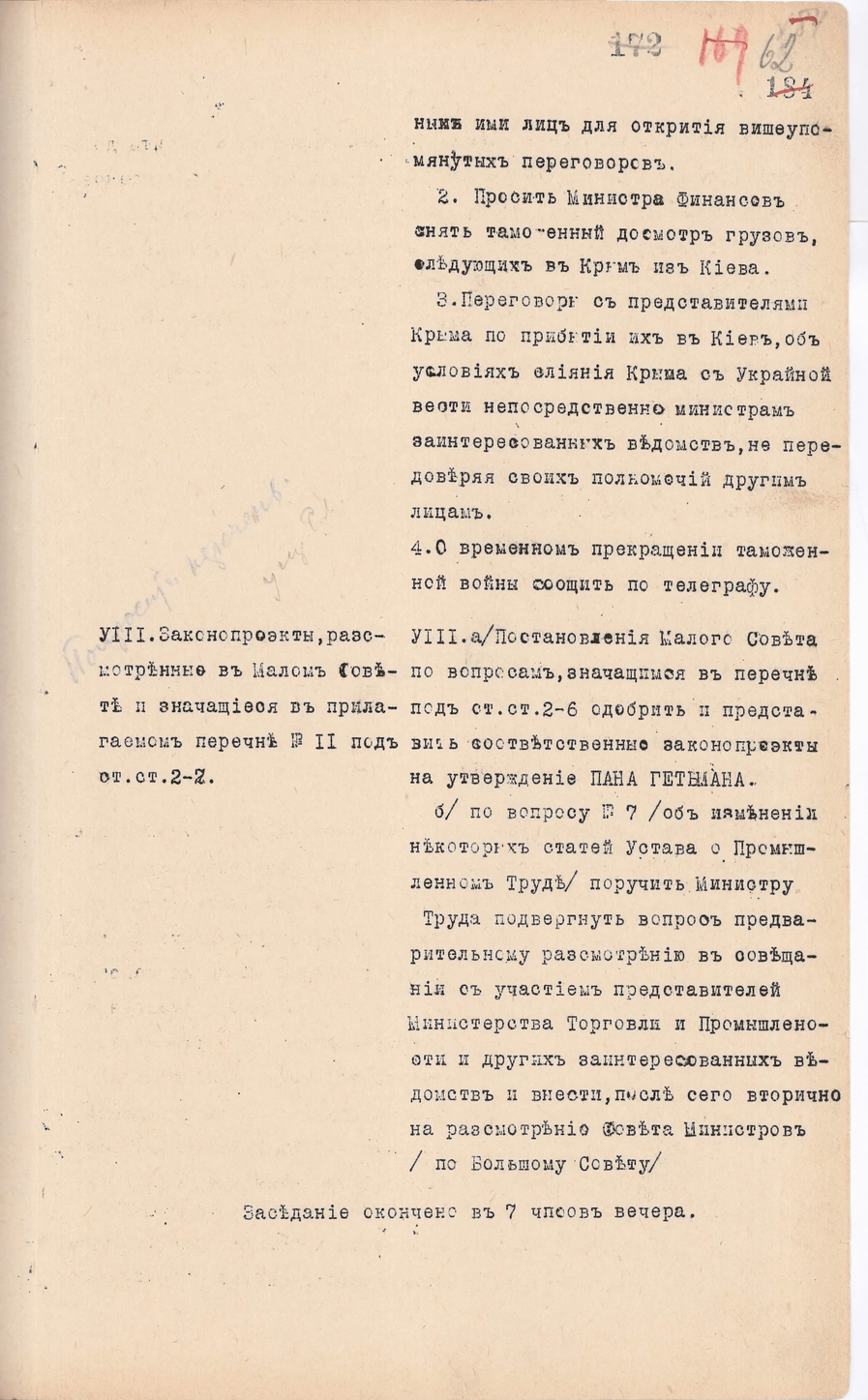
From the meeting log of the Council of Ministers of the Ukrainian State regarding ending the customs war with Crimea to conduct negotiations on Crimea's accession to Ukraine (item 7). September 18th, 1918. Certified copy. TsDAVO of Ukraine. F. 1064. Op. 1. File 11. Sheets 61, 61obv., 62
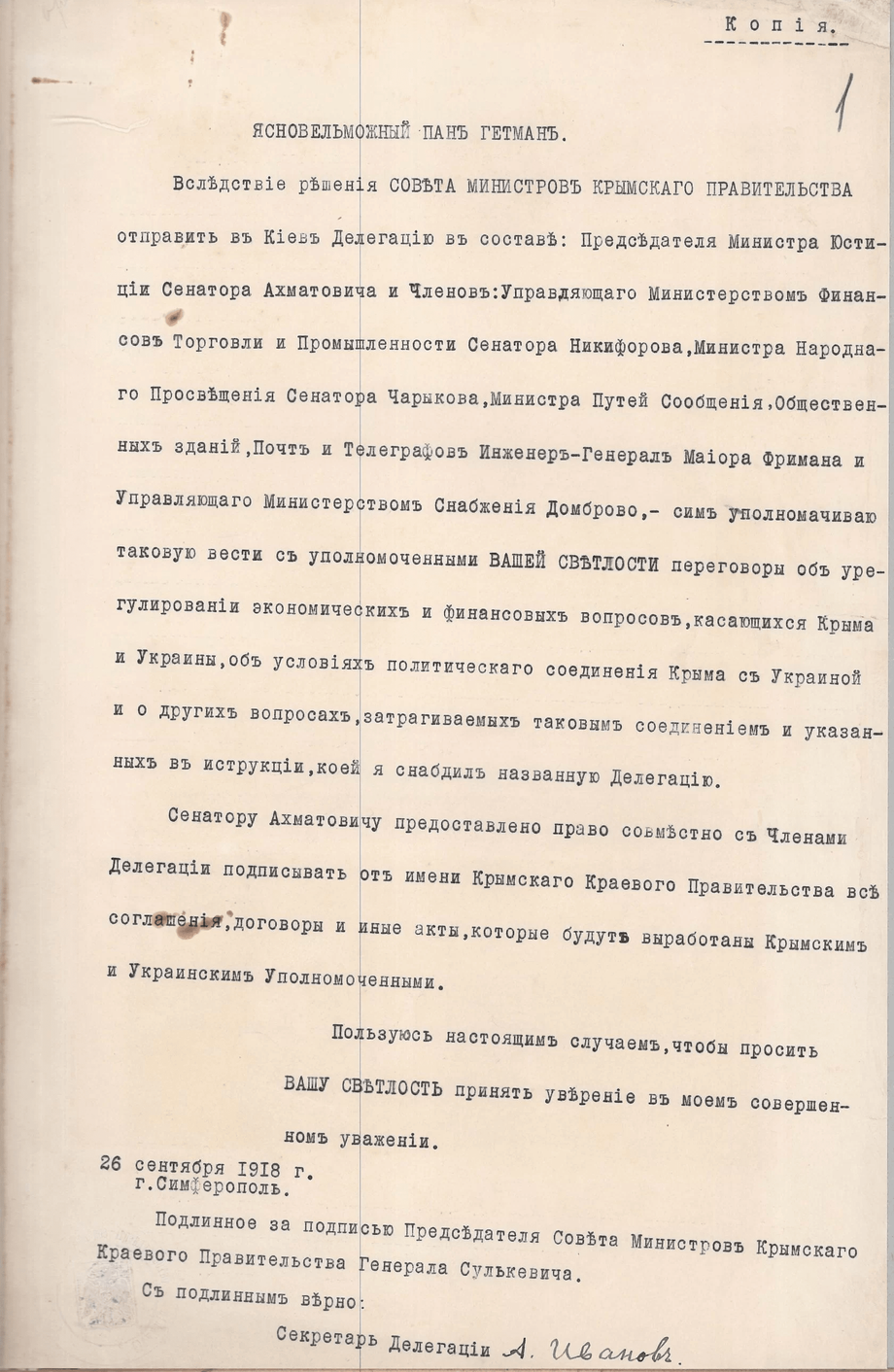
Letter of authorization from the Chairman of the Council of Ministers of the Crimean Regional Government, S. Sulkevych, to the Hetman of All Ukraine, P. Skoropadsky, regarding the sending of a delegation to Kyiv for negotiations on settling economic and financial issues and the conditions of the political unification of Crimea with Ukraine. September 26th, 1918. Certified copy. TsDAVO of Ukraine. F. 3696. Op. 2. File 703. Sheet 1
According to Protocol [No. 2] of the meeting of the Chairman of the Council of Ministers of the Ukrainian State, F. Lyzohub, with representatives of the Crimean Regional Government on relations between Crimea and Ukraine and the Main Principles of Unification of Crimea with the Ukrainian State on October 9th, 1918, 19 items of preconditions for Crimea's accession to the Ukrainian State were discussed with authorized representatives of the nationalities of Crimea. However, it was not possible to agree on them immediately, as the authorized officials of the Crimean government expressed the conviction that such a decision should only be made after consultation with the parliament, which represented the interests of the people of Crimea.
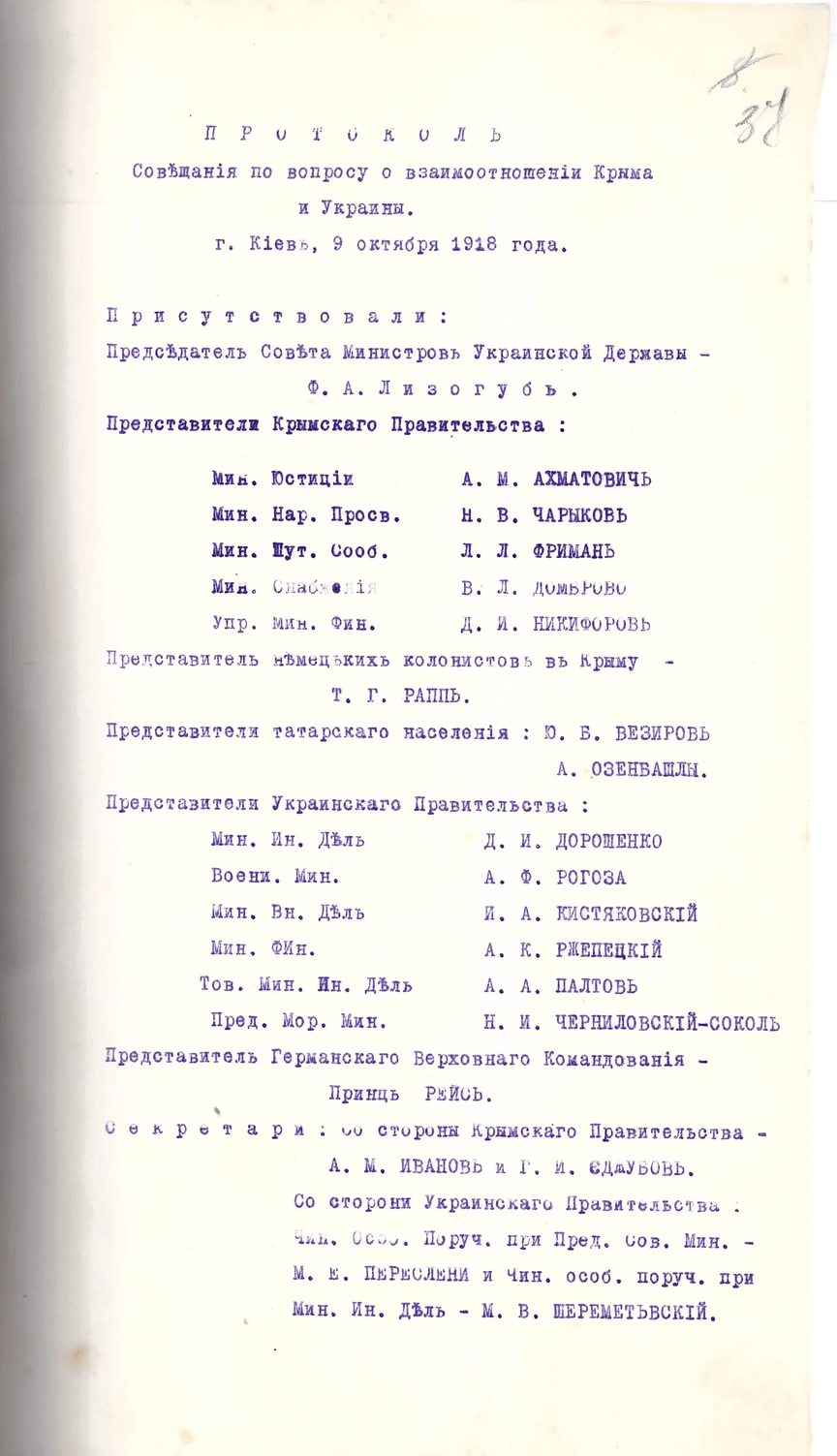
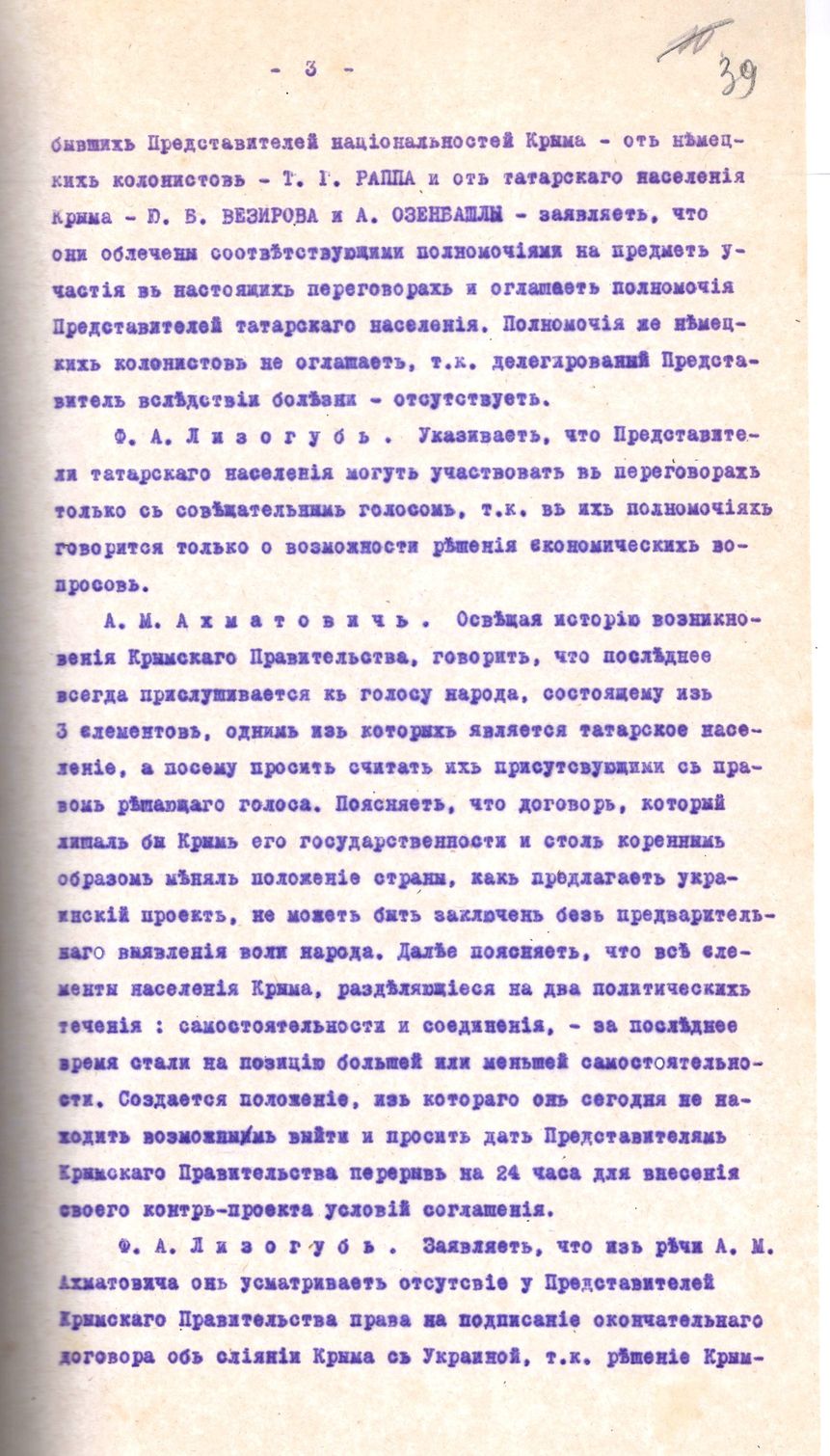
Protocol [No. 2] of the meeting of the Chairman of the Council of Ministers of the Ukrainian State, F. Lyzohub, with representatives of the Crimean Regional Government on relations between Crimea and Ukraine. October 9th, 1918. Copy. TsDAVO of Ukraine. F. 3808. Op. 1. File 21. Sheets 37-45
The Main Principles of Unification of Crimea with the Ukrainian State, dated October 9th, 1918, contained items on the joining of the peninsula with the rights of autonomy "under the sole Supreme authority of His Serene Highness the Lord Hetman." In turn, Crimea had the right to "its own Regional Government and Regional People's Assembly, as well as the right of local legislation within the limits of the competence of the Regional Government."
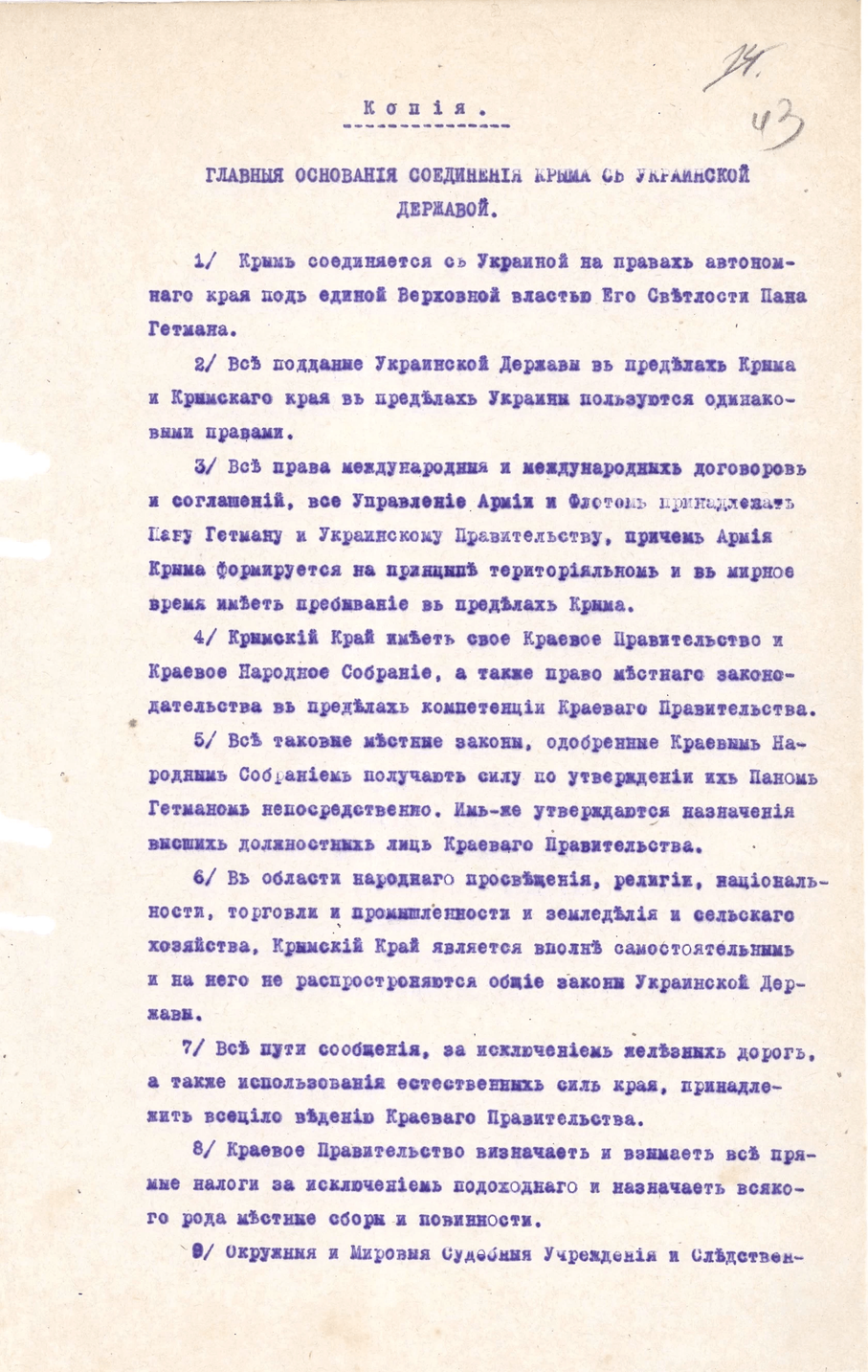
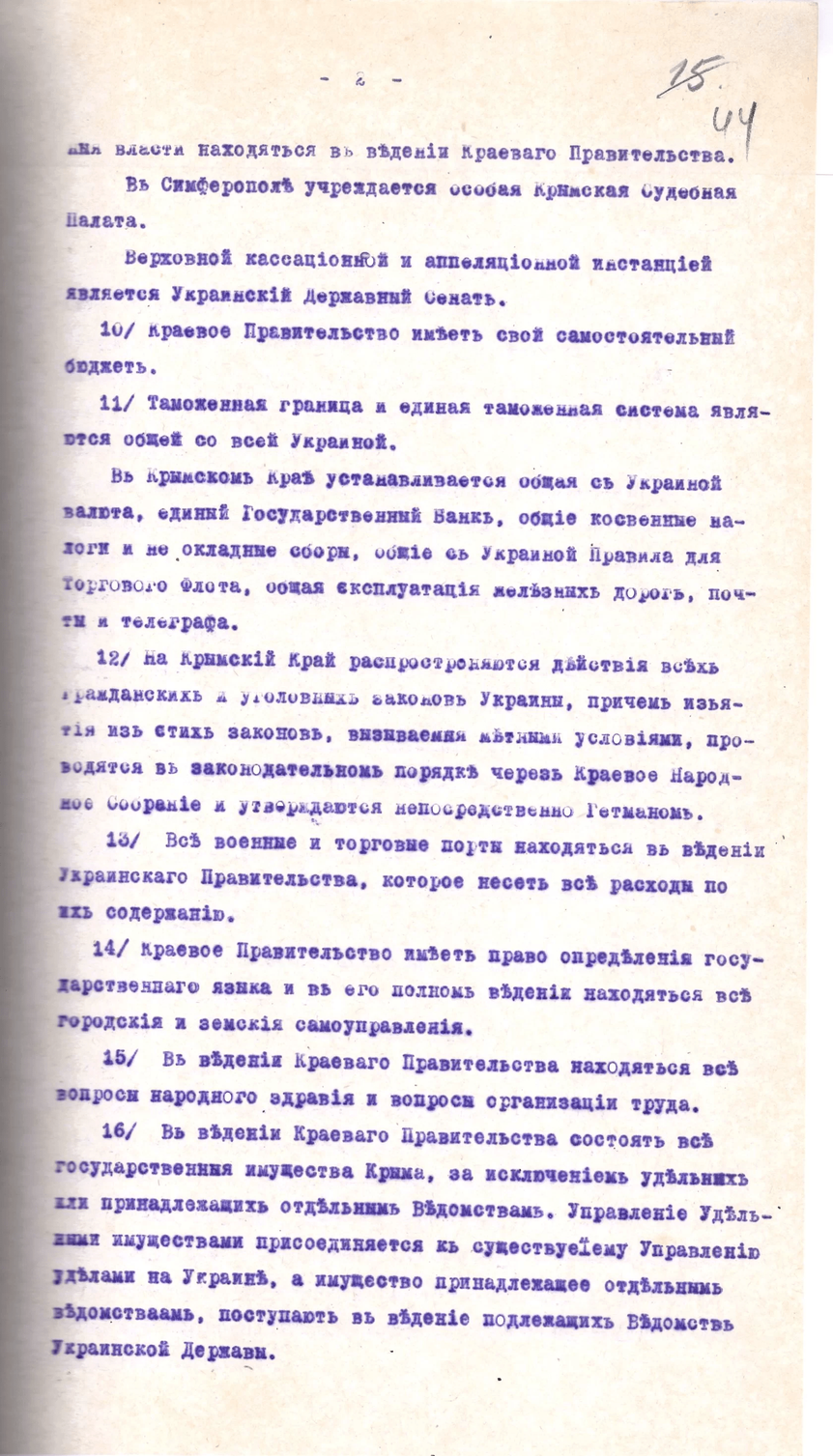
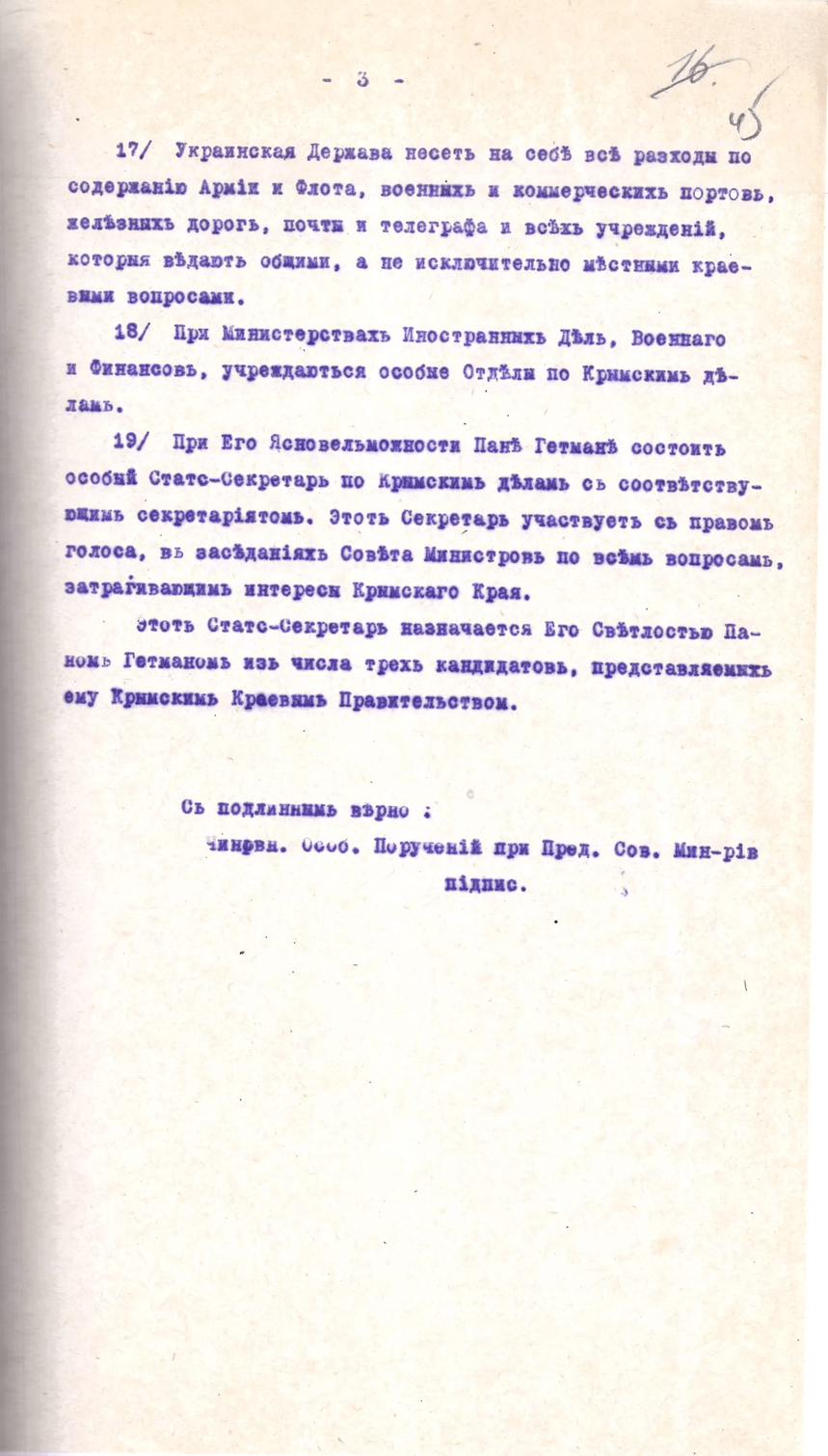
The Main Principles of Unification of Crimea with the Ukrainian State. October 9th, 1918. Copy. TsDAVO of Ukraine. F. 3808. Op. 1. File 21. Sheets 37-45
The unstable geopolitical situation did not affect subsequent developments in Ukraine in the best way. The defeat of Germany and its allies in the First World War made the fall of Sulkevych's government, which resigned on November 14th, inevitable. Consequently, the agreement between Crimea and Ukraine on the peninsula joining the Ukrainian State was not implemented.