Dnipro Water for Crimea
The Crimean Peninsula has always lacked fresh water. The deficit was caused by the dry climate and the lack of large rivers.
The Crimean Peninsula has always lacked fresh water. The deficit was caused by the dry climate and the lack of large rivers. Therefore, the people living on the peninsula spent centuries learning to find water and use it sparingly.
Under conditions of severe water shortage, Crimea could not hope for comprehensive economic development. The idea of constructing a canal to bring Dnipro water to the peninsula had long been circulating in the minds of leading scientists, so on the whole, it was not new.
Even in the mid-19th century, a similar option was considered by the imperial authorities. It was first proposed by Christian Steven, the founder and director of the Nikitsky Botanical Garden, but it did not receive adequate support. Attempts to return to this issue were made in 1916. Engineer V.D. Nykolsky developed and technically substantiated Steven's idea, but the revolutionary events prevented the implementation of these innovative plans. Only in 1923–1924 was it possible to obtain the necessary data and complete a design scheme. However, due to the low level of technology at the time, it was only in the 1930s that the hypotheses put forward by the author regarding the irrigation of Crimea with the waters of the Dnipro began to be considered in detail; their relevance was recognized, and the need for further development was acknowledged.
The conclusions of A.S. Panpulov regarding the explanatory note to the design scheme proposed by engineer V.D. Nykolsky for irrigating the steppe part of Crimea with the waters of the Dnipro River, dated 1930, are currently kept in the State Archives of Zaporizhzhya Oblast.
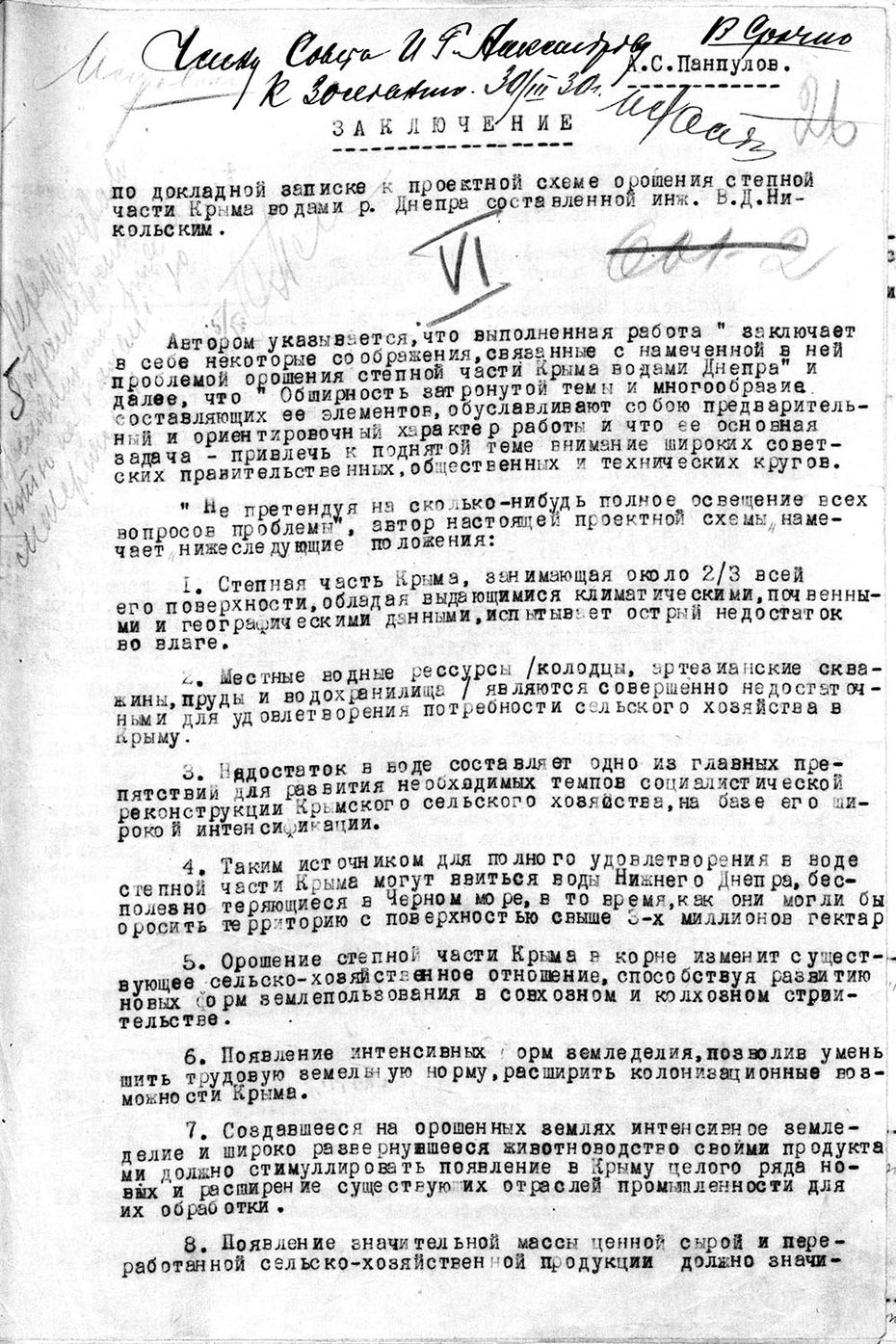
Conclusions of A.S. Pampulov regarding the explanatory note to the design scheme for irrigating the steppe part of Crimea with the waters of the Dnipro River, compiled by engineer V.D. Nykolsky, dated March 30, 1930.**
State Archives of Zaporizhzhya Oblast, R-813, Op. 1, file 654, sheets 25-49
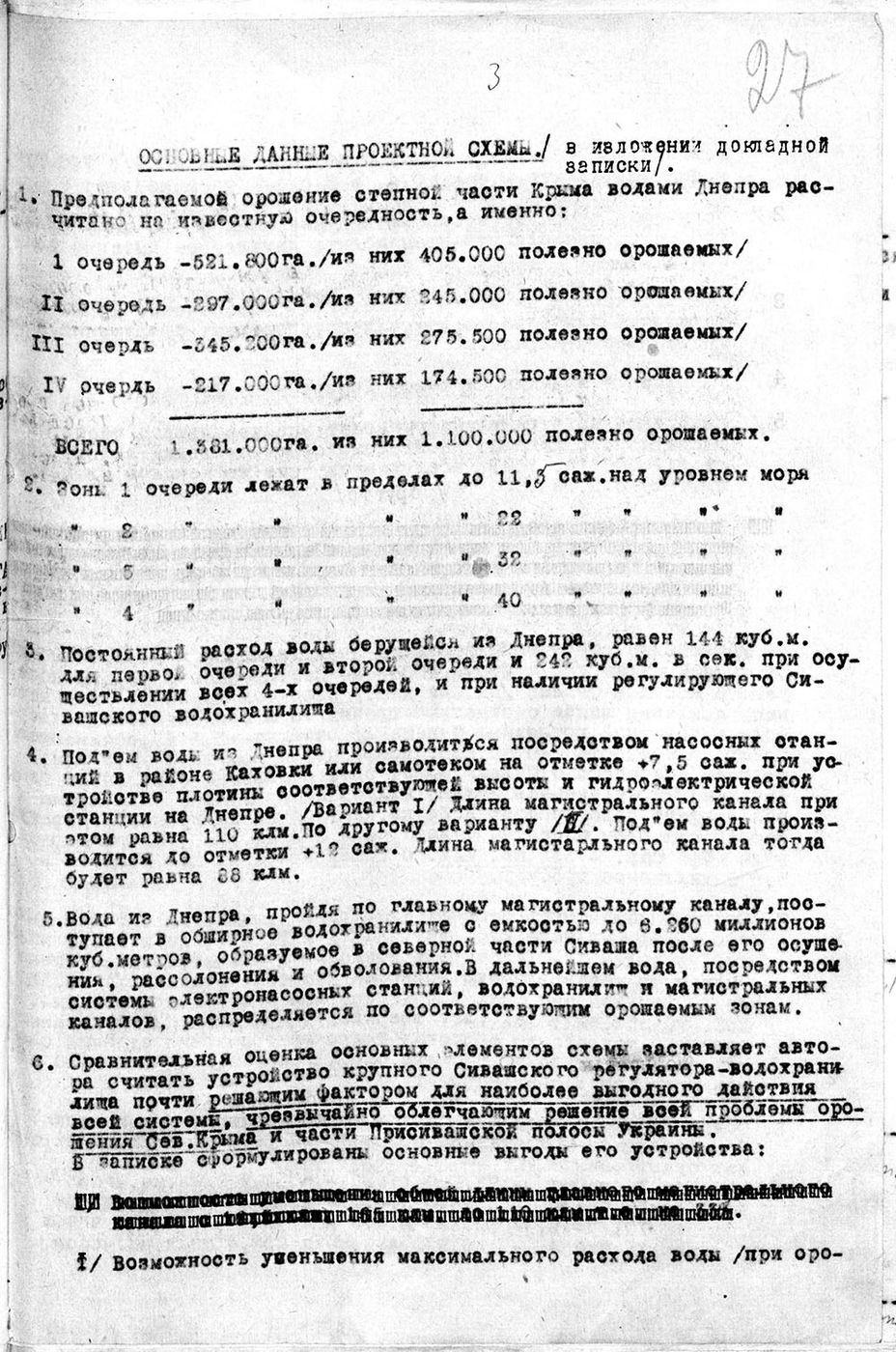
The engineer presented two versions of the irrigation scheme, identified four construction phases and corresponding irrigation zones, and developed the principles of water and energy management.
In addition, V.D. Nykolsky preliminarily forecasted the probable economic effect for agricultural development, including new forms of farming, and calculated the approximate cost of construction.
The conclusions emphasize in particular: "...the waters of the Lower Dnipro, which are uselessly lost in the Black Sea, can serve as a source for fully satisfying the water needs of the steppe part of Crimea, while they could irrigate an area of over three million hectares."
In his work, V.D. Nykolsky concisely and clearly formulated six key points: water must be found – taken – delivered – stored – distributed – used. In his irrigation scheme for northern Crimea, he identified the following crucial technical elements: the withdrawal of irrigation water from the Dnipro without significant damage to the economic interests of Ukraine; the possibility of transporting this water to the borders of northern Crimea; the possibility of creating sufficiently large reservoirs in northern Crimea; the possibility of desalinating the western part of Lake Syvash and creating a freshwater reservoir there.
Overall, V.D. Nykolsky's design scheme was positively evaluated by scientists: "All of the above does not allow us to take a negative view of the scheme of supplying water to Crimea in the author's interpretation... cannot but be confirmed with all indisputability that northern Crimea needs watering, and that no sources for this watering exist other than the water of the Dnipro."
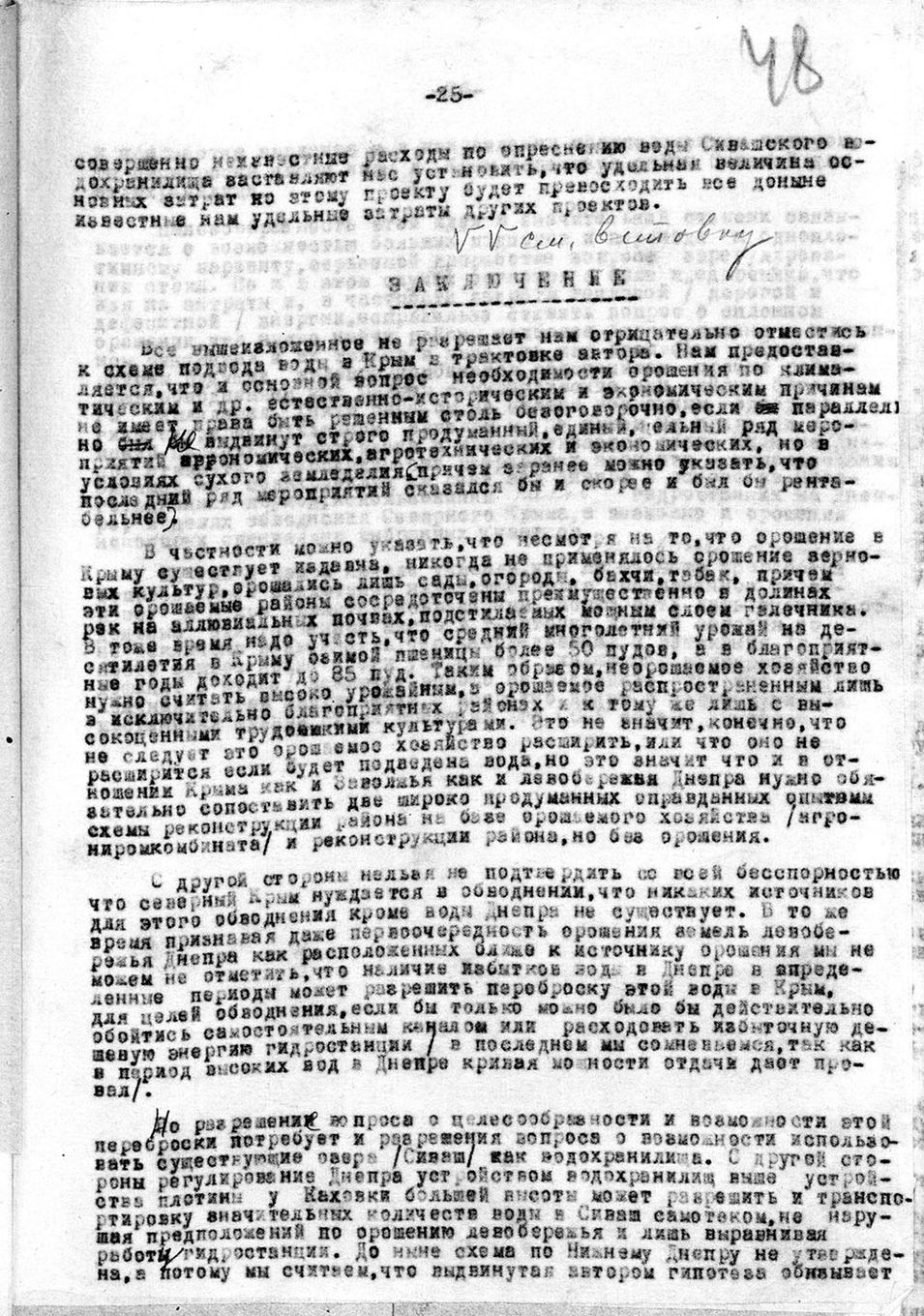
"...regulating the Dnipro by constructing reservoirs higher than a dam of greater height at Kakhovka can also enable the transport of significant amounts of water to Syvash by gravity, without violating assumptions regarding the irrigation of the left bank and only balancing the operation of the hydroelectric plant. Until now, the scheme for the Lower Dnipro has not been approved, and therefore we believe that the hypothesis put forward by the author obliges us to revise the option also in the direction proposed by the author, that is, transferring a part of the water to Crimea, using the Syvash area for a reservoir," the conclusion states.
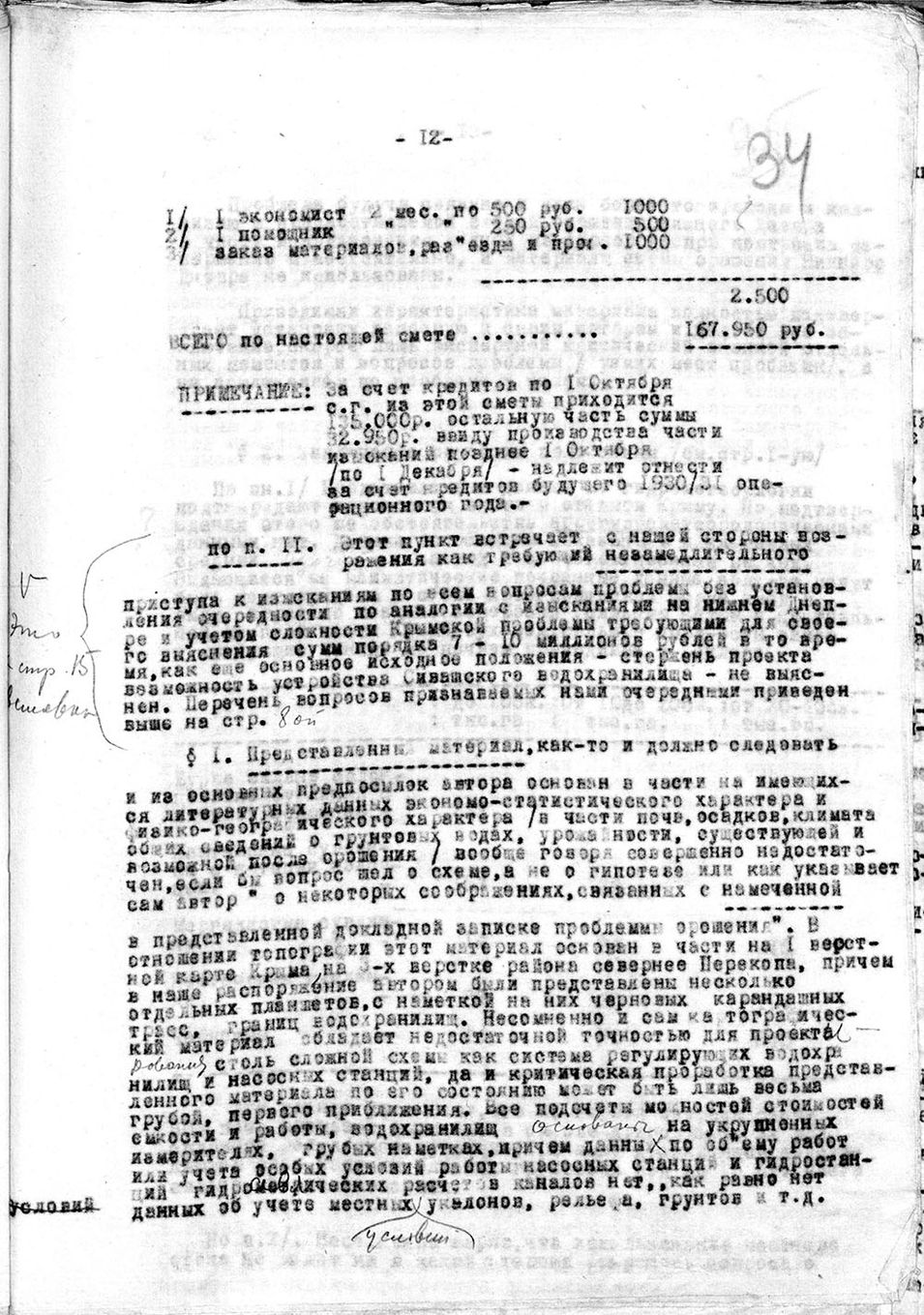
Although there were complaints and remarks regarding the superficial data and contradictory points used by the author, this did not spoil the overall impression of the engineer's work: "In view of the all-Union significance and large economic effect, the irrigation of northern Crimea with the waters of the Dnipro must immediately proceed to the necessary preparatory, organizational, exploratory, and design works for the purpose of comprehensive study."
Unfortunately, in the post-war period, when the construction of the irrigation canal – which later came to be named the North Crimean Canal – was recognized as a priority matter of state importance, the name of its intellectual mastermind was groundlessly forgotten. To this day, nothing is known for certain about the fate of engineer V.D. Nykolsky, not even his first name and patronymic, since all discovered documents provide only his initials.
V.D. Nykolsky can without hesitation be called the scientist who substantiated and technically proved the possibility of irrigating Crimea with the waters of the Dnipro. And this design was eventually realized several decades later.
During 1951–1971, the North Crimean Canal – the longest in Europe – was launched in stages, with thousands of Ukrainians working on its construction. In the State Archives of Zhytomyr Oblast, it was possible to find decisions on sending workers for the construction of the South Ukrainian and North Crimean canals.
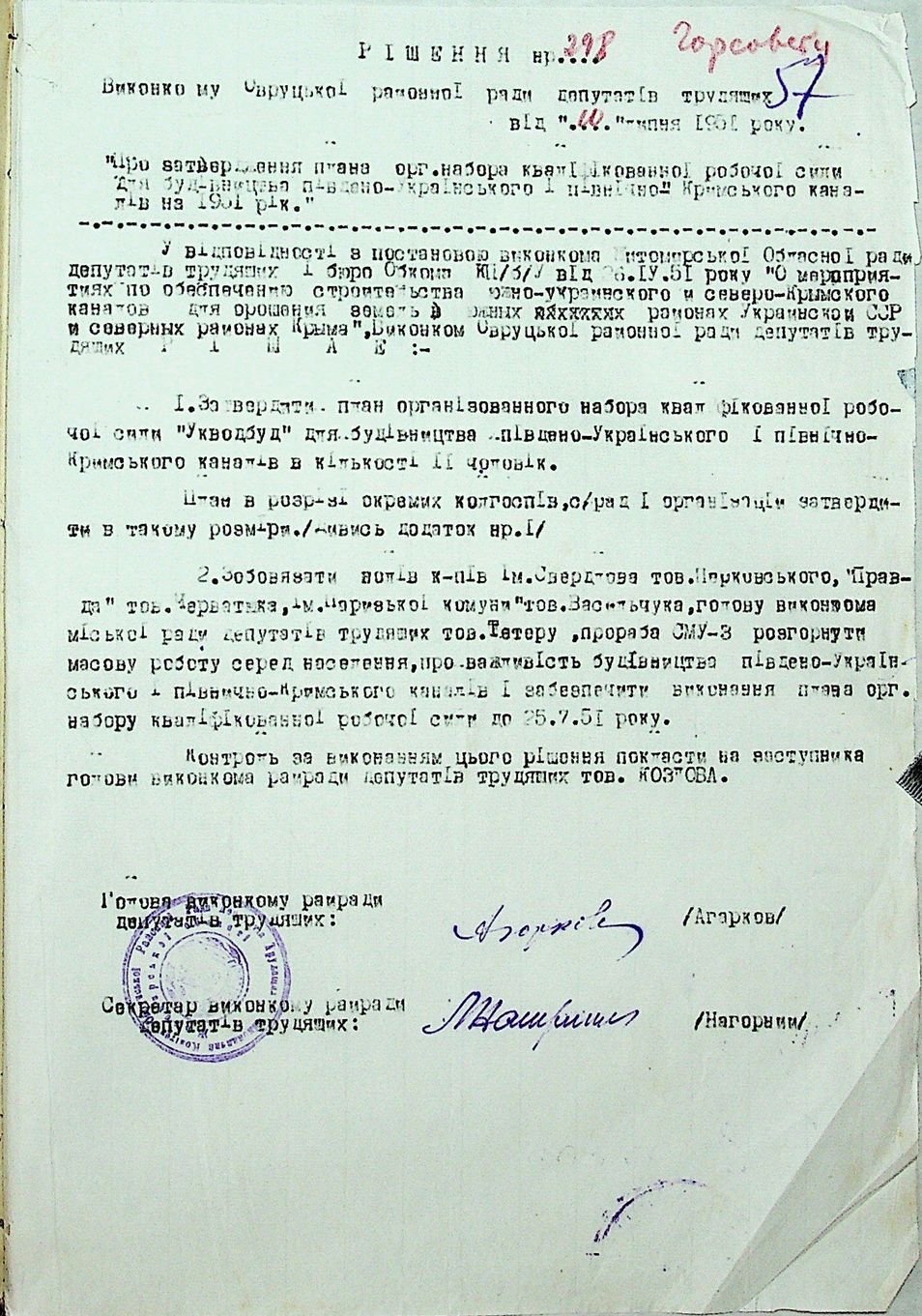
Decision of the Executive Committee of the Ovruch District Council of Workers' Deputies No. 298 dated July 10, 1951 "On approval of the organized recruitment of qualified labor for the construction of the South Ukrainian and North Crimean canals for 1951."
State Archives of Zhytomyr Oblast, fund R-4715, inventory 1, file 15, sheets 57-58
The construction of the South Ukrainian and North Crimean canals was started on the basis of a decree of the Council of Ministers of the USSR and the Central Committee of the CP(b)U dated September 20, 1950, "On the construction of the Kakhovka Hydroelectric Power Station, the South Ukrainian, and North Crimean canals, and on the irrigation of lands of the southern regions of Ukraine and northern regions of Crimea." The goal of the project was to create proper conditions for agricultural production in the southern regions of Ukraine and in the northern regions of Crimea.
The design of the construction of the South Ukrainian and North Crimean canals to the Chatyrlyk River in Crimea was to be carried out by the "Ukrvodproekt" organization. More than 2,000 engineering and technical personnel from various design organizations participated in the design and exploration works. In addition, 17 research and educational institutions of the Ukrainian SSR were involved in the process of project support for the construction of the South Ukrainian and North Crimean canals.
The North Crimean Canal was built by more than 10,000 people using 2,000 earth-moving machines. The most powerful of them were bulldozers converted from tanks.
In the first year of construction, the annual capital investment plan was fulfilled ahead of schedule. This was achieved thanks to the active assistance of the Council of Ministers of the Ukrainian SSR and the Central Committee of the CP(b)U, as the republican governing institutions provided personnel in a timely manner and established the management structure through party organizations.