Connections of Crimean Archaeology with Ukraine in the 19th–20th Centuries
Archaeological finds in Crimea and their significance to Ukraine.
Serhiy Konashevych. Newspaper "Krymska Svitlytsia", 2017, Issue No. 6
At the end of the 19th and the beginning of the 20th centuries, several interesting notes appeared in the press of Crimea and mainland Ukraine, testifying to the connection of the Crimean archaeological field with Ukraine. In 1882, the journal "Kyivska Starovyna" (Kyiv Antiquity, No. 5, pp. 327–329) mentioned the work carried out back in 1868–1871 by Dmytro Strukov, a restorer-artist of the Moscow Armory.
By "imperial command," he discovered, excavated, or cleared more than twenty cave and stone ancient Christian temples and other monuments on the southern coast of Crimea: plaster models were made of them, and their execution was awarded a gold medal at the Moscow Polytechnic Exhibition. These models were purchased by the Imperial Academy of Arts, which eventually transferred them to the Church-Archaeological Museum at the Kyiv Theological Academy. In 1874, the master himself personally donated several plaster miniatures of temples he had discovered in Crimea to this museum.
Thus, a fairly complete, one-of-a-kind collection of models of ancient Crimean structures appeared in Kyiv. "Kyivska Starovyna" provided their list: 1. The Inkerman rock with carved residential premises and temples; 2. The Temple of St. Clement, Pope of Rome, who, according to legend, performed divine services here, in the same Inkerman rock; 3-6. Three carved temples in the same rock; 7. A cave temple north of the Inkerman rock, across a gully, on the corner of another rock; 8-9. Two carved temples opposite Inkerman, across the Chorna River, on the corner of the rock; 10.
A temple in the Sevastopol Bay, on the southern side, four versts from the sea, on the corner of a rock; by that time destroyed; 11. A temple in a rock near the village of Shuli (now Ternivka), 15 versts from Inkerman; 12. The Tepe-Kermen rock with three tiers of caves; 13. A temple in the Tepe-Kermen rock, on the edge of the eastern side, halfway up the mountain, with an original altar layout; 14. A temple on the Mangup rock; 15. A ground-built temple in the village of Ai-Vasyl (now Vasylivka) near Yalta, with an inscription from 801; 16. A similar temple in the village of Nikita near Yalta, converted into a mosque in 1784; 17. An altar in the form of a special structure in a natural spacious stalactite cave on the top of Mount Iograf, between the villages of Autka and Ai-Vasyl (suburbs of Yalta); 18. The foundations of a spacious temple and the walls of the eastern part of the altar in the village of Gurzuf, near the Gorsuvity fortress built in the 6th century; 19. The remains of the walls of a temple at the foot of Mount Ayu-Dah, built by the Gothic Archbishop John in the 8th century and restored by Metropolitan Damian in 1428; 20-21.
Two temples on Mount Ayu-Dah; 22. A temple in the village of Artek, at the foot of Mount Ayu-Dah; 23. A two-story temple with paintings on Mount Demerdzhi near Alushta; 24. A temple in Sudak near the ancient fortress, with fresco paintings on the walls; 25. A temple in the village of Kozy (now Soniachna Dolyna) near Sudak; 26. A temple near the village of Otuzy (now Shchebetovka), between Sudak and Feodosia, in the forest; 27-32. Monuments excavated in Inkerman, near Sudak, in Kikeneiz (now Opolzneve), on Mangup; 33. Five monuments called Celtic, near the village of Ai-Vasyl; 34. A tomb with a lid; 35.
A section of a reservoir in Chersonesos; 36. A project of a monument to the soldiers of the Volyn and Selenginsky regiments who fell in the battle of October 24 (O.S.), 1854 on the Inkerman heights. It was noted that the models could interest not only historians of church architecture in general, but also Kyiv in particular: it was hypothesized that the Crimean caves served as a prototype for the Kyiv ones. Several original fragments of various Crimean monuments, carved crosses, inscriptions, etc., were also transferred to the museum.
In issue No. 4 for 1904 (pp. 28–30), "Kyivska Starovyna" published a note on the establishment and prospects of the Ethnographic Museum of the Kharkiv Historical and Philological Society, the arrangement of which was carried out under the direct supervision of the society's head, Prof. Mykola Sumtsov. Among the museum exhibits, a "small Crimean collection gathered by Privat-Docent Vasyl Danylevych" is also mentioned.
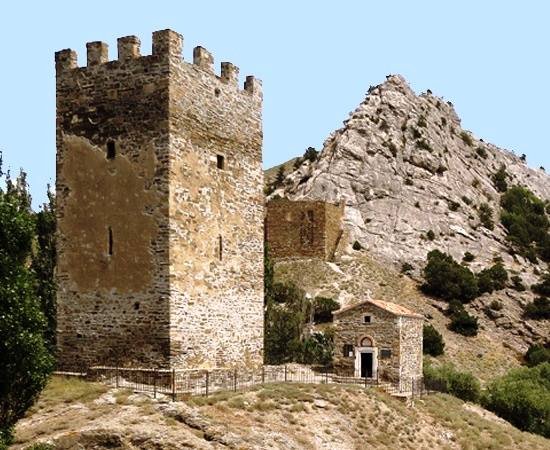
Church of the Twelve Apostles in the complex of the Sudak Fortress
On November 9 (22), 1913, the newspaper "Yuzhnye Vedomosti" (Southern Gazette) reported that in Kerch, the building on Mount Mithridates, which for some time housed a military church, was, on the initiative of the city governor and with the city's consent, placed at the disposal of the Odesa Society of History and Antiquities to establish a branch of the Kerch Museum. On January 19 (February 1) of the following year, the same newspaper reported that Archpriest Volodymyr Stanislavskyi, having performed a special service, burned the altar of the former church: the ashes, collected in a special urn, were left for safekeeping right there by the icon. As in the November issue, the opening of the museum in the spring was announced: artifacts for it were to be transferred from the Royal Kurgan and partially from the old building of the city museum.
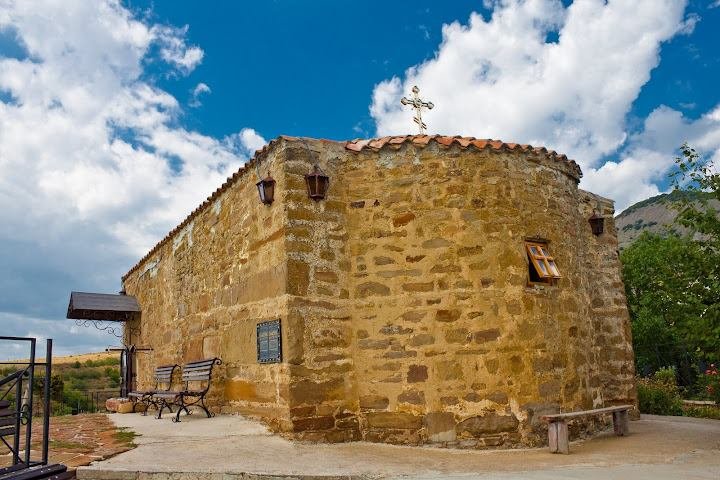
Church of the Holy Prophet Elijah (Soniachna Dolyna) in our days