«In memory of me, Aivazovsky, I bequeath the gallery to the city of Feodosia…»
The fate of the Aivazovsky Museum in Crimea.
Ihor Svitlychanin. "Krymska Svitlytsia" newspaper, 2020, issue No. 2
"My sincere desire is that the building of my art gallery in the city of Feodosia, with all the paintings, statues, and other works of art in it, be the complete property of the city of Feodosia, and in memory of me, Aivazovsky, I bequeath the gallery to the city of Feodosia, my native city," – such is the text of the will of the prominent marine and battle painter Ivan Aivazovsky. A plaque with this inscription still hangs on the facade of the artist's gallery.
In 1900, after the artist's death, in accordance with his will, the gallery was handed over to his native city, Feodosia. The museum houses a collection of approximately 12,000 marine paintings by the great master, the world's largest collection of his works on biblical, mythological, and other themes (417 pieces), works by like-minded colleagues and followers of Aivazovsky, and paintings by marine artists of the 18th-19th centuries.
Despite the fact that the gallery is the property of Feodosia, in 2014, after the annexation of Crimea, everything that was in the city's museums became the "property of the Republic of Crimea", at least according to a document signed by the current "head of the Crimean parliament" Volodymyr Konstantinov. In 2016, the Russian government of Crimea concluded a trilateral agreement with the Feodosia administration and the Art Gallery, stating that all art canvases are transferred to the museum for 10 years.
Ukraine has repeatedly reported gross violations in the actions of the Russian Federation regarding Ukrainian cultural heritage. Despite this, contrary to international and Ukrainian legislation, Russia took works from the Ivan Aivazovsky Gallery out of the Ukrainian peninsula for long-term exhibition, without asking anyone. Thus, in 2016, 38 paintings by Ivan Aivazovsky from Feodosia were transferred to the Moscow Tretyakov Gallery. In response, the Ministry of Culture of Ukraine declared a violation of Article 5 of the 1954 Hague Convention, which prohibits the removal of cultural property from occupied territories. Later, the director of the Feodosia Ivan Aivazovsky National Art Gallery, Tetiana Haiduk, reported that the paintings had returned to Crimea and there were no plans to take them to Russia again.
In September 2017, the "Public Chamber of Crimea" spoke about the need to transfer the art gallery to the "republican fund." The main argument was issues related to the further funding of the museum. This initiative was justified by the fact that, by subordinating to the "Republic of Crimea," the I. Aivazovsky Gallery would have better funding. This would allegedly allow for renovation work in the gallery, bringing the cultural institution to a new level. The "municipal authorities" cited many "advantages" of changing the form of ownership, assuring that the gallery would not relocate.
Fortunately or unfortunately for the museum itself, this proposal was not approved by the city residents, who consider the I. Aivazovsky Gallery the pride of Feodosia. Instead, the "municipal authorities," trying to reassure the townspeople, assured that this issue would not be resolved without taking public opinion into account.
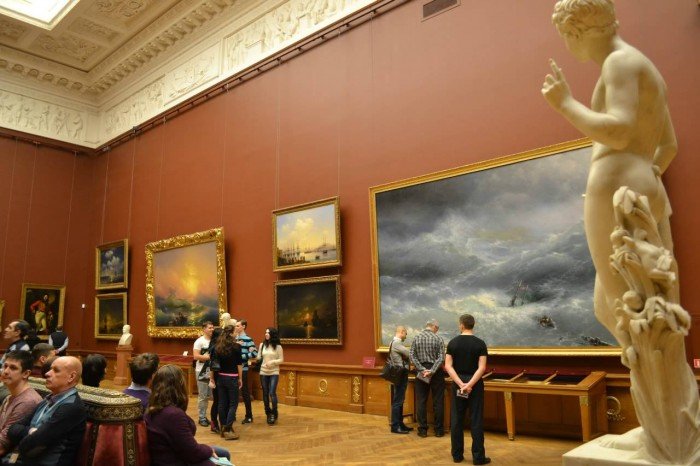
Halls of the I. Aivazovsky Art Gallery
At the beginning of November 2018, at a meeting of the "Public Chamber of Crimea," the fate of the I. K. Aivazovsky Gallery was discussed again, namely: its transfer to federal ownership and the creation of a branch of the State Tretyakov Gallery on its basis. At the same time, the "Minister of Culture" of Crimea, Arina Novoselskaya, confirmed that the Ministry of Culture of Crimea was against transferring the gallery to federal jurisdiction. She explained that the decision to transfer the Aivazovsky Gallery to the ownership of the Republic of Crimea had already been made, but it had not yet been documented.
According to her, this was done because the measures taken by local self-government bodies to ensure the physical preservation of museum objects and collections, their safety, and the realization of citizens' constitutional right to access cultural values were insufficient due to limited financial and human resources.
However, the "head" of Crimea, Sergey Aksyonov, during an on-site meeting held on December 13, 2018, announced that the I. K. Aivazovsky Art Gallery would remain the property of the city. The final point in this matter was made at the session of the Feodosia City Council on March 29, 2019, where it was decided to leave the gallery to the city.
While disputes over changing the museum's ownership form continued, the old building of the Feodosia I. Aivazovsky Art Gallery began to fall apart bit by bit, as it requires constant maintenance and repair. According to calculations by the current "authorities" of Feodosia, repairing the museum would require spending half of the city's budget, because the gallery lacks modern equipment, lighting, and a microclimate system, but the city has no money for this. However, emergency response works in the gallery did take place, lasting from December 2016 to July 2017, for which 30 million rubles were allocated from the federal budget.
In the museum building, they reinforced the roof over the main exhibition hall, completely replaced the tiles, and repaired the facade. After that, in August 2017, the museum director T. Haiduk stated that "according to preliminary calculations, the capital renovation of the main building of the gallery could cost 250-300 million rubles. This includes the repair of the main exhibition hall with an area of 260 square meters, the installation of climate control and fire extinguishing systems in the gallery, as well as equipping the halls with modern multimedia technology."
And so in December 2018, the "head" of Crimea, Sergey Aksyonov, declared that 100 million rubles had been allocated for the renovation of the gallery. "These funds will be spent on putting the museum premises in order," he specified. The so-called Minister of Culture of the Republic of Crimea, Arina Novoselskaya, in turn, spoke about the urgent expenses needed to preserve the museum's unique collection: design and estimate documentation would cost 200 million rubles, and the construction of new museum facilities, technical equipping of premises, and purchase of new equipment — 1.5 billion rubles by 2022.
However, where and on what the funds allocated by Aksyonov were spent is unclear, because less than a year and a half after the recent repair, in February 2019, residents of Feodosia began to notice significant cracks on the walls of the museum.
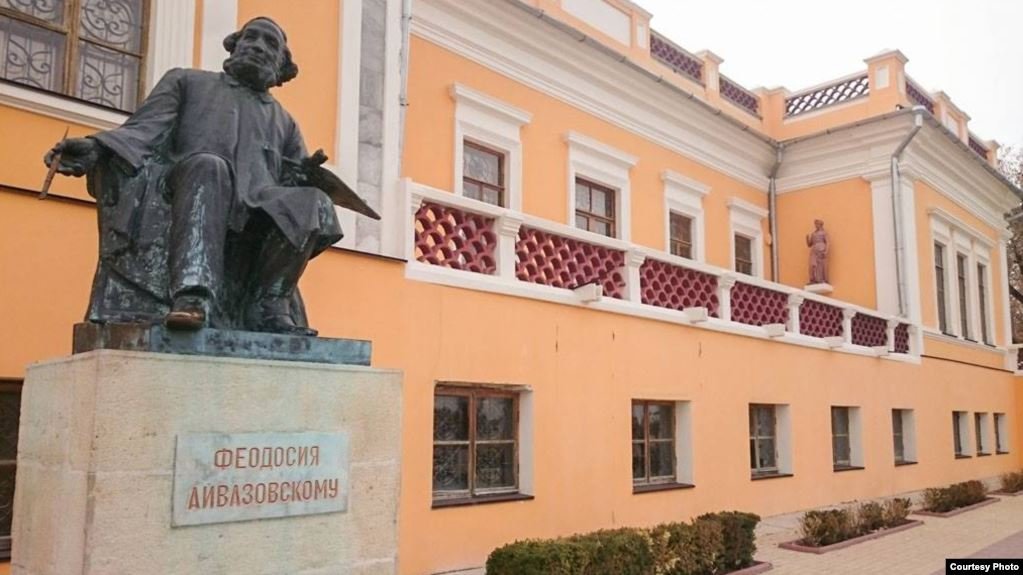
The I. Aivazovsky Gallery before renovation
According to the local media outlet "Kafa," "if you approach the Aivazovsky monument, you immediately notice a large vertical crack located to the right behind the marine painter's back, in the corner near the drainpipe, and it is topped by two dark gray spots from the ruined finish. In addition, here and there on the bright orange facade, traces of collapsed plaster are visible, making it clear that if measures are not taken in the near future to eliminate them, one can predict the rapid start of new restoration works on the main building of the gallery." Meanwhile, there was no immediate reaction to save the building from either the city or Crimean authorities. Everyone was busy with other, more important, paper matters.
Thus, in May 2019, the Crimean branch of the Russian Glavgosekspertiza approved the start of development of design documentation for the reconstruction of the building of the Feodosia I. K. Aivazovsky Art Gallery.
The justification of the investment plan states that comprehensive works will eliminate the existing problems of the cultural heritage site, which has not undergone capital repairs for many years. "Since no comprehensive restoration has been carried out in the building for a long time, and it has not been adapted to modern requirements, it is currently in a state of significant moral and technical obsolescence," the Glavgosekspertiza specialists concluded. "Authentic architectural, structural, and decorative elements have been lost or are under threat of loss. The exhibition halls lack continuous pathways for viewing the exposition and access for people with disabilities.
And the engineering networks and technological equipment cannot cope with their tasks, do not work, or are completely absent. Because of this, difficulties arise in ensuring the proper microclimate in the premises for holding museum exhibits and for visitors."
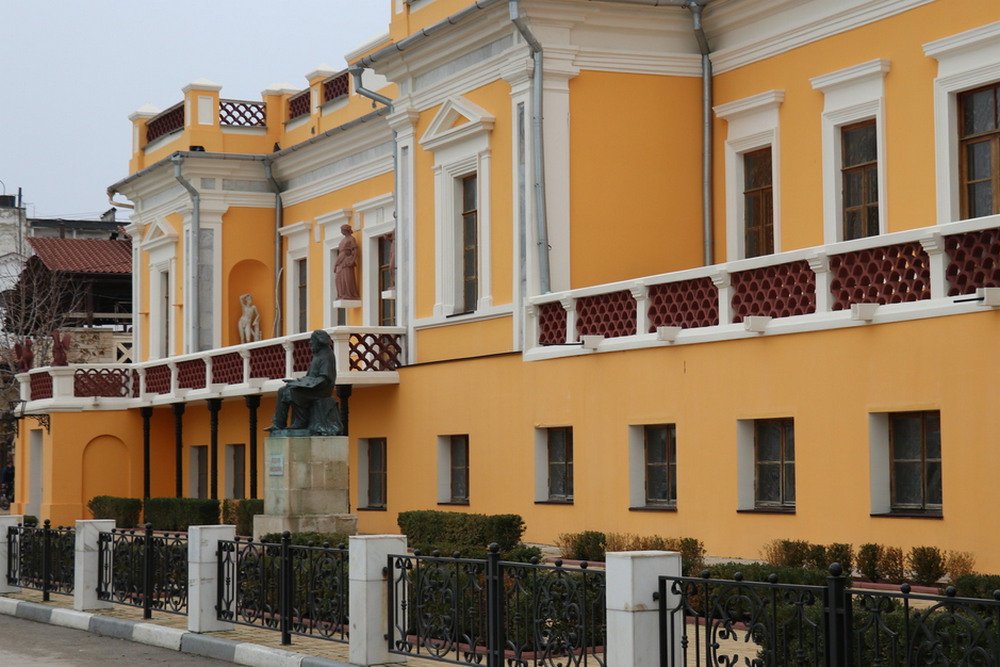
The Gallery after renovation
Funding of works to correct existing problems is planned from the federal and regional budgets. According to preliminary data, only the primary repair and restoration work will cost the state 500 million rubles.
As we can see, while the building of the Art Gallery is literally cracking at the seams, the funds for its repair are growing in geometric progression, albeit only on paper. According to the assurances of the "head of administration" of Feodosia, Sergey Bovtunenko, "in accordance with the federal target program for the development of Crimea and Sevastopol, this year (2019, – Ed.) design and estimate documentation for the capital repair of the building of the Aivazovsky Art Gallery will be prepared. The repair works will be carried out in 2020."
And the director of the Feodosia I. K. Aivazovsky Art Gallery, Tetiana Haiduk, in turn, added that the volume of planned work would depend on the size of funding. "Last year, commissioned by the State Committee for the Protection of Cultural Heritage, the contractor began preparing documentation. This year, the work continues and proceeds to the execution of design and survey works. When they are completed and undergo expertise, the volume of works and their cost will be clear.
Then we will have to make sure we lay this into the budget for 2020 in time. At the moment, the documentation is being prepared so that capital repair and restoration works can be carried out in our two buildings and a repository can be built. And then the question will arise in what amount this will be funded. But unequivocally, in one volume or another, work at the site will start in 2020," said the gallery director. In other words, the final amount and volume of "repair and restoration works" seem to be known only to God.
However, the contracting organization that carried out emergency works in the gallery in 2017 only in July 2019 (that is, less than half a year later, literally) proceeded with the warranty repair of the building's facade. According to the director of the institution, Tetiana Haiduk, the works are taking place not only on the facade but also in one of the premises of the institution.
"There was a leak in one of the halls. Now works are taking place there, during which the paintings were removed from the walls. This is the smallest hall, intermediate between the living rooms. As for the restoration of the facade, these works were supposed to be finished last week. But due to bad weather, firstly, the work stopped, and secondly, it took time for the facade to dry after the heavy downpours," reported T. Haiduk, specifying that the repair would end in the near future.
Meanwhile, the future transformation of the gallery announced by the Crimean authorities is impressive, the reconstruction of which, as already mentioned, will last until 2022. According to the "head" of Crimea, Sergey Aksyonov, in the next two years they plan to complete works to create a single Museum Quarter on the basis of the Feodosia Aivazovsky Art Gallery in Crimea; leading specialists from the Moscow Tretyakov Gallery have been sent to the peninsula for an expert assessment of the museum's funds and the development of the concept of its restoration. The first thing that will undergo changes is the museum halls.
It is planned that after the update, the Aivazovsky Gallery will become the main museum of Crimea. "There has been no similar project either in Crimea or in the south of Russia until now. The project is implemented within the framework of the federal target program; furthermore, part of the funds was attracted by the federal Ministry of Culture from programs supervised by the Ministry of Culture," noted Aksyonov.
Thus, despite all the Napoleonic plans of the current Crimean "leaders" and knowing with what "zeal" and, most importantly, "professionalism" (which is visible from the history of "repair" and "restoration" of other cultural heritage sites in Crimea) they get to work (i.e. to "developing" federal funds) and bring it to an end, there is a glimmer of hope that after all these "modernizations" and "capital repairs" Russian-style, something will still remain of the pearl of artistic life and pride of Feodosia — the Aivazovsky Art Gallery. After all, everything that is happening now in the cultural sphere of Crimea reminds of the favorite Russian proverb: "Make a fool pray to God, and he will hurt his forehead."
Supported by the Ukrainian Cultural Foundation.