The Heavenly Patriarchate
From the history of the Crimean Patriarchal Eparchy.
Valeriy Verkhovskyi. "Krymska Svitlytsia" Newspaper, 2018, Issue No. 1
A purely administrative issue about the subordination of eparchies, which can be resolved once and for all with a stroke of a pen, in the case of the Moscow Patriarchate turns from a bureaucratic-epistolary genre into a mystical series. Theses are put forward about the canonical belonging of territories. So who does the Crimean Orthodox Eparchy belong to?
Canon is Canon
Canons are church rules established to avoid misunderstandings and resolve controversial issues in accordance with brotherly love between all who participate in the life of the Church. They are like traffic rules; if everyone follows them, there will be no disasters.
For example, Apostolic Canon 34: The bishops of every nation (ethnos) must acknowledge the one who is first among them and recognize him as their head, and do nothing that is beyond their power without his consent; but each must do only what concerns his own eparchy and the localities belonging to it. But let the first do nothing without the consent of all. For so there will be unanimity and God will be glorified through the Lord in the Holy Spirit, the Father, and the Son, and the Holy Spirit.
In the original Greek text, it refers to a nation (ethnos), not a territory or a state, since the word "ethnos" is used.
Of course, when the church considers the power of Caesar sacred, and not the King of kings, the canons are interpreted as one pleases...
History without Politics
Christianity spread in Crimea back in apostolic times, when a forest grew on the site of modern Moscow, through which unafraid bears wandered.
When Pope Clement of Rome was sent to serve exile in Crimea in the year 96, the Christian community in Chersonesos numbered two thousand people. It is known that two eparchies — Bosporan and Chersonese — existed on the peninsula already at the beginning of the fourth century. By the end of the century, the Phullian eparchy was created here. In the eighth century, the Sougdaia and Gothic eparchies also arose. Small Crimea had five eparchies — all were part of the Patriarchate of Constantinople.
Subsequently, the Gothic eparchy united both the Sougdaia and Chersonese eparchies, and in this form existed until 1778, when Bishop St. Ignatius of Gotthia called on the Orthodox population to move from Crimea to a state that proclaimed itself Orthodox.
The Metropolia of Kyiv was transferred from the subordination of the Patriarchate of Constantinople to the Moscow Patriarchate in 1686 — and "in violation of canonical rules" (as Patriarch Gregory VII of Constantinople acknowledged already in 1924). But Constantinople never transferred the territory of Crimea to the Moscow Patriarchate, neither then, nor later, nor at any point in history.
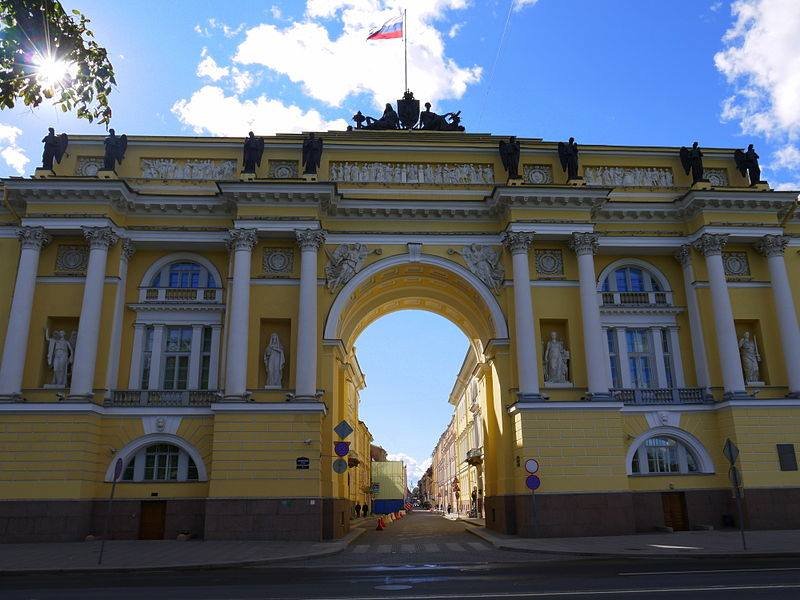
The building of the Senate and Synod in St. Petersburg
Who Violated the Canons?
With the annexation of the territory of the Crimean Khanate to Russia in 1783, the most interesting part begins. This entire territory became part of the Eparchy of Slavyansk and Kherson (cathedral in Poltava).
Only in 1859 was a separate eparchy created on the "canonical" territory of Crimea. Of which patriarchate? The St. Petersburg Ober-Procuratorate? For there was no patriarch in Russia for two hundred years at all: since the time of Peter I, religious and state power were combined in the monarch's right hand; the direct leadership of the Synod was carried out by the "Ober-Procurator" appointed by the monarch — a position unheard of anywhere else and never before in the history of Orthodoxy, which did not correspond to any canons, especially the biblical principle of "render unto Caesar what is Caesar's." However, no one cared about the compliance of this state of affairs with the canons. In St. Petersburg, the Synod was located in the same building as the Governing Senate, and this building is still called the Senate and Synod, a visible testimony of the combination of God's with Caesar's.
It turns out that, with the aim of promoting the Orthodox empire and expanding borders, the "patriarch-less" church liquidated the Crimean Eparchy, just as before that it liquidated the Kyiv Metropolia, which they did not create. First, it liquidated the independence of the Kyiv Metropolia, later the Metropolia itself, then the office of the Patriarch of Moscow was liquidated, and finally, having lured tens of thousands of people from Crimea to the steppe on the banks of the Volnovakha River, to liquidate "as unnecessary" the eparchy that had existed for several centuries, on the land cleared of the ancient apostolic tradition, they created a new eparchy with a new, resettled flock.
Patriarchate of God and Patriarchate of Caesar
There is not a single one among the canons of the Orthodox Church that directly and unambiguously regulates the issue of the division of territories. Because the church is not a territory, the church is the people who come to the temple, it is the parish communities, it is the priests who lead the service. The rest of the superstructure in the form of eparchies, metropolias, and patriarchates is needed to facilitate this activity.
There is no canon that would cancel the Word of God. Did Christ speak of the canonical character of the patriarchate or the division of territories? No, only: "For where two or three are gathered in my name, there am I among them."
Canonical territory is an artificial concept caused by the desire of the Russian Orthodox Church to control not only parishioners, but all residents of the "canonical" territory, almost by the fact of birth, regardless of whether a person believes in God at all, whether they share the principles of the Orthodox confession, or how they perceive themselves by ethnic origin. From this approach, it is only one step to the restoration of serfdom.
The canon is nothing, just an empty word, if it is not based on faith and spirit. It is not given to earthly patriarchs to refute the power of the only canonical Patriarch. The church is not only a temple, not only hierarchs, not only canons — the church is the people. It is those two or three who, together, supporting each other, strive for the sole and highest Patriarchate — the heavenly one.