Ukrainian Karaites
History of a small ethnic group living in the territory of modern Crimea.
Yaroslav Samovydets. "Krymska Svitlytsia" newspaper, 2016, issue No. 37
The Karaites are one of the few indigenous peoples whose homeland is Ukraine. Today, there are only a few hundred of them in Ukraine. There are several centers of compact Karaite population: Yevpatoria, Feodosia, Sevastopol, Simferopol, Bakhchysarai, Halych, Lutsk, Kyiv, Kharkiv, Lviv. Most Karaites live in Crimea. Just like for Crimean Tatars and Krymchaks, Crimea became the ancestral homeland for the Karaites.
ON THE THEORY OF ORIGIN
To date, several theories about the origin of the Karaites exist in scientific literature. According to the first, the Karaites are Turks who adopted Ananism back in the Khazar Khaganate. According to the second version, the Karaites are an ethnic group that formed in Crimea through the assimilation of Jews with Turks, who began appearing on the peninsula in the 13th century. Another theory views the Karaites as a group of Jews, followers of pre-Talmudic Judaism, who assimilated with Turkic peoples in the Khazar Khaganate and settled in Crimea. Significantly, in Crimean Tatar documents, the Karaites were called the "Jewish people" or Jewish Karaites. However, studies have shown that the Karaites do not share complete kinship with the Jewish nation, much like their ancestors—Khazars, Sarmatians, Alans, and nomadic Turks.
The name "Karaite" emerged through religion. Thus, the word "kara" is translated from Hebrew as "to read," and "karay" as "reader." Furthermore, in Judaism, "karay" refers to a connoisseur of sacred texts. Ananism, which forms the basis of the Karaite religion, is one of the currents in Judaism. The name of the current comes from the preacher Anan ben David, who criticized the Talmud in Baghdad, proposing instead the direct reading and understanding of the Holy Scriptures without intermediary books, without the interpretation of priests—that is, direct communication with God. Here is Anan's key approach: "Search thoroughly in the Bible and do not rely on my judgment."
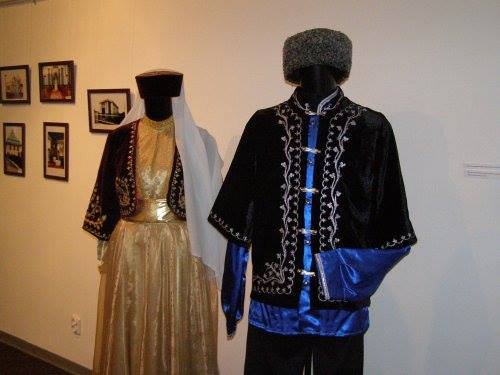
Nevertheless, the religious system of the Karaites is based exclusively on the Tanakh (Old Testament). Folkloric and ethnographic studies have revealed distinctive features of Karaite cultural components. Perhaps the most prominent among these are the cults of ancestors (the most striking example is the performance of prayer rituals at the Balta Tiymez cemetery near Juft-Kale near Bakhchysarai), the world tree (reverence of oaks, prayers in groves, placing trees carved from black marble with severed branches on graves as a sign of the end of life), celestial bodies (images of the moon, sun, and stars on clothing elements, baking dough products with images of celestial bodies), etc.
Karaite folklore has many parallels with Khazar culture. In most Turkic folklore systems, the god Tengri (Tangri) denotes a supernatural cosmic force. For the Karaites, Teng'ri is not the name of a specific god, but the name of God Himself. The name is used both in reference to pagan gods and to the God of Israel, of the Bible—Teng'ri Yisraelnin.
The personification of Tengri Khan on earth is the oak, which for the Karaites, as for many peoples, is a sacral, sacred tree. The sacrality of the oak for the Karaites can be illustrated by the Balta Tiymez cemetery (the name of the cemetery translates as "axe will not touch") in Juft-Kale. The Karaites deeply revere the oaks growing here. These oaks are personified, and they are addressed with prayers and requests.
ETHNIC CHARACTERISTICS
The religious principles of the Karaites, established in particular by the teachings of Anan, formed the basis for their ethnic character. Thus, most researchers of Crimea note that the Karaites are characterized by charity (it was virtually impossible to meet a Karaite beggar), peacefulness, and tolerance. It was hard to find an informant among the Karaites. Some Yevpatoria sanatoriums, hospitals, and parks were built with funds from wealthy Karaite families. Karaites even funded the construction of an Orthodox church. Compared to other peoples, Karaites married relatively late: men at the age of 30, and women at 20. The marriage ceremony always took place in the morning, without loud mass celebrations, in the presence of close relatives and community elders.
The calendar of the Crimean Karaites begins its chronology from the creation of the world (3751 years are added to the Christian chronology). The day begins in the evening. According to the lunar calendar used by the Karaites, the duration of the year is 354 days, 8 hours, and 48 minutes. The New Year arrives at the end of September. The main day of the week is Saturday. All holidays are traditionally started after sunset of the previous day with a festive service in a kenesa (a kenesa is a Karaite temple, which is always oriented strictly north-south, near which there are always fountains and facilities for ritual washing; one must take off one's shoes when entering a kenesa) and ended at sunset on the day indicated in the calendar. On holidays, they rest and do not work.
The first written mentions of the Karaites date back to the 14th century. Even then, they lived in Solkhat (present-day Staryi Krym), the capital of the Crimean Khanate at the time. From the 14th century until the 19th century, the center of the Crimean Karaites was the town of Chufut-Kale, which translates to "Jewish Fortress." The Karaites emphasize that it is historically correct to call this town Juft-Kale, meaning "Double Fortress." The second name of the town appeared later. Based on linguistic research, it has been established that the Karaite language belongs to the Kipchak group of Turkic languages. In writing, the language of the Karaites primarily served religious texts.
Religious texts were and are written almost exclusively in Leshon Kodesh—the language of the Torah, Hebrew. The Karaite Turkic language was used in everyday life, and later became the language of secular literature. In some cases, it was used to translate religious texts from Hebrew (for those who did not know the original language).
One of the main sources of the history of the Karaite language and history in general is the inscriptions on the gravestones of old Karaite cemeteries. Until the early 20th century, the language of the gravestones was almost exclusively Hebrew, and in very rare cases, the Karaite Turkic language. From the beginning and especially the middle of the 20th century, gravestone inscriptions began to be made in Russian. Therefore, the study of Karaite cemeteries in Crimea and Western Ukraine holds good scientific prospects. During the Khanate era, the Karaites did not experience significant oppression; they were even respected individuals at court, supervising the mint. As early as the Crimean Khanate (since 1734), the Karaites had their own printing house in Juft-Kale. Coexistence with the Crimean Tatars led to changes in the language and customs of the Karaites.
A SEPARATE ETHNOS
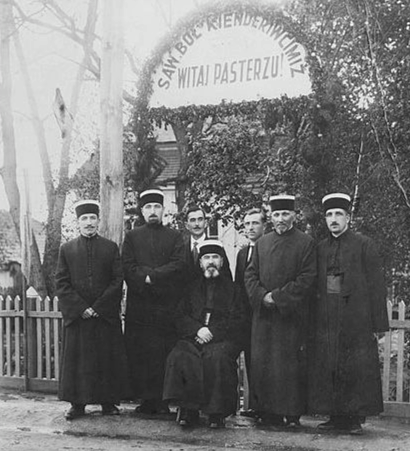
The Karaites made a significant name for themselves during the Russian Empire as well. However, Nicholas I officially recognized the Karaites as a separate ethnic group by his decree in 1837, when spiritual administrations were established in Yevpatoria (this city became the second center of the Karaites after Chufut-Kale), Halych, and Trakai (Lithuania). It was also officially recognized that the leading position among the Karaites was the Gakham. The Gakham served as both a spiritual mentor and an administrative leader. In the Russian Empire, the Karaites enjoyed concessions; unlike Jews, they were allowed to acquire land ownership, which enabled them to become wealthy landowners and industrialists. Economic pressure on the Karaites in Crimea at the end of the 19th and the beginning of the 20th centuries became the basis for the issuance of a circular by the Minister of Internal Affairs Stolypin, which confirmed that the Karaites were non-Jews.
Anti-Semitism at the turn of the 19th and 20th centuries prompted Karaite leaders to officially seek expert opinions regarding their national identity from Jewish scholars. The mayor of Yevpatoria, Semen Duvan (of Karaite origin), went to Berlin in September 1938, where he demanded that the Minister of Internal Affairs conduct an examination and recognize the ethnic distinctiveness of the Karaites. On January 5, 1939, a document with findings was delivered to Semen Duvan. The expert assessments yielded conclusions that were satisfactory for the Karaites.
They proved that the Karaites were not Jews. In the future, these conclusions saved the people from complete annihilation. During World War II, a Yevpatoria lawyer, Samuil Khojash, of Karaite origin, found documents in the central Simferopol archive that once again confirmed that the Karaites were not Jews, but Turks. Despite this, in Israel, the Karaites are recognized as a Jewish sect, which makes it possible for Karaites to relocate to Israel.
For the general public, the Karaites were simply Jews. This perception was shaped by circumstances such as: the Jewish faith, the Hebrew alphabet, and Jewish names. The Crimean Tatars and Turks did not distinguish the Karaites from Jews. Neither did Polish, and later Austrian, legislation. Even less so did the local Ukrainian population, including the Cossacks.
KARAITES IN UKRAINE
As with the origin of the Karaites, there are also several versions of how they appeared in Halych, Lutsk, Lviv, and other cities of Ukraine. Here are the two most common: 1. The Karaites settled in Halych during the reign of Danylo of Halych, when he concluded a treaty with Khan Batu in 1246. At that time, 80 families moved to the banks of the Dniester. 2. The Grand Duke of Lithuania, Vytautas, resettled 383 Karaite families from Crimea to Trakai, and later to Lutsk and Halych after the Crimean campaign in 1392–1397. From there, the Karaites later scattered to other cities of Lithuania, Volhynia, and Podolia.
No documentary evidence has survived to support the first version, and the Galician-Volhynian Chronicle also makes no mention of the Karaites; the only thing keeping this theory in researchers' sights is a mention of an entry in an old religious book that burned in a fire in 1830. A copy of this entry was made in 1813 for the Halych-Lviv Metropolitan Anhelovych by the Hazzan Abraham Leonowicz. The record stated that under the terms of the treaty concluded between Khan Batu and the Galician prince Danylo, the Khan permitted a hundred Karaite families living in Crimea to resettle in Halych to conduct trade between the East and Danylo's principality.
Obviously, the second version of the appearance of the Karaites in Western Ukraine is historically more motivated and documentarily substantiated. The Karaite communities appeared in Halych, Lviv, Lutsk, and other cities of this region precisely due to the military-political activities of Vytautas.
The first documentary mention of the Karaites of Halych dates back to 1578. At that time, King Stefan Batory granted them the right of residence, duty-free trade in goods and spirits, and also guaranteed the preservation of their rights and customs. In return, each Karaite household had to pay a tax of 1 florin and 30 groschen.
The Karaites settled in Halych near Rynok (Market) Square. The Karaites were quite influential in the urban environment of Halych. The history of the Halych Karaites began to be recorded in detail from the beginning of the 18th century. Mostly, no more than two to three hundred Karaites lived in Halych. The Karaites of Galicia also achieved equality with Christians after the partition of Poland and the transition of Galicia to Austrian rule. The attitude towards the Karaites in the Grand Duchy of Lithuania can be illustrated by this telling fact. Under Sigismund I, a dispute arose between the Karaites and the Jews: a Jewish elder demanded that the Karaites submit to him, which the latter categorically rejected and opposed. Having heard both sides and examined the essence of the matter, Chancellor Gastold sided with the Karaites.
In Lutsk, the Karaites lived in the downtown area of the time, next to the Jewish, Armenian, and Latin quarters. The street where they lived has been called Karaite Street ever since. Lutsk still preserves an architectural monument—the Karaite kenesa. Until 1936, the Karaite magazine "Karaj Awazy" was published twice a year in Lutsk.
CULTURAL HERITAGE
In Europe, interest in the Karaites arose mainly in the 16th century. Talmudic Jews viewed the Karaites as heretics, reproaching them for godlessness, inability to write on religious topics, etc. However, this was not entirely true. The Karaites are authors of a number of artistic, publicistic, and scientific works. Even Voltaire praised the polemical work of the Karaite Isaac, "Chizzuk Emunah." The Galician Karaites also produced a number of public and cultural figures, including the poet Zacharia Abrahamowicz (1878–1903). Twelve of his poems were published, including the song "Hey, eagle, eagle."
In Ukraine, there is an institution engaged in preserving monuments of Karaite culture—the Museum of Galician Karaites. There is also a private Karaite museum in Feodosia, as well as a museum department in Bakhchysarai. In our country, only one kenesa is active—in Yevpatoria.
In 1940, the Karaite Ethnographic Museum was opened in Vilnius, and its collections were later transferred to the Historical and Ethnographic Museum of the Academy of Sciences of Lithuania... In Lithuania, collections dedicated to Lithuanian Karaites are gathered. The exhibitions are not very large, but they include unique items: Karaite weapons, items that emphasize the military power of the Karaites. The largest number of Karaite temples is also in Lithuania. On the initiative of the Karaites, inter-republican congresses were repeatedly organized with the aim of introducing Karaite youth to each other for the subsequent creation of families. Such events were held in Moscow, Trakai (Lithuania), Simferopol...
Currently, Karaite communities live in Ukraine (Crimea, Lutsk, Halych), Russia, Lithuania, Poland, Turkey, France, the USA, and Israel.