Bound in One Community
The history of the creation of the work 'Crimean Commercial Horticulture'.
Petro Lan. Newspaper "Krymska Svitlytsia", 2017, Issue No. 16
I am firmly convinced that whoever takes this unique publication and flips through its pages will inevitably return to this priceless work again and again. The book fascinates the reader not only with its content and versatility, but also with a certain special authorial manner of presenting the material. It stands out for its high quality and printing execution, design, and very artistic illustrative content. In it, true horticultural science is harmoniously combined with poetic landscapes, photographs of unique corners of the Crimean South Coast not yet spoiled by man, and generous Taurida orchards. The highly artistic drawings of the rich variety of Crimean fruit types are simply stunning.
I hope that most Crimean readers and admirers of the immortal Simirenko heritage will guess without extra reminding that we are talking about the fundamental scientific work of the horticultural genius of Ukraine, Levko Simirenko, "Crimean Commercial Horticulture." It saw the light of day at the beginning of the last century, passed the test of time, achieved a longevity unheard of for professional literature (this year it turned 105 years old), and successfully steps into the third millennium.
Such success of this scientific work, significant not only for Ukraine but also for the world, was ensured not only by the personality of the world-famous scientist but also by the cohort of those great masters of their craft whom the author ignited with his idea and united into a cohort of like-minded people. Among them are outstanding typographers, artists well-known in the art world, and famous photographers.
Unfortunately, when it comes to the unique Simirenko scientific work, even conscientious researchers do not often mention those who to a large extent ensured "Crimean Commercial Horticulture" global fame and recognition. This refers, first of all, to the Moscow "Publishing House" of Nikolai Kushnerev. In my opinion, it produced probably the best scientific publication in the Russian Empire at that time. In terms of printing quality, it is flawless.
It is known that the Ukrainian "king of horticulture," as the scientific world officially called Levko Simirenko, caring about providing high-quality horticultural literature to wide segments of the population, envisioned several versions of the publication: from a rather expensive one for wealthy people to a quite cheap one for ordinary gardeners and students of horticultural schools and colleges. And it is characteristic that the entire ten-thousand print run of this work was sold out and found its reader.
In the preface to the publication of the first volume of "Crimean Commercial Horticulture," written in late December 1911, L. Simirenko wrote: "...I would like to bring the matter to a successful conclusion, that is, to release the 2nd volume of my work and eventually a color album of the leading commercial apple and pear trees." And further, the scientist notes: "Most of the color plates, as well as some pencil drawings, were executed by the famous artist Ksenia Ivanova, who faded away in the prime of her huge talent, and also by the famous artist Grigory Myasoyedov."
To illustrate his work, the prominent scientist engaged quite distinguished artists. But, unfortunately, due to lack of funds, the author could not fully use their works in the first volume. The manuscript of the second volume was lost during post-war hardships. And the artists' color drawings for the Atlas of Fruits (the third volume) were lost in Munich during the First World War. Therefore, the artistic legacy of the prominent artists Grigory Myasoyedov and Ksenia Ivanova is almost lost. Despite this huge loss, both of them can quite deservedly be considered co-creators of the priceless Simirenko work.
The scientist himself proudly recognized their huge contribution to the preparation of the conceived book. He noted: "These names speak for themselves." The first volume of "Crimean Commercial Horticulture" contains only a few pencil drawings of apple and pear fruits executed by Ksenia Ivanova.
And Levko Simirenko exhibited her highly artistic color drawings and paintings at the international fruit exhibition in 1894. The artist was honored with a gold medal for them. One can only guess what a grandiose triumph would have awaited the third volume of the Simirenko work, "Album of Fruits," produced in color. Unfortunately, this was not destined to happen. And our search for the lost drawings of Grigory Myasoyedov and Ksenia Ivanova continues. The artists, having a dacha in Yalta, periodically lived in Crimea. Both of them, since the late 80s of the 19th century, often met with the outstanding Ukrainian scientist and closely cooperated with him. They had many common creative plans, but not all of them could be realized. However, even what the artists and the scientist managed to do also joined them to eternity.
Today it is known for certain that the great artist, having purchased part of D. Golitsyn's estate in Yalta, built a dacha—"Villa Elena." It was located on the coast itself. So most of the art works, including the drawings of fruits for the Simirenko atlas, were painted in Yalta on Autkinskaya Street.
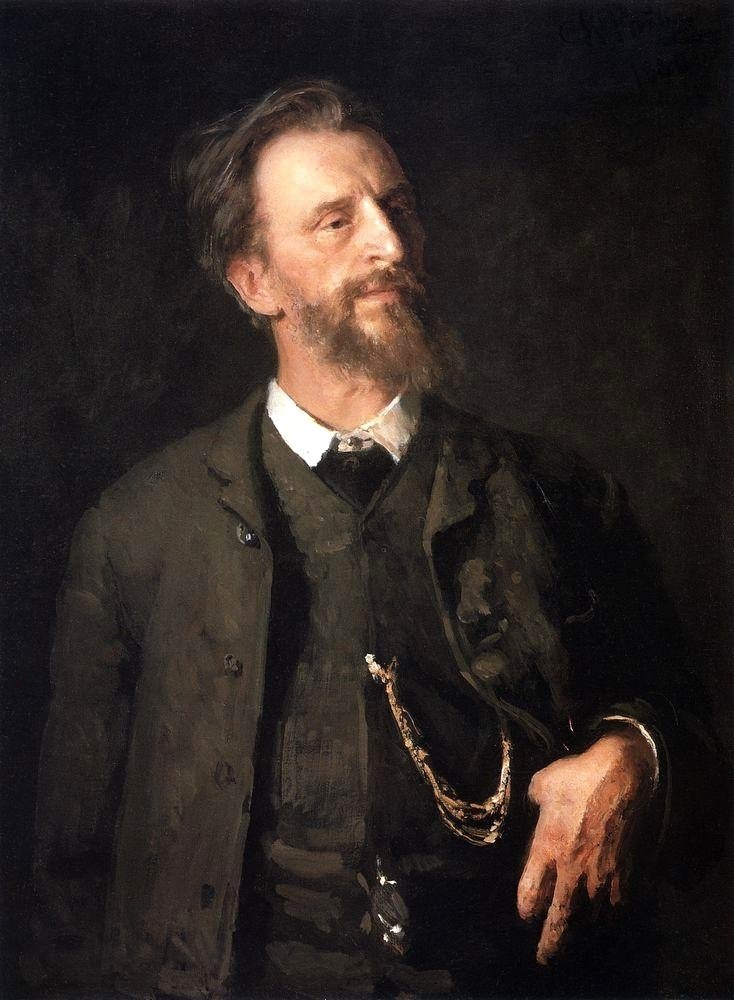
Ilya Repin. Grigory Myasoyedov
Grigory Myasoyedov's professional life and activity were closely connected with Ukraine, although he himself came from the Orel Governorate. But in the last decades of his life, he preferred to live and work in Ukraine. The outstanding artist purchased an estate on the outskirts of Poltava, where he lived the last 20 years of his life and where his grave is located. Therefore, with full right, we call him a Ukrainian-Russian artist. In Poltava, Grigory Myasoyedov was friends with Vladimir Korolenko, with whom, as a political prisoner, Levko Simirenko paved the way to Siberia.
We must also note the prominent Simferopol master photographer K. Kniazkov, whose contribution to the illustrative decoration of the first and subsequent volumes of "Crimean Commercial Horticulture" was highly appreciated by the author himself: "The vast majority of the autotypes illustrating the text were produced by the famous firm of F. Bruckmann in Munich from the original photographs of the photographer K. Kniazkov, who participated in almost all of my trips through the orchards of Crimea. Recalling those times and the circumstances under which he had to work, I cannot but appreciate them with great dignity...".
The scientist also mentioned another Crimean artist, T. Safronov: "All other drawings (except for the drawings of G. Myasoyedov and K. Ivanova) belong to the artist T. Safronov, who accompanied me on all trips through Crimea and worked on site," L. Simirenko noted. With special warmth and gratitude, the scientist spoke of the support and huge contribution to the preparation of his work by the genius Crimean landscape photographer V. Sokornov. It was the participation of these prominent specialists in the publication of the genius Ukrainian scientist that ensured the work's resounding success and immortality.