Crimea in Works of Foreign Literature: Horse Day by the Kerch Calendar
A separate, special place for Crimea in world literature.
Valeriy Verkhovskyi. Newspaper "Krymska Svitlytsia", 2017, issue No. 40
History has decided that Europeans know about the existence of Crimea not only from abstract geography; they remember where Sevastopol and Balaklava are located. The peninsula has entered their history textbooks, their urban toponymy, and it has also remained in their literature.
In Ukrainian literature, Crimea occupies a separate place. Precisely a "separate" place, and not just a special one – after all, the generation of writers born in Crimea is only now entering Ukrainian-language literature, and the Ukrainian view of the sunny peninsula is something of an "outsider's" view. In Russian literature, Crimea was and remains a piece of exoticism in the body of a large empire, an "inner Mediterranean", a land resembling Paradise, a country residence. The Western reader, however, is not to be surprised by Mediterranean "exoticism"; even distant India and Africa have become part of their world. So how does Crimea look from their perspective?
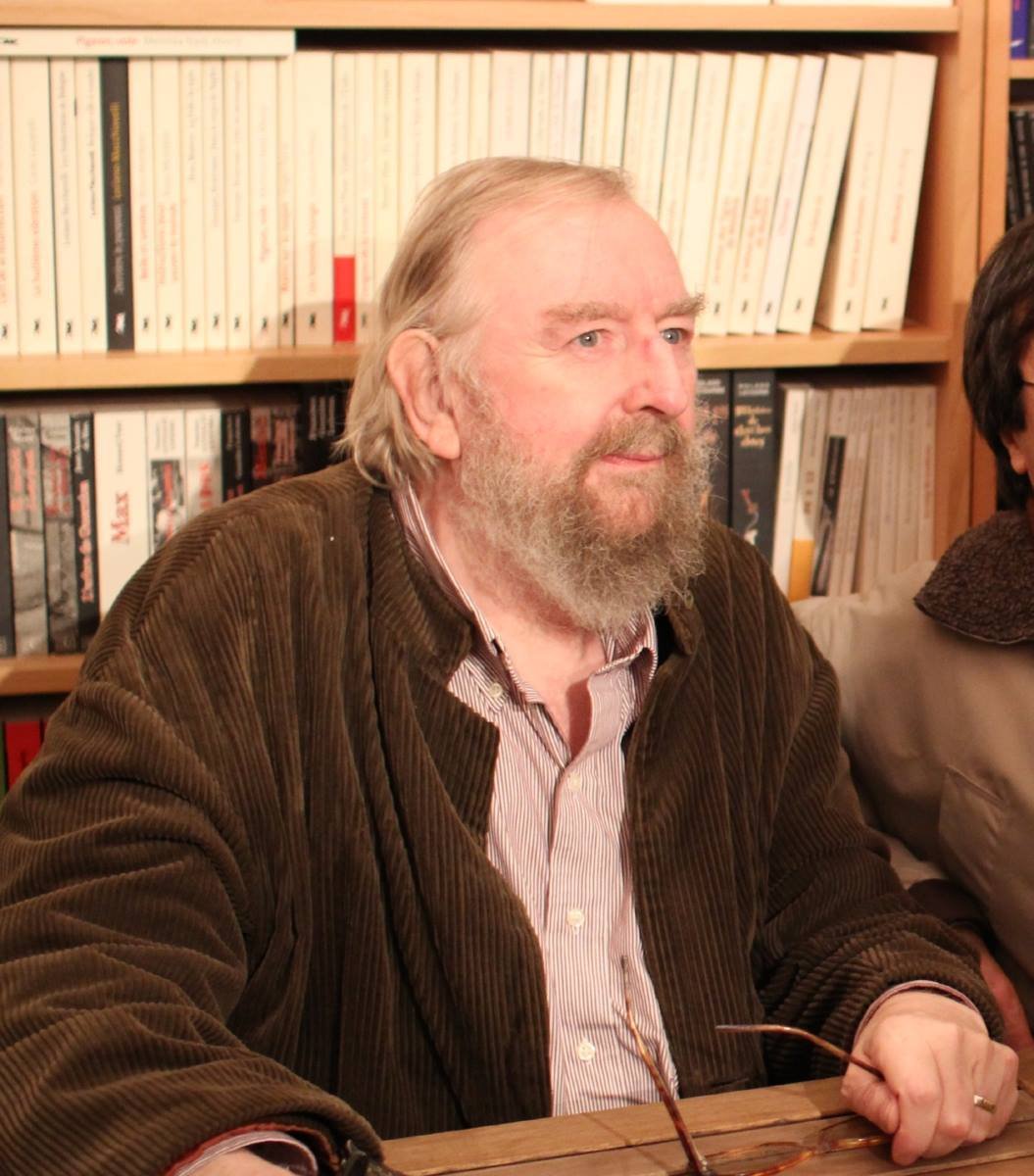
Writer Michael Moorcock
"The story is fantastic! And what happened next?"
Michael Moorcock "The Amulet of the Mad God"
Michael Moorcock, a British writer and rock musician, was born in 1939 near London. In our country, after the publication of translations of his books – especially the "Chronicles of Castle Brass" and the Hawkmoon books – he was jokingly called Mykola Murko, for reasons that will be discussed below.
The genre in which Michael Moorcock's cycle about Duke Hawkmoon is written can be most accurately described as "techno-fantasy" – it has most of the attributes of typical fantasy, but the action takes place not in an abstract past, but in an (equally abstract) future, when a new "dark age" has set in after a nuclear apocalypse.
Thus, Dorian Hawkmoon, Duke of Köln, the main character of Moorcock's cycle of seven novels, travels through the ruins of Europe not of his own free will. He is a prisoner, thrown into a dungeon for the German rebellion against the occupiers from Granbretan. Hawkmoon is offered freedom in exchange for a service – to kidnap Yisselda, the daughter of Count Brass of Kamarg. However, something went wrong: having seen Yisselda, Hawkmoon fell in love. But it is impossible to deceive the Granbretanians – the "Black Jewel" is embedded in Hawkmoon's forehead skull bone – a means of manipulation: should Hawkmoon disobey orders or start behaving contrary to orders, the jewel punishes him with shocking pain; in addition, everything Hawkmoon sees, the oppressors see as well thanks to the Black Jewel. But the mysterious Warrior in Jet and Gold comes to help from nowhere and disappears just as inexplicably.
In search of the missing Yisselda, Hawkmoon's path leads to familiar places: "In Simferopol they sold their booty, and with some of the money they bought provisions, necessities, and horses, and the rest they left for safekeeping with a merchant whom everyone recommended as the most honest man in Crimea..."
On a sailing ship, the characters cross the Black Sea from Turkish Zonguldak directly to the port city of Simferopol. They are attacked by zombie pirates, one of whom they capture. After recovering from a psychotropic "potion", the pirate says his name is Coriantum and he is from Kerch, where he hired as a sailor on a ship on March 11, the "horse day by the Kerch calendar", and remembers nothing after that day.
"The black ship, now jumping quickly over the waves, now falling into a dead calm, wandered the sea for over a week. According to Hawkmoon's calculations, they found themselves near the strait connecting the Black and Azov seas, near Kerch..."
The captain of the slave-hunting ship, Sharagov, captured in the Black Sea, said he was hired by fanatics from the cult of the Mad God. The cult of the Mad God rules in Ukrania, and now the characters are heading there.
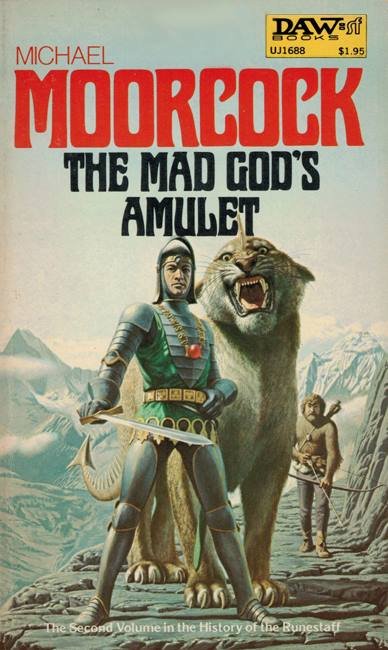
Cover of one of Michael Moorcock's books
"The Warrior in Jet and Gold pointed west.
— We shall ride that way tomorrow morning. Beyond the Pulsing Bridge lies Ukrania, and deep inland is the castle of the Mad God.
Two days later they reached the Pulsing Bridge, which stretched for several miles between two rocky shores. The bridge looked spectacular: it was made not of solid matter, but of a vast number of gold, green, red, and yellow light beams crossing and even weaving among themselves. Below, among sharp reefs, water churned and foamed, and the bridge constantly pulsed like a living creature.
— What is this? — asked Duke Hawkmoon. — It doesn't look like this bridge was created by nature. — No, it was built by people who passed into oblivion in ancient times, taking with them the knowledge thanks to which this wonder was created. That people existed on earth after the Death Rain, but before the appearance of the Principalities."
Later it turns out that the Mad God is actually a man named Stalnikov (an allusion to Stalinism). He rules with the help of psychotropic substances and psychotronic means, turning his subjects into puppet bio-robots... The hero still manages to snatch Yisselda from his clutches, and now his path turns to the West. Ahead are five more volumes of exciting adventures in a future that so resembles the past...
The most interesting thing in such a blend of genres as techno-fantasy is the opportunity to show examples of the combination of barbarism and technology, the enhancement of the darkest aspects of human nature by means of machine civilization, which fully corresponds to the purpose of such a fundamentally philosophical genre as science fiction – science or completely non-scientific.
The Crimea depicted by the writer has very little in common with the real one. However, the seven-book series about Duke Hawkmoon was written by the author from the start as not very serious, and by the end of the cycle, some reviewers noted that it turned into an author's self-parody.