Here You Go, Nephew, What is of No Use to Me...
The state of the agricultural sector on the eve of the transfer of the Crimean Oblast to Ukraine
Petro Volvach, Full Member of the Shevchenko Scientific Society (NTSh), member of the National Writers' Union of Ukraine (NSPU), Honored Worker of Science and Technology of the AR of Crimea, Crimean resident with 60 years of experience. "Krymska Svitlytsa" newspaper, 2017, Issues No. 5 – 6
In the Soviet era, when it came to statistics, they said that there are big lies and statistics. Indeed, Soviet statistics were always part of Communist ideology. It was closely monitored by the Politburo itself and the NKVD-KGB guards. After all, the facts of the total destruction of statistical workers who submitted data inconvenient for the Kremlin leaders are a fairly common phenomenon. Therefore, there were several forms of statistical reporting in the country — one for the wide "masses of the people" and abroad, and another — unvarnished, real — for the Politburo and the KGB.
Therefore, one does not have to rely on the integrity of official Soviet statistical data on the state of the economy in the country and in any union republic. The current data on economic troubles, which fell into the local press without ideological cosmetics, evoke more trust. Their study convincingly proves that during the first post-war decade, Crimea's economy was in a fairly neglected state and was moving towards a real economic and humanitarian disaster.
It was these reasons that forced the then Kremlin leadership, primarily the Chairman of the Council of Ministers of the USSR Georgy Malenkov and the First Secretary of the CC of the CPSU Nikita Khrushchev at the end of 1953 to resort to a card-sharper act — to impose the Crimea, neglected by the RSFSR and devastated by the war, on Ukraine, which was to revive it and save the peninsula from Russian incompetent management. The Kremlin ideologists disguised this clever action as fraternal charity of the "great Russian people" before the celebration of the 300th anniversary of the "Pereyaslav Council" and "voluntary reunification with Great Russia."
The Kremlin leaders began negotiations with the leadership of the Ukrainian SSR, hidden from prying eyes, shortly after the September 1953 plenum of the CC of the CPSU dedicated to agriculture — one of the most neglected sectors of the economy of the Soviet Union. It was at this plenum of the CC that the idea matured to impose the Crimean Oblast of the RSFSR on Ukraine.
This version is confirmed by the editor-in-chief of the leading union newspaper "Izvestia," Nikita Khrushchev's son-in-law Alexei Adzhubei. He accompanied the First Secretary of the CC of the CPSU in his secret inspection trip to steppe Crimea in late autumn 1953. We were unable to find any information about this event in the Crimean press of the time. Undoubtedly, Nikita Khrushchev was prompted to this short-term expedition through steppe Crimea by the catastrophic state of agriculture on the peninsula and the inability of the Crimean party leadership to restore the economy in Crimea, in Yalta. After the September plenum of the CC of the CPSU, which was very difficult for him, Nikita Khrushchev decided to personally familiarize himself with the life of settlers in steppe Crimea.
They flooded central authorities and newspapers with an avalanche of complaints. Alexei Adzhubei's memoirs allow us to understand the motivation behind the rather unexpected decision of the Kremlin leadership to transfer the Crimean Oblast to Ukraine. They are so valuable that they should be reminded more often to those who stubbornly, without evidence, never tire of asserting that Nikita Khrushchev, as a party functionary who worked in Ukraine for a long time, "gifted" Crimea to Ukrainians in 1954 because of his affection for it. This primitive provocative nonsense and Moscow falsification does not stand up to any criticism and is not supported by any document.
So, Alexei Adzhubei testifies in his memoirs: "Here, on the plateau, everything still breathed of a terrible war. Along the roads lay destroyed tanks and artillery pieces and everywhere, to the horizon, grey stone obelisks erected by military builders in memory of their fallen comrades. And the land too was dried up and overgrown with the stiff bristle of weeds. The settlements, Tatar auls, stood empty; their owners, sent away by the evil will of Stalin to distant cold lands, lost all hope of return... Khrushchev was in no hurry to get to Simferopol, although the hosts persistently offered to rest from the journey.
He turned off the highway, a tarpaulin was spread on the scorched grass, they had a snack practically on the go, as if the war was still going on. Most of all, Nikita Sergeyevich was struck and upset by the crowds of settlers who had somehow heard about his trip.
A silent grey mass of people blocked the road and stood just as silently, not parting, waiting for the cars to stop. People did not start a conversation for a long, difficult time, giving Khrushchev the opportunity to start first. Then one question, a second, a third came from the crowd. About food, housing, help. The majority of the settlers came from Russia, from the Volga, from the northern Russian regions" (Adzhubei A. How Khrushchev gave Crimea to Ukraine // Novoe Vremya. — 1992. - No. 6. — p. 21).
"Id-d" (Wait, "Это я сейчас пишу..." -> "I am writing 'came' now," Adzhubei continues, "but they screamed 'we were driven' — the usual groan of people losing hope in life. Hysterical shouts even came from the crowd: 'Potatoes don't grow here, cabbage withers.' Or suddenly a completely sad one: 'Bedbugs ate us.' 'Why did you come?' Khrushchev asked, and the crowd exhaled: 'We were deceived'")
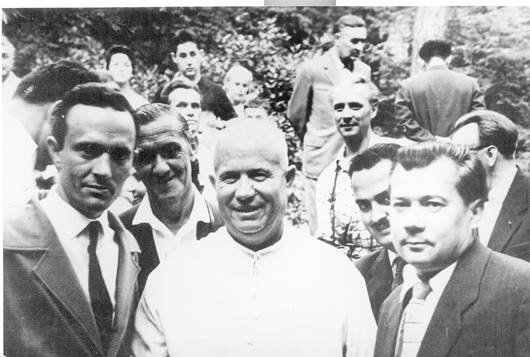
First Secretary of the CC of the CPSU, Chairman of the Council of Ministers of the USSR Nikita Sergeyevich Khrushchev in Ukrainian Crimea
After this quite unpleasant trip through steppe Crimea, the First Secretary of the CC of the CPSU Nikita Khrushchev and the Chairman of the Council of Ministers of the USSR Georgy Malenkov, who was also resting in Crimea, supposedly flew to Kyiv. It is said that they literally begged on their knees the then first secretary of the CC of the CPU Oleksiy Kyrychenko and the chairman of the Council of Ministers of the Ukrainian SSR Nykyfor Kalchenko to save the Crimean Oblast from imminent economic and humanitarian catastrophe. Undoubtedly, the decision to transfer the Crimean Oblast from the RSFSR to the Ukrainian SSR was not taken single-handedly, but was the collective opinion of the entire highest political and state leadership of the then USSR. It matured shortly after the return of the first persons of the party and state from Ukraine to Moscow.
Already at the end of 1953, active preparatory work began. This is evidenced by a report on the state of agriculture in the Crimean Oblast, prepared for the first secretary of the CC of the CPU Oleksiy Kyrychenko dated January 4, 1954. It was intended to familiarize the party leader of the republic with the state of agriculture in the Crimean Oblast on the eve of its transfer to Ukraine. Let us note that the report was compiled quite professionally and it seems to us that the statistical data given in it on the state of agriculture in the Crimean Oblast on the eve of its transfer to Ukraine evoke trust.
It is valuable that to compare indicators with the pre-war period, it provides data for 1940. So there is an opportunity to trace the dynamics of statistical indicators for the entire post-war period.
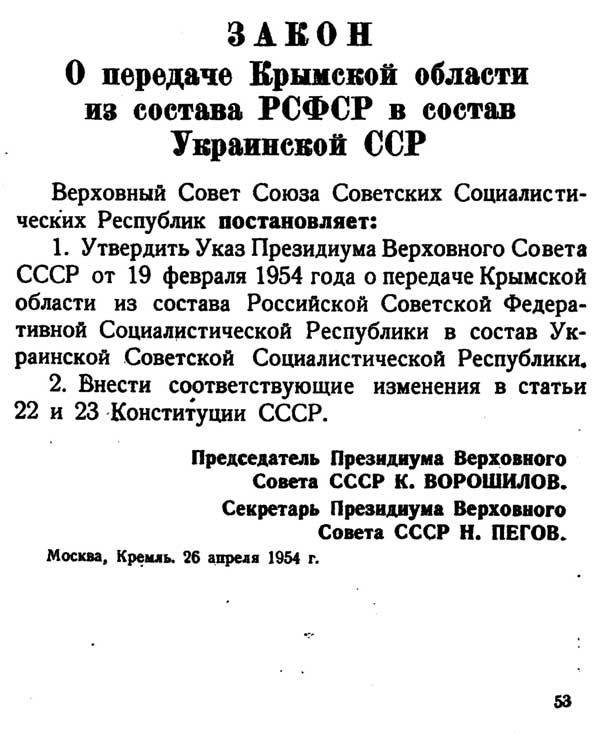
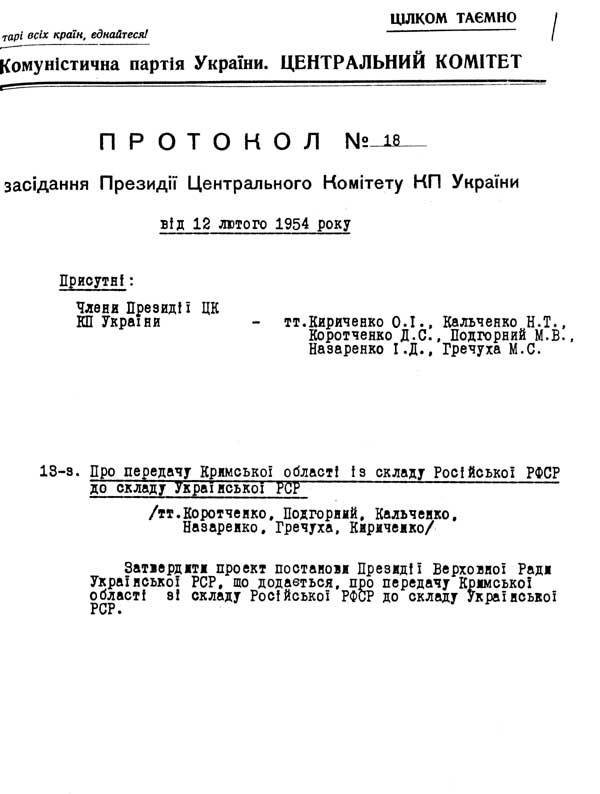
Thus, as of the end of 1953, the area of land of the Crimean Oblast was 2,562.1 thousand hectares, of which 1,270.6 thousand hectares were under cultivation. Compared to 1940, the area of crops in 1950 in Crimea decreased by almost 135 thousand hectares, and in 1953 — by 35 thousand hectares. For 1954, the planned sown area in the region decreased compared to 1940 by 80 thousand hectares. Not only the sown areas of grain crops decreased, but their yields also fell catastrophically. While in 1913 the yield of grain on Crimean land was 11.2 centners per hectare, in 1940 — 10.7, in 1950 only 3.9 centners per hectare was obtained from each hectare of crops.
Quite indicatively, the compilers of the report excluded the most disastrous year for the Crimean authorities — 1950. But it is this year that reflects the level of degradation of the agricultural sector in the Crimean Oblast and convincingly proves the direct dependence of the yield of Crimean fields on the weather conditions of the year. For the compilers of the report presented the higher grain yield in 1952 (15.2 centners per hectare) granted by God as a huge achievement of the party leadership. The indicators in the region with the production of the main food crop — winter wheat — were also quite disappointing.
In 1940, winter wheat in Crimea was grown on an area of almost 370 thousand hectares. In 1950, its area was cut almost in half and was 195 thousand hectares. Only in 1953 did the areas of winter wheat reach the pre-war level, and it was planned to stop at this figure in the following year 1954.
The yield of winter wheat in the region was also quite low and did not reach the level of 1913 and 1940. While in 1913, 13.1 centners were obtained from each hectare of winter wheat in Crimea, and in 1940 — 11.5 centners, in 1950 it was only 4.4 centners. In the favorable year of 1952, the winter wheat yield increased to 15.3 centners per hectare. In 1954, it was planned to obtain 12.4 centners from each hectare of winter wheat, that is, almost at the level of 1913.
The yield of vegetable crops decreased almost twofold (118.2 centners per hectare in 1940), 51 centners per hectare in 1952 and 55 centners per hectare in 1953. There was also no significant expansion of the area of vegetable crops. Compared to 1940, the area under vegetable crops decreased almost in half (118 thousand hectares in 1940 and 51-55 thousand hectares in 1952 and 1953, respectively).
The population of Crimea suffered from an acute shortage of the main food crop after winter wheat — potatoes. While in 1940, almost 70 centners were obtained from each hectare of potato field, in 1950 and 1953 the potato yield decreased to 29.0 – 30 centners per hectare.
A real catastrophe occurred with the cultivation of root crops (mainly fodder beet). It decreased compared to 1940 almost threefold and was 42 centners per hectare in 1952 and 47.0 centners per hectare in 1953.
The yield of hay also decreased twofold. Thus, the fodder base for livestock breeding in the post-war years deteriorated significantly. No noticeable progress occurred during the ten post-war years in the development of horticulture and viticulture — once leading sectors of the Crimean economy.
As the report shows, the total area of orchards in the collective and state farms of Crimea in 1940 was 12.3 thousand hectares. In 1952 — 9.8 thousand hectares, and in 1953 — 10 thousand hectares. No planting of new orchards was planned for 1954 either. It was not possible to restore the former glory of Crimean horticulture during the ten post-war years. While in 1940, 55 centners were obtained from each hectare of Crimean orchard, in 1951 it was only 15.6, in 1953 — 48.5, and in 1954 it was planned to obtain 29 centners. In 1913, more than 20 centners of high-quality apples were harvested from just one tree of Crimean Sinaps.
An even more catastrophic situation in the first post-war decade developed in viticulture. According to statistical data, even in 1954, the area of commercial vineyards did not reach the level of 1940 and was reduced to 7,069 hectares. This was only 79.2% of the pre-war level. Plans for planting new vineyards were systematically not fulfilled; planting material was extremely lacking for this.
The yield of commercial vineyards was very low and varied in the range of 19.6-11.9 centners per hectare, and compared to 1939 was 18.5 centners per hectare in 1951 and 24.8% in 1953.
There was not enough raw material for the winemaking industry. To prevent production from stopping, wine materials were imported from Ukraine and the North Caucasus. The local press reported that it was impossible to buy the once popular vintage wines "Soniachna Dolyna," "Kokur," "Cahors," and "Tashly" in brand stores, even at high prices.
Crimean livestock breeding suffered from a deficit of not only concentrated but also rough fodder year after year. From the January 1954 report provided to the Ukrainian leadership, we learn that Crimean farms were provided with rough fodder by only 81%, hay by only 3%, and succulent fodder by 40%.
The situation with the provision of livestock farms was especially catastrophic in the Crimean foothills. The farms of the Alushta district were provided with rough fodder by only 10%, Balaklava by 48%, Kuibyshevske by 50%, Sudak by 46%, Bakhchysarai by 55%, and Bilohirsk by 60%. While in 1940, on average, 20.2 centners of rough fodder were allocated per cow, in 1953 this indicator fell to 17.4 centners, and in 1953 amounted to 19.8 centners. Fodder and silage were catastrophically lacking for cattle. Compared to the pre-war period, the provision of animals with this fodder decreased by 2-2.5 times.
In almost all districts, there was a lack of appropriate facilities for winter keeping of animals. Cattle were provided with facilities by 92%, calves by 82%, sheep by 77%, pigs by 87%, and poultry by 82%.
The Crimean Oblast in the first post-war decade did not fulfill the plans for state procurement of agricultural products year after year. Even in 1953, the region did not reach the pre-war volume of grain procurement (393 thousand tons versus 407 thousand tons in 1940). State procurement of vegetables and potatoes decreased almost 1.5-2 times. The indicators of harvesting fruits, grapes, and tobacco fell sharply. Due to the livestock on the personal subsidiary plots of the settlers, there was an increase in state procurement of meat, milk, and egg production rose.
But own production was not enough for the full supply of the Crimean population with basic food products. Therefore, the main part of food products for the urban population had to be brought to the peninsula from Ukraine. The state of industrial production, the construction industry, and the social-humanitarian sphere on the eve of the transfer of the Crimean Oblast to Ukraine is a topic for a separate conversation.