Whose Shore, Their Water
Construction of the Crimean canal network.
Petro Volvach, Full Member of the Shevchenko Scientific Society, Member of the National Writers' Union of Ukraine, Honored Worker of Science and Technology of the AR of Crimea, Crimean resident with 60 years of experience. "Krymska Svitlytsia" newspaper, 2018, issue No. 5
The decision to construct the Kakhovka Hydroelectric Power Station, the Kakhovka Reservoir, the South Ukrainian and North Crimean canals was made a few years after the end of the Second World War, when the European part of the country was still in complete ruins and the peninsula's economy was barely surviving. However, the Kremlin authorities were prompted to undertake this rather costly project for the country's economy, which had not yet recovered from the war, by the acute problem of supplying the Black Sea Fleet and Crimean resorts with food. After all, it was the Black Sea resorts that the Soviet government viewed as its most effective propaganda and agitation platform. The Black Sea Fleet, in the opinion of Kremlin leaders, was supposed to provide the Soviet Union with complete control not only in the Black Sea region but also in the entire Mediterranean.
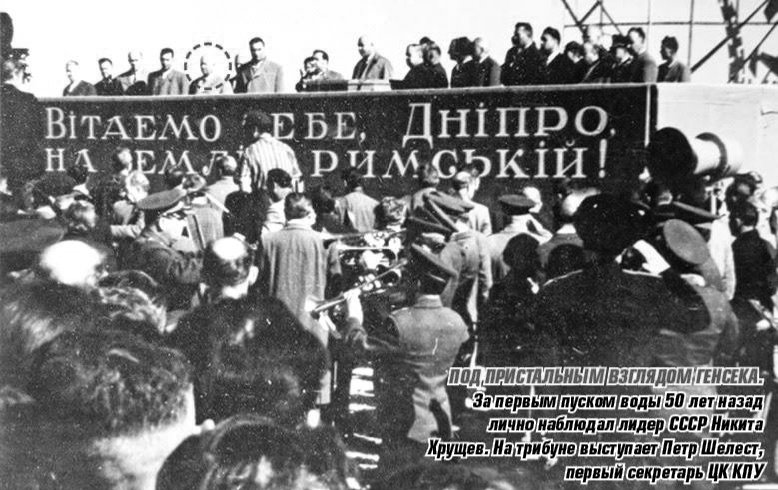
First Secretary of the CPSU Central Committee Nikita Khrushchev arrived for the opening of the main water artery
One of the tasks hidden from the international community regarding the irrigation construction of the century in the South of Ukraine and in arid Crimea was the expansion of raw materials strategically important for the military industry—cotton. Kremlin officials hoped to sharply increase their own cotton production at the expense of Southern Ukraine and partially Northern Crimea. The importance of the government's intentions is evidenced by the creation of a special Ministry of Cotton Growing in Ukraine in the late 1940s and mass plantings of this capricious, heat- and moisture-loving crop in almost all southern and southwestern regions of the republic. Cotton at that time became a 'party crop.' For destroying even ten plants during soil cultivation, tractor drivers were sent to prison for several years.
And the entire rural population and even schoolchildren were involved in harvesting the government crop until the very frosts. Peasants dried cotton bolls on stoves all winter long. Thus, it was precisely by the necessity of growing cotton as raw material for the 'mighty Soviet army' that they tried to convince the local population of the expediency of building the Kakhovka Sea, the South Ukrainian and North Crimean canals, and destroying the Dnieper floodplains. However, this was just another Stalinist propaganda trick. As already noted in previous publications, the government officials never actually got around to building the South Ukrainian Canal advertised by propaganda. This ambitious project ended only with the preparation of design and survey documentation.
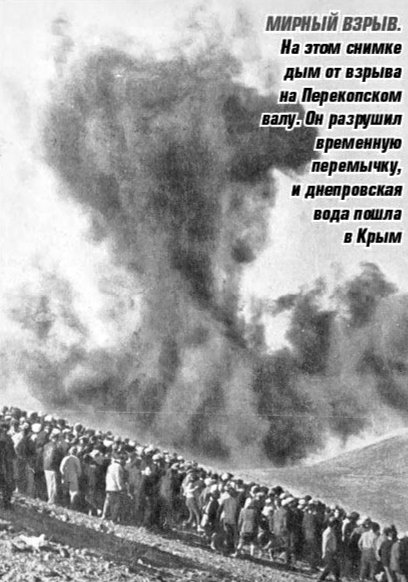
In contrast, Ukraine was involved in design and survey work for the construction of the North Crimean Canal and the irrigation network as early as 1951. From 1954, this activity became more fruitful and large-scale. Officially, the construction of the North Crimean Canal began in 1957. It was carried out in three stages. The first stage of the canal was opened on October 17, 1963. The opening took place solemnly. For Crimea, it was a real holiday. First Secretary of the CPSU Central Committee Nikita Khrushchev arrived for the opening of the main water artery—he also cut the red ribbon. After the destruction of the last earthen dam on Perekop, Dnieper water began to flow by gravity into the already constructed main channel of the canal (Krasnoperekopsk line). In 1965, the water also reached Dzhankoy.
The construction of the canal network continued, and in 1971, with the help of two pumping stations, water reached Kerch. The construction of the canal was completed on December 29, 1975, with the commissioning of the Stantsiine Reservoir. The volumes of work performed on the construction of the canal and its parameters are staggering. The length of the canal is 406.2 km, the design capacity is 294 m³/s, the average width is 10-15 m, and the maximum depth is 6 m.
In April 1979, the construction of the second stage began, from which the irrigation area increased by 80.8 thousand hectares. In addition to irrigating agricultural land, the task on the peninsula was also to ensure the water supply of the city of Simferopol and the Southern Coast of Crimea. For this purpose, Mizhhirne, one of the largest reservoirs on the peninsula, was built near Simferopol, near the village of Skvortsove on the border of Simferopol and Saky districts. The construction of the second stage of the canal was completed in 1986. At the same time, Ukrainian builders constructed a connecting canal 6 km long, which connected the Rozdolne and Chornomorske canals. In the process, Dnieper water was raised to a height of 88 m.
It was planned to build two more reservoirs south of Simferopol—Zapovidne-1 and Zapovidne-2. But due to a lack of funds, they were never built.
In July 1983, the construction of the third stage of the North Crimean Canal began with an irrigation area of 89.3 thousand hectares. The design irrigation area was 187.7 thousand hectares of the Syvash lowland, the Southern Coast, the Karkinit Bay, the central part of Crimea, and the Tarkhankut plateau. However, due to a lack of funds, the third stage remained unfinished.
It can be quite reasonably argued that Ukraine had and has more economic losses and ecological damage than benefits from the irrigation constructions of the century. For Crimea, the Kakhovka Reservoir, the Kakhovka Hydroelectric Power Station, and the North Crimean Canal brought significant economic benefits. Thanks to the first stage of the North Crimean Canal, the area of irrigated land in the Crimean Oblast quadrupled. New profitable industries emerged in Crimea—fish farming and rice growing (over 20 thousand hectares). Dnieper water allowed the expansion of fruit growing and viticulture in the steppe regions of Crimea. Already in the first years of the canal's operation, the yield of grain crops increased almost 4.5 times.
Statistical data show that in 1990, the production of grain and meat in the oblast increased by 2 times compared to 1963, milk—by 2.7 times, fruit—by 5.5 times, vegetables—by 2.3 times, and animal feed—by 3.3 times. This allowed for an increase in the cattle population by 1.4 times, and pigs—by 1.6 times. In addition, another powerful sector formed in the oblast—poultry farming and greenhouse farming. Thanks to irrigation, in 1990 the Crimean Oblast produced 38% of grapes, 15% of fruit, 6% of vegetables, and 4.6% of meat of the total Union production.
After the occupation of Crimea by Moscow, all these economic achievements were lost. Only the inevitable de-occupation of the peninsula and its return to the Ukrainian legal field in the future will make it possible to revive and multiply the former achievements of the Crimean economy.