The Bravest Knight Bernard Pretwicz
Biography of Bernard Pretwicz, the starost of Bar.
Valeriy Verkhovsky. "Krymska Svitlytsia" newspaper, 2018, issue No. 14
"What kind of peace is it that can be violated!" Stanislaw Orichovius-Roxolanus, 1543
Why study history? Ancient events cannot be changed, lost battles are lost forever, and the obsessive search for roots and revival of traditions only hinder the understanding of the challenges of the modern era. The past cannot be returned. But history allows us to better understand the present. The fact that Karamzin wrote the "History of the Russian State", while Hrushevsky wrote the "Outline History of the Ukrainian People" — is a distinction more than eloquent.
Knowing history is not only interesting but also useful. Not only for "certified" historians, and not at all to fit the past to the political needs of the present; not to boast of doubtful victories or to worry about historical justice.
History must be known primarily to avoid repeating the mistakes of previous generations. The deeper you study history, the more you run into interesting coincidences. Although the world has changed over half a millennium, parallels with our time are noticeable even across centuries.
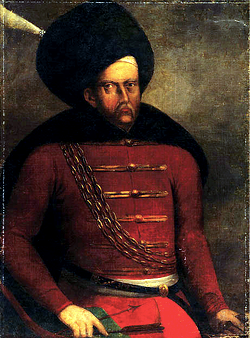
Bernard Pretwicz
The beginning of the 16th century did not portend anything bright for our people. The territory was torn to pieces between Lithuania, Poland, and Muscovy.
Sultan Suleiman I Kanuni (son of a Crimean Tatar woman and husband of Roxelana) headed the Ottoman Empire in those days; his son Selim, who inherited the throne of the Porte, can even be considered an "ethnic Ukrainian." At the same time, his Moscow "colleague" Grand Duke Vasily III was married to Elena Glinskaya, and their son Ivan the Terrible, by the same logic, should also be written down as an "outstanding Ukrainian"; especially since Elena was never called "Yelena" by Glinskaya herself: "to my wife Olena", that is how the Moscow autocrat signed letters to her.
King Sigismund of Poland married the Italian Bona Sforza; in honor of her small homeland, Bari, he named the town founded in the southeast of the kingdom (this is Podillia) Bar. By "rotation", representatives of the five districts of the kingdom, replacing each other, carried out service on the southeastern border of Poland, but this did not guarantee safety for the lands of the former Rus'...
Tribute was paid to Crimea annually, but the raids did not stop. When the Crimean Khan, in response to complaints, explained that those were not his troops, but some unknown robbers making attacks contrary to peace agreements, the inhabitants of the border Ukrainian lands had to create volunteer combat units and act at their own peril and risk.
The starost of Bar, Bernard Pretwicz (latinized version — Pretvicius), lived five centuries ago, but how many similarities can be found in the events of that era and our time. Pretwicz moved from repelling invasions and defending in castles to offensive tactics — launching pre-emptive strikes on the Crimeans: "Having united, we all together went after the Tatars along their entire path, right to Ochakiv, where we found them and by God's grace defeated them, capturing about fifty prisoners. There, what had been taken of Turkish property was returned, for which the Turks gave a receipt to Prince Koretsky, as general..." (From the memoirs of Bernard Pretwicz).
Some called this man "the bravest knight", others cursed him. Crimean Tatar women even scared disobedient children with his name, and the inhabitants of the Wild Fields region repeated the saying "under Lord Pretvicius the border is clear of Tatars." Sultan Suleiman personally calculated the losses from the Ochakiv campaign led by Pretwicz. Pretwicz and Prince Vyshnevetsky were accused of taking sheep worth 6,745 akçe, almost two hundred horses, two hundred and forty-five oxen, 9,000 akçe in cash from the population of Ochakiv, as well as capturing eighty-seven people and killing eighteen.
It reached the point where the Sultan demanded that the King hand over Pretwicz, blaming him specifically for provocations that violated peace and cooperation. The Sejm, disposed against confrontation with a powerful neighboring state (otherwise the Sultan will attack!), was inclined to sell the hero for empty Turkish promises...
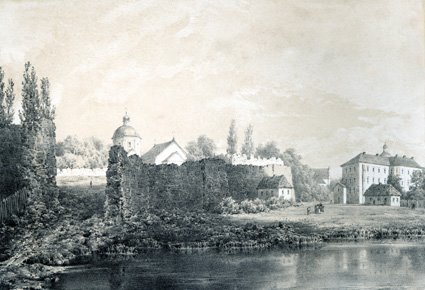
Painting by Belarusian artist Napoleon Orda "Bar", 19th century
Stanisław Orzechowski (Stanislaus Orichovius), a graduate of Wittenberg University, a student of Luther and Melanchthon; a Przemyśl Catholic nobleman who married against the canons; who is considered the first Polish political scientist, and at the same time, the first Ukrainian Protestant, who, proud of his origin, added to his family name the name of his people at that time — Roxolan.
It was Orichovius-Roxolan who wrote to King Sigismund II and advised him to show will in relations with the Turks: "They are used to dictating terms to everyone, so it is not surprising that, referring to the agreement, they began to demand the extradition of the bravest knight Bernard Pretvicius. For you, this is the same as speaking out against yourself. And on what grounds did he demand Pretvicius from you? It is shameful, I swear by Heracles, even to say this! Pretvicius allegedly became an obstacle to concluding a lasting peace between you and him! How so?".
And then a question that resonates perfectly with today: "What kind of peace is it that can be violated!".
Pretwicz set off for the Sejm with that undisturbed courage with which he always went to meet danger. Retribution awaited him, but the "noblest knight" won another victory.
Military cunning came in handy this time too: all "sins" were blamed on unknown Cossacks who appeared out of nowhere and then disappeared somewhere — either they were from Lithuania, or from Muscovy...
Although Pretwicz constantly denied connections with the Cossacks, it was he who was directly involved in the formation of the Cossacks. And soon Pretwicz's brother-in-arms Dmytro Vyshnevetsky founded the Sich — beyond the rapids of the Dnipro and beyond the threshold of Ukraine.
Everyone who wanted to defend Ukraine joined the Cossack host. Since those times, Cheremises — warriors of Volga-Finnic (Mari) origin who fled Muscovite enslavement — settled in Podillia, and in our country became some of the first Cossacks. Pretwicz himself was from Silesia, descended from a German family.
This is how the Ukrainian nation arose, accepting those who were ready to stand up in its defense and sacrifice themselves; the Ukrainian nation has always stood on such people and won. And what blood is Ukrainian? Probably the one shed for Ukraine, for its freedom...